Healthcare providers work hard to deliver quality patient care, yet payment is never guaranteed simply because a service was provided. One denied claim can delay reimbursement for weeks. Multiple denied claims can create serious cash flow problems, increase administrative work, and negatively affect the entire revenue cycle.
Every year, healthcare organizations lose significant revenue because of avoidable billing mistakes, missing documentation, coding errors, and insurance verification issues. While many denials can eventually be appealed, appeals consume valuable time and resources that could have been avoided with stronger processes from the beginning.
The good news is that most claim denial reasons are predictable. When providers understand why insurers reject claims, they can implement procedures that dramatically improve first-pass acceptance rates and reduce unnecessary delays.
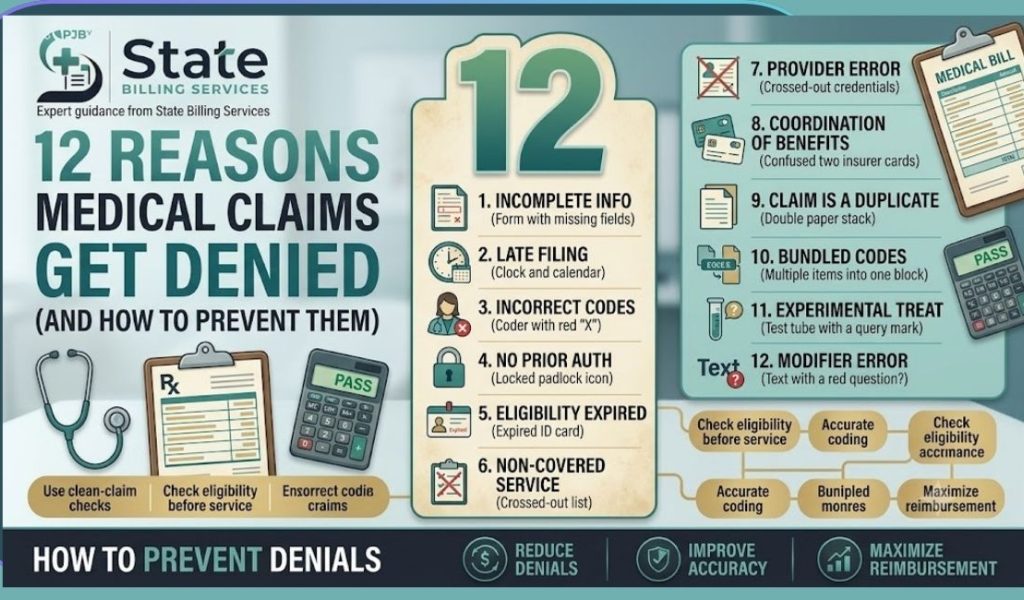
This guide explains the twelve most common reasons medical claims get denied, how each problem occurs in real-world practice, and the practical steps healthcare organizations can take to prevent them. Whether you manage a small private practice, specialty clinic, or multi-provider organization, these strategies can help reduce denied insurance claims, improve clean claims, and strengthen overall denial management.
Why Medical Claims Get Denied More Often Than Many Providers Realize
A medical claim moves through several stages before payment is issued. Patient registration, insurance verification, medical coding, documentation, claim submission, payer edits, and payment processing all influence whether reimbursement is approved.
Even one small mistake at any stage can trigger a denial.
For example, a patient’s insurance may have changed since the previous visit. A diagnosis code may not support the procedure billed. Prior authorization may have expired. Clinical notes may not justify medical necessity.
Insurance companies use sophisticated claim editing systems that automatically identify inconsistencies before payment is approved. These systems rely on coding rules, payer policies, federal regulations, and automated edits.
Organizations such as the Centers for Medicare & Medicaid Services and the American Medical Association regularly update coding guidance, reimbursement policies, and documentation standards that providers must follow.
Reducing denials requires consistent attention throughout the revenue cycle instead of focusing only after claims are rejected.
The Cost of Claim Denials
Denied claims affect much more than reimbursement.
A denied claim often leads to:
- Delayed payments
- Increased administrative costs
- Additional staff workload
- Higher accounts receivable balances
- More patient billing questions
- Lower practice profitability
Many providers spend substantially more correcting and appealing a denied claim than they would have spent preventing the denial in the first place.
Strong denial prevention improves operational efficiency while allowing staff to spend more time supporting patients instead of correcting preventable errors.
1. Insurance Eligibility Was Never Verified
Insurance eligibility issues remain one of the leading claim denial reasons across nearly every specialty.
Patients frequently change:
- Insurance plans
- Employer coverage
- Policy numbers
- Group numbers
- Secondary insurance
If eligibility is not verified before the visit, claims may be submitted to inactive coverage.
Real-world example
A patient visited an orthopedic clinic using an insurance card from the previous year. Staff assumed the policy remained active and submitted the claim.
Three weeks later, the payer rejected the claim because the policy had terminated months earlier.
The clinic then had to locate the updated insurance information and resubmit the claim.
Prevention
Insurance verification should occur:
- Before every appointment
- Again on the day of service
- Whenever demographic information changes
Practices that invest in reliable eligibility verification services significantly reduce these preventable denials because coverage issues are identified before care is provided.
2. Missing Prior Authorization
Many insurance plans require approval before certain procedures, imaging studies, surgeries, medications, or specialty treatments.
Without authorization, payment may be denied regardless of medical necessity.
This problem commonly affects:
- Advanced imaging
- Cardiology procedures
- Orthopedic surgery
- Mental health treatment
- Specialty medications
- Elective procedures
Real-world example
A physician ordered an MRI that clinically met all treatment guidelines.
However, staff overlooked the payer’s authorization requirement.
Although the patient received appropriate care, the insurer denied payment due to the missing authorization.
Prevention
Maintain payer-specific authorization checklists.
Use tracking systems that monitor:
- Authorization numbers
- Expiration dates
- Approved procedure codes
- Approved service locations
Reliable prior authorization services help practices avoid these costly administrative oversights.
3. Incorrect Medical Coding
Coding errors remain one of the most common causes of claim rejection.
Common coding mistakes include:
- Incorrect diagnosis codes
- Outdated CPT codes
- Invalid modifiers
- Incompatible code combinations
- Missing diagnosis specificity
Medical coding changes annually. Providers who rely on outdated coding references increase denial risk.
Coding accuracy depends on complete provider documentation as well as experienced coders who understand specialty-specific billing requirements.
Professional medical coding services can improve coding accuracy while helping practices stay current with annual coding updates.
4. Insufficient Clinical Documentation
Insurance companies expect documentation to support every billed service.
Documentation should clearly explain:
- Patient history
- Examination findings
- Medical decision making
- Treatment performed
- Medical necessity
- Follow-up plans
If documentation does not justify the services billed, insurers may deny reimbursement.
Example
A provider billed a high-level evaluation and management service.
The medical record contained only a brief note with minimal clinical detail.
The payer concluded that documentation failed to support the billing level and denied the claim.
Prevention
Documentation should be completed immediately after each patient encounter.
Electronic Health Record systems such as Epic and athenaOne often include documentation templates that help providers maintain consistency while supporting coding accuracy.
5. Duplicate Claim Submission
Duplicate billing can occur for many reasons.
Examples include:
- Staff uncertainty about submission status
- Clearinghouse delays
- Manual resubmission
- Software synchronization problems
Insurance companies typically reject duplicate submissions automatically.
Prevention
Before resubmitting any claim:
- Confirm payer receipt
- Check clearinghouse reports
- Review claim status
- Verify whether corrections are actually required
Claim tracking software helps eliminate unnecessary duplicate submissions.
6. Patient Information Errors
Simple registration mistakes can trigger immediate denials.
Common errors include:
| Registration Error | Possible Result |
| Incorrect date of birth | Claim denied |
| Misspelled patient name | Patient mismatch |
| Wrong member ID | Coverage cannot be verified |
| Incorrect gender | Eligibility conflict |
| Invalid address | Processing delay |
Even a single incorrect digit in an insurance identification number may prevent successful claim processing.
Prevention
Front desk staff should verify demographics during every patient visit instead of relying on previously stored records.
7. Services Were Not Considered Medically Necessary
Insurance companies evaluate whether treatment meets medical necessity requirements.
Even when providers believe care is appropriate, insurers require documentation showing that services satisfy coverage policies.
Medical necessity decisions often reference:
- Clinical guidelines
- Diagnosis codes
- Supporting documentation
- Payer-specific coverage policies
Example
A provider orders advanced diagnostic testing earlier than the payer’s coverage policy allows.
Without sufficient documentation supporting the exception, reimbursement may be denied.
Prevention
Review payer policies regularly and document the patient’s clinical condition thoroughly whenever exceptions apply.
8. Filing Deadlines Were Missed
Every insurance company has claim submission deadlines.
Late filing remains one of the easiest denials to prevent.
Examples include:
- 90-day filing limits
- 180-day filing limits
- One-year filing deadlines
Late claims often cannot be appealed successfully.
Prevention
Practices should monitor aging claims daily.
Automated billing software can alert staff before filing deadlines expire.
An efficient medical billing services workflow helps ensure claims are submitted promptly after encounters are completed.
9. Coordination of Benefits Problems
Patients often have:
- Primary insurance
- Secondary insurance
- Medicare
- Medicaid
- Employer-sponsored coverage
Submitting claims to the wrong payer commonly results in denied insurance claims.
Example
A patient recently became eligible for Medicare, but the practice continued billing the commercial insurer as the primary payer.
The claim was denied until the correct coordination of benefits information was updated.
Prevention
Review insurance coordination during registration whenever patients report coverage changes.
10. Non-Covered Services
Some services simply are not covered under certain insurance plans.
Coverage exclusions may include:
- Cosmetic procedures
- Experimental treatments
- Certain preventive services
- Frequency limitations
- Benefit exclusions
Patients often assume insurance covers every recommended treatment.
Providers should verify benefits before services are delivered.
Reliable eligibility verification services help identify benefit limitations early, allowing patients to make informed financial decisions.
11. Incorrect Use of Modifiers
Modifiers provide additional information about procedures.
Incorrect modifier use may result in:
- Claim rejection
- Reduced reimbursement
- Payment delays
- Compliance concerns
Certain specialties such as surgery, radiology, cardiology, and orthopedics rely heavily on accurate modifier reporting.
Prevention
Coders should receive continuing education regarding annual modifier updates and payer-specific billing policies.
Regular coding audits also identify recurring modifier issues before they become widespread.
12. Poor Denial Follow-Up
Some practices focus only on submitting claims while neglecting denied claims after they occur.
Without structured follow-up:
- Appeals are delayed
- Deadlines expire
- Revenue remains uncollected
- Denial patterns continue
Effective denial management requires ongoing monitoring rather than reactive correction.
Prevention
Create a denial tracking process that identifies:
| Denial Category | Recommended Response |
| Eligibility | Update insurance and resubmit |
| Coding | Correct codes and rebill |
| Documentation | Obtain additional provider documentation |
| Authorization | Appeal if appropriate or educate staff |
| Timely filing | Review internal workflow improvements |
Organizations that use dedicated denial management services often identify recurring trends much faster, allowing process improvements before similar denials accumulate.
Technology Plays a Major Role in Preventing Claim Denials
Modern healthcare organizations increasingly rely on technology to reduce billing errors before claims reach insurance companies.
Common tools include:
- Electronic Health Records
- Practice Management Systems
- Clearinghouses
- Revenue cycle analytics platforms
- Coding validation software
- Eligibility verification systems
Platforms such as Availity help providers verify eligibility, review payer requirements, and monitor claim status throughout the reimbursement process.
Automation reduces repetitive manual tasks while improving consistency across billing operations.
Technology alone, however, cannot replace well-trained staff and standardized workflows.
Specialty Practices Face Unique Denial Challenges
Different medical specialties encounter different denial risks.
For example:
An urgent care clinic may experience higher eligibility verification challenges because many patients are first-time visitors.
An orthopedic practice frequently manages complex surgical authorizations.
Cardiology providers often deal with high-cost diagnostic testing that requires extensive documentation.
Mental health organizations may face visit limitations, authorization requirements, and telehealth coverage rules.
Radiology departments depend heavily on accurate coding, documentation, and medical necessity requirements.
Specialty-specific billing expertise helps address these unique payer expectations before claims are submitted.
How Clean Claims Improve Financial Performance
A clean claims process means claims are submitted accurately the first time, without errors that require correction or additional information.
Clean claims typically include:
- Complete patient demographics
- Verified insurance coverage
- Accurate diagnosis coding
- Correct procedure coding
- Required modifiers
- Complete provider documentation
- Valid authorization information
- Compliance with payer guidelines
Higher clean claim rates generally produce:
- Faster reimbursement
- Lower administrative costs
- Reduced denial volume
- Better cash flow
- Improved staff productivity
Rather than measuring success by how many denied claims are appealed, leading healthcare organizations focus on preventing denials before submission.
Building a Strong Denial Prevention Strategy
Reducing denials requires collaboration across the entire practice.
Front desk teams, providers, coders, billers, and administrators all contribute to claim accuracy.
A practical strategy includes:
- Verifying eligibility before every visit.
- Reviewing authorization requirements before scheduled services.
- Maintaining accurate patient demographics.
- Performing regular coding audits.
- Monitoring denial trends monthly.
- Providing ongoing staff education.
- Using revenue cycle reports to identify recurring issues.
- Updating billing workflows as payer policies change.
Practices seeking comprehensive support often combine these efforts with professional revenue cycle management services in SC to improve performance across registration, coding, billing, payment posting, collections, and reporting.
Practical Example: Preventing a Cascade of Denials
Imagine an internal medicine practice seeing fifty patients each day.
Without standardized workflows, several problems occur during a single week:
A patient’s insurance eligibility is never verified.
Another patient’s prior authorization expires before treatment.
One provider documents incomplete examination findings.
A coder accidentally applies an outdated procedure code.
Another claim is submitted twice because staff members cannot determine whether the original transmission succeeded.
Individually, these mistakes appear minor.
Collectively, they delay thousands of dollars in reimbursement, increase staff overtime, and frustrate patients receiving unexpected billing statements.
Now imagine the same practice implementing standardized verification, coding reviews, documentation audits, claim tracking, and denial reporting.
The number of preventable denials decreases significantly. Staff spend less time correcting rejected claims and more time supporting patient care. Cash flow becomes more predictable because more claims are paid on the first submission.
This example illustrates why denial prevention should be viewed as a continuous operational process rather than a task performed only after claims are rejected.
Final Thoughts
Every healthcare organization experiences claim denials. The difference between high-performing practices and struggling ones lies in how consistently they prevent recurring problems.
Most claim denial reasons are avoidable through stronger registration procedures, accurate coding, complete documentation, timely filing, insurance verification, and ongoing monitoring of payer requirements. Investing in cleaner workflows today can significantly reduce denied insurance claims, minimize claim rejection, improve clean claims, and create a more effective denial management process over time.
For practices looking to strengthen every stage of the revenue cycle, from eligibility verification and coding to billing and denial resolution, States Billing Services SC provides tailored support designed to improve reimbursement accuracy and operational efficiency. Visit our website to review available solutions, including revenue cycle management, medical billing, coding, and denial management services that align with your practice’s needs.