
Medical practices face increasing pressure to deliver high-quality patient care while keeping administrative responsibilities under control. Medical billing has become far more complex than it was just a few years ago. Frequent coding updates, evolving payer requirements, prior authorization rules, compliance standards, and rising claim denial rates make it difficult to manage billing efficiently without dedicated expertise.
Many physicians and practice managers start with an internal billing team because it seems like the most practical option. Over time, however, administrative workloads increase, reimbursement becomes slower, and revenue starts slipping through the cracks. Problems often develop gradually, making them difficult to notice until they begin affecting the financial health of the practice.
This is why many healthcare organizations choose to outsource medical billing. Instead of managing every aspect of the revenue cycle internally, they partner with experienced billing specialists who focus on claim accuracy, payment follow-up, denial management, coding compliance, and accounts receivable.
The decision is not simply about reducing administrative work. It is about creating a billing process that supports consistent cash flow, improves operational efficiency, and allows providers to spend more time with patients.
Whether you operate a small family practice, a specialty clinic, an urgent care center, or a growing multi-provider organization, recognizing the warning signs early can prevent significant revenue loss.
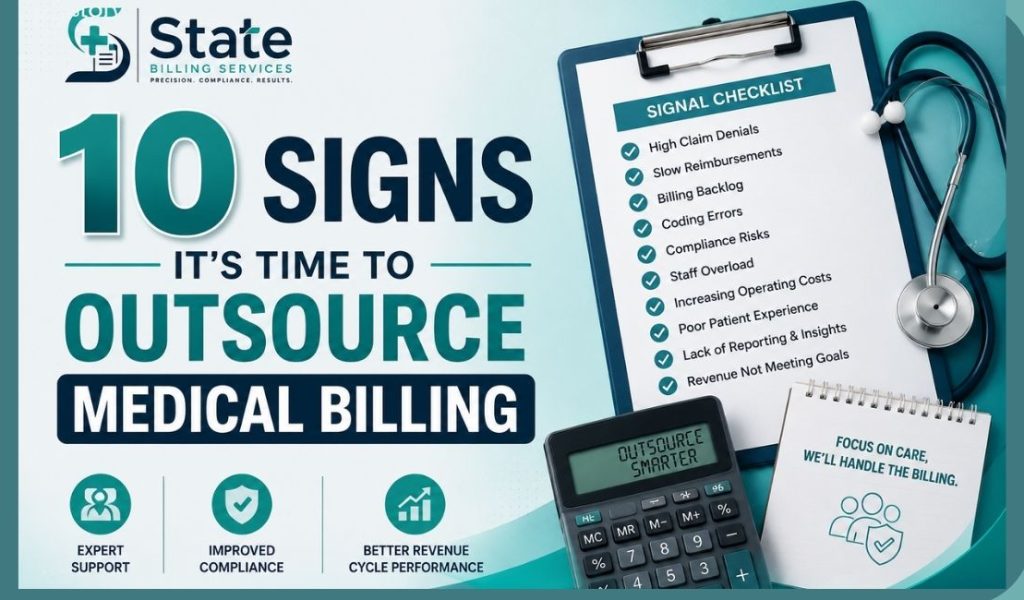
This guide discusses ten practical signs that indicate it may be time to outsource medical billing, along with examples and considerations that help you decide whether medical billing outsourcing is the right move for your practice.
Why Medical Billing Has Become More Challenging
Healthcare reimbursement continues to evolve. Insurance carriers regularly update coverage policies, coding guidelines change every year, and government programs introduce new compliance requirements.
A modern billing workflow typically includes:
- Patient eligibility verification
- Insurance credentialing
- Medical coding
- Claim submission
- Payment posting
- Dencrypted claim correction
- Denial management
- Appeals
- Accounts receivable follow-up
- Revenue reporting
Each step affects reimbursement.
A small mistake during patient registration or coding can delay payment for weeks or even months.
Practices relying entirely on in-house billing often struggle to keep pace as patient volume increases. Billing staff must constantly monitor payer policy updates, coding revisions, and regulatory requirements while maintaining daily claim submissions.
That workload becomes difficult to sustain without specialized support.
Practices looking to strengthen their entire billing workflow often benefit from comprehensive Revenue Cycle Management services in South Carolina and other states rather than addressing individual issues after they occur.
Sign 1: Claim Denials Keep Increasing
One of the earliest indicators that billing processes need improvement is a steady increase in claim denials.
A denial does not always mean the practice will lose revenue. However, every denied claim requires additional work before payment can be recovered.
Common denial reasons include:
- Coding errors
- Missing documentation
- Incorrect modifiers
- Eligibility issues
- Authorization problems
- Filing deadline violations
When denial rates increase, staff spend more time correcting old claims instead of processing new ones.
Real Example
A five-provider internal medicine clinic notices that denied claims have increased from 5 percent to nearly 15 percent over six months.
The billing team becomes overwhelmed with appeals, delaying new claim submissions.
Payments slow significantly.
Cash flow becomes unpredictable.
This situation often indicates that the practice needs stronger denial prevention processes rather than simply hiring another employee.
An experienced billing company typically monitors payer trends, identifies recurring denial patterns, and addresses root causes before they become ongoing problems.
Practices facing repeated denials can also benefit from specialized Denial Management Services that focus on reducing preventable claim rejections.
For additional guidance, the article on Medical Claim Denial Reasons provides practical insight into common denial patterns and prevention strategies.
Sign 2: Payments Are Taking Longer Than Expected
Healthy practices maintain predictable reimbursement cycles.
If payments consistently arrive later than expected, billing delays are often contributing factors.
Long payment cycles may result from:
- Delayed claim submission
- Incomplete documentation
- Slow follow-up on unpaid claims
- Incorrect coding
- Insurance rejections
- Inefficient accounts receivable management
Many practices focus only on submitting claims without giving equal attention to unpaid balances.
Successful RCM outsourcing includes continuous monitoring of aging reports and prompt payer follow-up.
Typical Billing Timeline
| Billing Activity | Efficient Process | Delayed Process |
| Claim submission | Within 24 to 48 hours | Several days later |
| Rejected claims | Corrected immediately | Delayed for weeks |
| Insurance follow-up | Ongoing | Inconsistent |
| Payment posting | Daily | Backlogged |
| Accounts receivable review | Weekly | Monthly or less |
The longer unpaid claims remain unresolved, the lower the likelihood of collecting the full reimbursement.
Sign 3: Your Staff Spends More Time on Billing Than Patient Care
Administrative work continues expanding across healthcare.
Reception staff answer insurance questions.
Clinical staff provide additional documentation.
Providers respond to coding inquiries.
Managers review aging reports.
The result is less time devoted to patient care.
This often affects:
- Patient satisfaction
- Appointment availability
- Staff morale
- Provider productivity
Consider a growing cardiology clinic.
As patient visits increase, administrative responsibilities also grow.
Instead of hiring another physician, the practice hires two billing employees simply to manage insurance claims.
Within a year, payroll costs rise significantly, yet reimbursement delays continue.
This is a common point where medical billing outsourcing becomes financially attractive.
Instead of expanding internal administrative departments, practices gain access to experienced billing professionals who already have established workflows.
Organizations offering specialized Medical Billing Services often provide dedicated billing teams without the overhead associated with recruiting, training, and retaining additional employees.
Sign 4: Billing Costs Continue Rising
Many practice owners underestimate the actual cost of maintaining an internal billing department.
Expenses extend beyond employee salaries.
Hidden costs often include:
- Payroll taxes
- Benefits
- Office space
- Billing software
- Clearinghouse fees
- Staff training
- Continuing education
- Coding updates
- Compliance resources
- Employee turnover
When these expenses are added together, maintaining in-house billing may cost considerably more than expected.
Example Cost Comparison
Imagine a four-provider specialty practice.
Annual expenses may include:
| Expense Category | Estimated Internal Cost |
| Billing staff salaries | High |
| Employee benefits | Moderate to High |
| Software licensing | Moderate |
| Ongoing training | Moderate |
| Staff replacement costs | Variable |
| Compliance resources | Moderate |
A qualified billing partner spreads these operational costs across multiple clients, allowing practices to benefit from experienced billing infrastructure without investing in every internal resource themselves.
Cost alone should never drive outsourcing decisions.
However, when higher expenses are accompanied by declining collections or slower reimbursements, outsourcing becomes a practical option worth evaluating.
Sign 5: Staff Turnover Keeps Interrupting Your Billing Process
Employee turnover is expensive in any business, but it can be especially disruptive in healthcare billing. When an experienced biller leaves, they often take years of practical knowledge with them. A replacement may need weeks or months to become familiar with your practice management system, payer rules, specialty-specific coding, and internal workflows.
During that transition, claims may be submitted late, payment posting can fall behind, and follow-up on unpaid accounts may slow considerably.
For example, imagine an orthopedic practice where the lead biller resigns unexpectedly. The remaining staff members divide the workload while a replacement is hired. Over the next two months:
- Claims begin piling up.
- Insurance follow-up becomes inconsistent.
- Accounts receivable increase.
- Providers notice slower reimbursements.
- Patients wait longer for billing questions to be answered.
Even after hiring someone new, additional time is needed for training and quality assurance.
With medical billing outsourcing, the workflow does not depend on one individual. An experienced billing company typically assigns a team rather than a single employee, helping maintain continuity when staff changes occur.
Practices looking for specialty-focused support can also benefit from services such as Orthopedic RCM SC, where billing professionals understand the documentation and coding requirements unique to orthopedic care.
Sign 6: Coding Errors Are Becoming More Common
Medical coding changes frequently. Annual updates to ICD-10-CM, CPT, and HCPCS codes, along with payer-specific billing policies, require continuous education.
Even highly capable internal staff can struggle to stay current while handling their daily responsibilities.
Common coding issues include:
- Incorrect diagnosis selection
- Missing modifiers
- Outdated CPT codes
- Insufficient documentation
- Incorrect procedure sequencing
- Failure to meet payer-specific requirements
These mistakes may lead to:
- Claim denials
- Reduced reimbursement
- Payment delays
- Compliance concerns
- Increased audit risk
An experienced billing partner generally works with certified coding professionals who receive ongoing education and routinely monitor payer updates.
If coding accuracy has become a recurring concern, dedicated Medical Coding Services SC can strengthen claim quality before submission, reducing avoidable errors and improving first-pass acceptance rates.
Practical Scenario
A cardiology practice performs several diagnostic procedures each day. Minor coding inconsistencies begin triggering repeated payer requests for additional documentation.
Although each issue seems small on its own, together they delay thousands of dollars in reimbursement every month.
Improving coding quality at the beginning of the billing process often produces better results than repeatedly correcting claims after denial.
Sign 7: Your Practice Has Outgrown Its Current Billing Team
Growth is a positive sign, but it also places additional demands on administrative operations.
Perhaps your practice has:
- Added new providers.
- Opened another location.
- Expanded office hours.
- Introduced new specialty services.
- Increased daily patient volume.
While patient appointments may increase by 30 percent, billing staff often remain the same size.
Eventually, backlogs begin to develop.
Common symptoms include:
- Claims submitted several days after visits.
- Growing accounts receivable.
- Delayed payment posting.
- Longer insurance follow-up times.
- Increased employee overtime.
Rather than continuously hiring additional administrative employees, many growing practices choose to outsource medical billing to gain immediate access to larger billing teams and scalable processes.
For example, an urgent care center experiencing seasonal spikes in patient visits may find that outsourcing provides greater flexibility than constantly expanding its internal workforce. Specialized Urgent Care Billing services are designed to manage high claim volumes while maintaining billing accuracy.
Sign 8: Keeping Up With Insurance Rules Has Become Overwhelming
Every insurance payer has its own billing requirements.
These may include:
- Documentation standards
- Modifier policies
- Authorization requirements
- Filing deadlines
- Medical necessity guidelines
- Electronic claim submission rules
On top of commercial insurance policies, practices must also monitor updates from Medicare and Medicaid.
Regulatory changes occur throughout the year, making ongoing education essential.
When internal teams spend most of their day processing claims, they often have limited time to monitor changing payer requirements.
This increases the likelihood of avoidable denials.
Why Specialized Expertise Matters
Experienced RCM outsourcing providers generally dedicate resources to monitoring regulatory changes, payer bulletins, and coding updates.
Their teams adjust billing workflows before policy changes begin affecting reimbursement.
Practices can also reduce preventable denials by strengthening front-end processes such as Eligibility Verification Services and Prior Authorization Services. Addressing coverage issues before treatment often prevents billing complications later in the revenue cycle.
A Comparison Between In-House Billing and Medical Billing Outsourcing
| Area | In-House Billing | Medical Billing Outsourcing |
| Staffing | Practice recruits and trains employees | Experienced billing team already in place |
| Scalability | Hiring required as patient volume grows | Easier to scale with practice growth |
| Coding updates | Internal responsibility | Managed by billing specialists |
| Technology | Practice purchases and maintains systems | Often included within the service model |
| Business continuity | Can be affected by employee turnover | Team-based support reduces disruptions |
| Claim follow-up | Depends on available staff | Dedicated accounts receivable follow-up |
| Reporting | Varies by practice | Regular performance reporting is commonly available |
Neither approach is universally better for every organization. Smaller practices with experienced billing teams may perform well internally, while growing practices often benefit from the additional expertise and scalability that outsourcing provides.
Choosing the Right Billing Partner
Not every billing company offers the same level of service. Before making a decision, evaluate potential partners carefully.
Look for a company that can clearly explain:
- Their experience with your specialty.
- The technology platforms they support.
- How they measure claim acceptance rates.
- Their denial management process.
- Reporting frequency and performance metrics.
- Compliance and data security practices.
- Communication methods and response times.
You should also ask whether they provide services beyond claim submission, such as payment posting, accounts receivable follow-up, credentialing, and revenue analysis.
A reliable billing partner should function as an extension of your practice rather than simply processing claims.
Reading industry updates can also help practices stay informed about reimbursement trends and regulatory developments.
Looking Ahead
If several of these warning signs sound familiar, your billing process may be limiting your practice’s financial performance rather than supporting it.
Recognizing the problem early allows you to improve collections before administrative challenges begin affecting patient care and long-term growth.
Sign 9: Your Accounts Receivable Continue to Grow
Every healthcare practice has outstanding claims waiting for payment. However, when accounts receivable (A/R) continue to increase month after month, it often signals deeper problems within the billing process.
A healthy revenue cycle includes consistent claim submission, prompt payment posting, regular insurance follow-up, and timely patient collections. When one or more of these steps slows down, unpaid balances begin to accumulate.
Some common reasons include:
- Claims are not followed up after submission.
- Denied claims remain unresolved.
- Secondary insurance is billed late.
- Patient balances are not collected efficiently.
- Older claims exceed timely filing limits.
Many practice owners focus on the total dollar amount in A/R instead of its age. A claim that is 20 days old is very different from one that has been outstanding for 120 days.
As claims age, the likelihood of collecting the full reimbursement decreases.
An experienced billing partner actively reviews aging reports, prioritizes high-value claims, communicates with insurance carriers, and escalates unresolved issues before they become write-offs.
Practices with significant outstanding balances may also benefit from dedicated AR Recovery Services, which focus on recovering delayed or overlooked reimbursements that might otherwise be lost.
Practical Example
An internal medicine clinic notices that more than 35 percent of its outstanding claims are over 90 days old.
The billing team is focused on processing new claims and rarely has enough time to pursue older balances. Over several months, cash flow becomes inconsistent even though patient volume remains steady.
After moving to a structured RCM outsourcing model with routine A/R follow-up, the clinic gradually reduces its aging accounts and shortens its average collection cycle.
This example illustrates that improving collections is often about improving processes rather than simply increasing patient volume.
Sign 10: Your Revenue Has Become Unpredictable
Consistent revenue is essential for planning staff schedules, purchasing equipment, investing in technology, and expanding services.
If monthly collections fluctuate significantly without a clear explanation, billing inefficiencies may be contributing to the problem.
Some warning signs include:
- Strong patient volume but declining collections.
- Large swings in monthly revenue.
- Delayed insurance payments.
- Increasing write-offs.
- Frequent billing backlogs.
- Difficulty forecasting cash flow.
Revenue instability is not always caused by external factors. In many cases, it results from inconsistent billing operations.
A well-managed billing process produces measurable performance indicators such as:
- First-pass claim acceptance rate.
- Average reimbursement time.
- Denial rate.
- Net collection rate.
- Days in accounts receivable.
Monitoring these metrics helps identify operational issues before they affect the financial health of the practice.
Professional medical billing outsourcing companies typically provide regular reporting that allows practice owners to track these key performance indicators and make informed business decisions.
How to Transition from In-House Billing to Outsourcing
Moving from in-house billing to an outsourced model does not have to disrupt your practice. With careful planning and a structured implementation process, the transition can be completed smoothly.
A typical transition includes the following stages:
- Review your current billing performance, including denial rates, A/R aging, reimbursement timelines, and collection rates.
- Select a billing company with experience in your specialty and the billing software you already use.
- Transfer billing data securely while maintaining compliance with patient privacy regulations.
- Define responsibilities for communication, reporting, and issue resolution.
- Monitor performance during the first few months to ensure claims continue moving through the revenue cycle efficiently.
The goal is not simply to hand off billing responsibilities. It is to build a long-term partnership that improves financial performance while allowing your team to focus on patient care.
Frequently Asked Questions
Is medical billing outsourcing only suitable for large healthcare organizations?
No. Small practices often benefit just as much as larger organizations. Many independent physicians outsource billing because they do not have the resources to maintain a full internal billing department.
Will I lose visibility into my billing process?
Not if you choose the right provider. Reputable billing companies provide regular reports, performance dashboards, and ongoing communication so practice owners remain informed about collections, denials, and accounts receivable.
Can outsourcing improve claim approval rates?
It can, provided billing errors, coding issues, or workflow inefficiencies are contributing to denials. Experienced billing teams generally implement quality control measures that improve claim accuracy before submission.
What specialties commonly outsource billing?
Many specialties choose outsourcing, including internal medicine, cardiology, orthopedics, radiology, urgent care, behavioral health, and multi-specialty practices. The specific needs vary, but the objective remains the same: maintaining an efficient revenue cycle while reducing administrative burden.
Does outsourcing replace my front office staff?
No. Front office teams continue handling patient registration, scheduling, and day-to-day interactions. The outsourced billing team works alongside your practice by managing claims, payment follow-up, reporting, and reimbursement activities.
Choosing a Long-Term Billing Partner
Selecting a billing company should involve more than comparing service fees.
A strong partner demonstrates:
- Experience with your medical specialty.
- Knowledge of current payer policies.
- Transparent performance reporting.
- Secure handling of patient information.
- Responsive communication.
- Proven denial management processes.
- Scalable services that grow with your practice.
Ask prospective providers how they monitor claim quality, resolve denials, and measure success. Their answers should be supported by clear processes rather than broad promises.
Final Thoughts
Medical billing is no longer a simple administrative task. It is a critical part of financial performance, patient satisfaction, and practice growth. As reimbursement requirements become more complex, many healthcare organizations find that maintaining every aspect of the revenue cycle internally becomes increasingly difficult.
If your practice is experiencing rising claim denials, delayed reimbursements, increasing accounts receivable, staffing challenges, coding errors, or unpredictable cash flow, it may be time to outsource medical billing.
The right billing partner does more than submit claims. They help strengthen every stage of the revenue cycle, reduce preventable errors, improve reimbursement timelines, and provide the reporting needed to make informed operational decisions.
For organizations seeking comprehensive support, Medical Billing Services can help improve claim accuracy, accelerate reimbursements, and reduce administrative burden. You can also visit the States Billing Services SC to learn more about its complete revenue cycle solutions and specialty-focused billing services.
By recognizing these ten warning signs early and taking proactive steps, healthcare providers can build a more efficient billing process that supports sustainable financial performance while allowing clinicians to focus on delivering quality patient care.