
A patient shows up for a scheduled MRI, checks in, changes into a gown, and waits. Twenty minutes later, the front desk gets a call from the imaging center: the authorization on file does not match the ordered procedure, and the scan cannot proceed until it gets sorted out. The patient leaves without the test. The physician’s schedule gets thrown off. And somewhere in the back office, a staff member spends the next hour on hold with the payer trying to figure out what went wrong.
This scenario, or some version of it, plays out in practices constantly. Prior authorization is one of the most frustrating parts of the healthcare billing process, not because the concept itself is complicated, but because the execution leaves so much room for small, avoidable mistakes. A missed detail here, an outdated code there, and a service that should have been approved without issue turns into a denied claim, a delayed patient, or both.
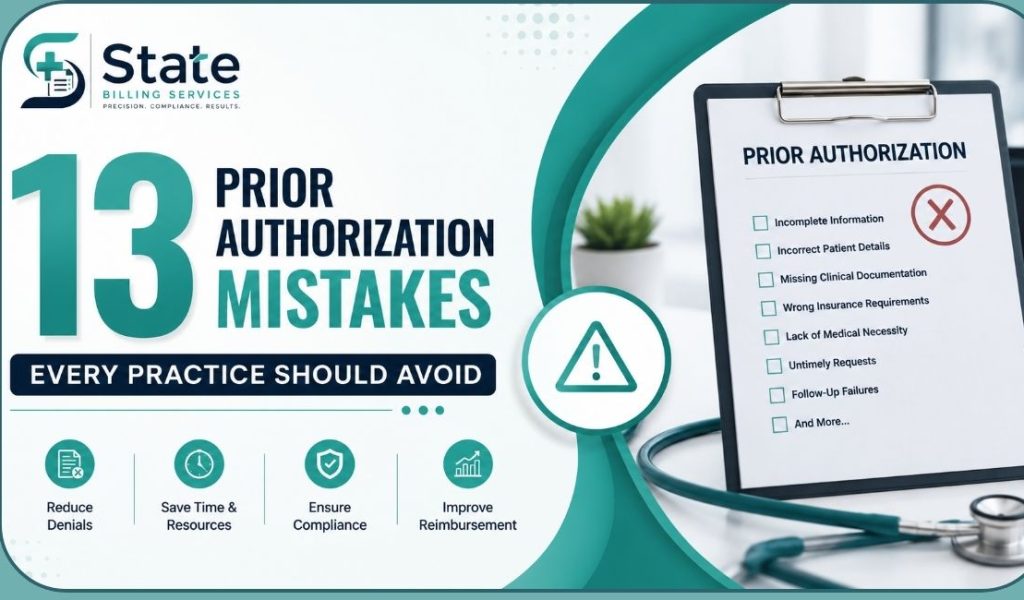
This article walks through 13 common prior authorization mistakes that practices in South Carolina and elsewhere run into regularly. Each one comes with an explanation of why it happens and what a practice can do differently. The goal is not to eliminate every possible error, since payer requirements shift constantly, but to build a process resilient enough that most mistakes get caught before they affect a patient or a claim.
Why Prior Authorization Mistakes Carry Such High Stakes
Prior authorization exists because payers want to confirm that certain services, procedures, or medications are medically necessary before they agree to cover the cost. Without proper authorization, a payer can deny the entire claim, regardless of whether the service itself was appropriate or well documented. This makes prior authorization one of the few points in the revenue cycle where a single administrative mistake can completely block payment, even for a service that was clinically justified.
The financial impact adds up quickly. A denied claim due to a missing or incorrect authorization requires staff time to investigate, correct, and resubmit, and in some cases the payer will not accept a retroactive authorization at all, meaning the claim is permanently unpayable. Beyond the financial cost, authorization mistakes disrupt patient care, delaying procedures, imaging studies, and treatments that patients are often already anxious about.
Process and Timing Mistakes
1. Not Verifying Which Services Require Authorization
Not every procedure needs prior authorization, and payer rules on this vary constantly. A service that required authorization last year might not this year, and a service that never needed it before might suddenly require one after a payer updates its policy. Practices that rely on outdated assumptions about which services need authorization frequently skip a step that has since become mandatory.
The safest approach is confirming authorization requirements for each specific payer and plan before scheduling, rather than assuming based on past experience. Building this check into eligibility verification SC at the time of scheduling catches these requirement changes before they become a problem on the day of service.
2. Waiting Until the Last Minute to Submit
Authorization requests take time to process, and payers rarely guarantee a fast turnaround. Submitting a request only a day or two before a scheduled procedure leaves no room for delays, additional information requests, or denials that need to be appealed before the service date. Many practices run into this problem when a procedure gets scheduled quickly after a diagnosis, without enough lead time built into the authorization timeline.
A practical fix is setting an internal deadline that is well ahead of the payer’s stated turnaround time, giving staff room to follow up if the request stalls or gets flagged for additional documentation.
3. Submitting Incomplete Clinical Documentation
Authorization requests need enough clinical detail to justify medical necessity. A request submitted with vague or minimal documentation is far more likely to get denied or sent back with a request for more information, both of which delay the process. This is especially common with specialty procedures, where payers expect specific clinical criteria to be documented clearly, such as failed conservative treatment before approving a more invasive intervention.
4. Using Outdated or Incorrect Procedure Codes
The CPT code submitted with an authorization request has to match the code that will eventually appear on the claim. If a coder or scheduler uses an outdated code, or a code that does not precisely describe the planned procedure, the payer may approve an authorization that does not actually cover the service performed. This mismatch often does not surface until the claim is submitted for payment, at which point the authorization on file no longer matches the billed service, resulting in a denial that could have been avoided with more careful code selection upfront.
Documentation and Communication Mistakes
5. Assuming Authorization Covers Every Related Service
An authorization approved for one procedure does not automatically extend to additional services performed during the same visit. If a provider adds an unplanned procedure during a scheduled visit, that addition may need its own separate authorization. Practices that assume broad coverage under a single approved authorization often discover the gap only after the claim comes back partially denied.
6. Failing to Track Authorization Expiration Dates
Authorizations come with a specific window of time during which the approved service must be performed. If a procedure gets rescheduled or delayed past that window, the original authorization is no longer valid, even if nothing about the clinical situation has changed. Practices without a reliable tracking system for authorization expiration dates often miss this detail, leading to a denied claim for a service that was technically approved, just not within the correct timeframe.
7. Not Communicating Authorization Status Between Front Office and Clinical Staff
A breakdown between scheduling staff and clinical staff is one of the more preventable causes of authorization problems. If the front office knows an authorization is still pending but that information does not reach the clinical team before the appointment, a procedure can move forward without proper approval in place. Clear internal communication about authorization status, ideally built into the scheduling system itself, prevents this kind of gap.
A few warning signs that internal communication may be breaking down include:
- Authorization status showing as pending in the system while the appointment proceeds as scheduled
- Clinical staff unaware that a specific payer requires authorization for a routine procedure
- Front office staff unaware that a provider added a new service during the visit that also needs approval
8. Overlooking Payer Specific Requirements
Every payer sets its own rules for prior authorization, including which services require it, what documentation is needed, and how long approval remains valid. A practice that applies a single generic process across every payer, rather than adjusting for these differences, is more likely to run into mismatches. Medicaid managed care plans, for example, often have different authorization thresholds than commercial payers, and treating them identically increases the risk of missed requirements.
Follow Up and Tracking Mistakes
9. Not Appealing Denied Authorization Requests
A denied authorization is not always final. Many payers allow a peer to peer review or a formal appeal if the initial request gets denied, particularly when the denial stems from insufficient documentation rather than a true coverage exclusion. Practices that treat every denied authorization as the end of the road miss opportunities to secure approval through additional clinical justification or a direct conversation between the ordering provider and the payer’s medical reviewer.
10. Assuming Authorization Guarantees Full Payment
An approved authorization confirms that a service is considered medically necessary. It does not guarantee full payment, since the claim can still be reduced or denied for other reasons, such as coding errors, eligibility issues that arose after the authorization was granted, or documentation gaps unrelated to the authorization itself. Treating authorization as a payment guarantee sometimes leads practices to skip other verification steps that remain necessary even after approval is secured.
11. Not Rechecking Authorization Requirements at Renewal
Ongoing treatments, such as certain therapies or long term medication management, often require periodic reauthorization. Practices that assume a previous approval will simply renew automatically sometimes miss the window to submit a new request, resulting in a lapse in coverage for an otherwise continuous course of treatment. Building a reminder system for renewal deadlines prevents this kind of gap, particularly for treatments spanning several months.
12. Poor Record Keeping of Authorization Numbers and Confirmations
Every approved authorization comes with a reference number that needs to be recorded accurately and attached to the eventual claim. Losing track of this number, or entering it incorrectly on the claim, can cause a payer to treat the claim as if no authorization exists at all, triggering an unnecessary denial. Consistent documentation practices, including saving confirmation emails or portal screenshots alongside the reference number, protect against this kind of easily preventable error.
13. Not Reviewing Authorization Denial Patterns Over Time
Individual authorization mistakes are one problem. A pattern of repeated mistakes across many claims is a different, more serious problem, since it points to a process gap rather than an isolated error. Practices that do not periodically review their authorization denial trends often keep repeating the same mistake for months without realizing it. Reviewing recurring medical claim denial reasons on a regular basis helps surface these patterns early, whether the root cause is a specific payer, a specific service type, or a gap in internal communication.
The Real Cost of Authorization Delays
Prior authorization mistakes create more than administrative headaches, they directly affect revenue, staff productivity, and patient satisfaction. Even small errors can quickly add up, creating ongoing operational and financial challenges for a practice.
The Financial Impact
Consider a practice that submits 20 prior authorization requests each week. If just 15% of those requests contain errors, that’s:
- 3 delayed or denied authorizations per week
- Approximately 150 authorization issues per year
- 20–60+ minutes of staff time spent investigating, correcting, and resubmitting each request
Over time, these hours translate into hundreds of lost productivity hours that could have been devoted to patient care or other high-value administrative tasks.
Cash Flow Delays
Authorization errors also slow down reimbursement. Instead of receiving payment within the typical three to four weeks, practices often face extended payment timelines because of resubmissions and additional payer reviews.
Common consequences include:
- Delayed claim processing
- Slower revenue recognition
- Increased accounts receivable (A/R) days
- Greater cash flow pressure, particularly for smaller practices
The financial impact becomes even more significant when delayed authorizations involve high-value services such as advanced imaging, specialty procedures, or surgeries.
The Hidden Cost: Patient Experience
The effects extend beyond finances. When an authorization issue causes a procedure or appointment to be postponed, patients experience unnecessary inconvenience and uncertainty.
Potential outcomes include:
- Canceled or rescheduled procedures
- Delays in diagnosis or treatment
- Increased patient frustration
- Reduced confidence in the practice’s efficiency and reliability
Even when clinical care remains excellent, repeated scheduling disruptions can negatively influence how patients perceive the overall quality of the practice.
Why Prevention Matters
Every authorization error has a ripple effect across the organization. By strengthening documentation, verifying payer requirements, and improving internal workflows, practices can reduce preventable delays, accelerate reimbursements, and provide a smoother experience for both staff and patients.
A Common Prior Authorization Mistake
Imagine a specialty practice orders an MRI for a patient with ongoing back pain. The provider documents the patient’s condition, and the staff requests prior authorization for a lumbar spine MRI without contrast. The insurance company approves the request.
On the day of the scan, the radiologist decides that an MRI with contrast will give better results. The procedure is changed and completed with contrast instead.
The problem starts when the claim is submitted. The CPT code on the claim no longer matches the code on the approved authorization. Since the insurance company only approved the original procedure, it denies the claim.
The practice must then request a retroactive authorization. Many payers reject these requests or take weeks to review them. As a result, payment is delayed, and staff spend extra time fixing the issue.
The Lesson
Prior authorization should not be treated as a one-time task completed during scheduling. Any change to the planned procedure should trigger a review of the authorization.
A simple final check can prevent many denials. Before submitting a claim, confirm that:
- The authorized CPT code matches the billed CPT code.
- The approved procedure matches the service that was performed.
- Any changes have been updated with the payer before billing.
This small step helps practices avoid unnecessary denials, speed up payments, and reduce extra administrative work.
| Mistake | Root Cause | Practical Fix |
| Skipping authorization checks | Outdated assumptions about payer rules | Verify requirements at scheduling for every payer |
| Last minute submission | Procedures scheduled without buffer time | Set internal deadlines ahead of payer turnaround |
| Incomplete documentation | Vague clinical notes submitted with request | Include specific clinical criteria upfront |
| Expired authorization | No tracking system for approval windows | Build expiration alerts into scheduling software |
| Lost reference numbers | Inconsistent record keeping | Store confirmation details with the patient’s chart |
How These Mistakes Affect Specialty Practices Differently
Prior authorization challenges do not look identical across every specialty. Radiology practices deal constantly with imaging studies that require pre approval, and a mismatch between the ordered study and the approved authorization is one of the most common denial triggers in this setting. Orthopedic practices run into authorization issues around surgical procedures and durable medical equipment, where documentation needs to clearly support medical necessity based on failed conservative treatment.
Different specialties face different prior authorization challenges. Cardiology practices often need approvals for diagnostic tests, imaging, and certain interventional procedures. The fast pace of cardiac care can create time pressure, increasing the risk of last-minute authorization requests. This is one reason many providers work with cardiology billing services in South Carolina to help manage authorizations, reduce claim denials, and keep reimbursements on track.
Mental health practices face a different challenge. Many insurance plans place limits on the number of covered therapy sessions. Once that limit is reached, a new authorization is often required. Missing the renewal deadline can delay treatment and disrupt a patient’s continuity of care.
Internal medicine practices handle a broad range of referrals, diagnostic tests, and specialty services. Because so many different procedures may require prior authorization, these practices benefit from a flexible tracking system that helps staff monitor approvals, renewals, and payer-specific requirements before claims are submitted.
Urgent care billing services also involve managing prior authorization for certain services. Urgent care centers do not need authorization as often as specialty practices. However, they still need it for some imaging tests, specialist referrals, and follow-up procedures.
Because urgent care focuses on same-day treatment, staff may miss authorization requirements. These requirements are more common in specialty settings with scheduled visits.
A simple authorization check before a referral or procedure can prevent mistakes. It helps ensure the required approval is in place before billing. This reduces claim denials, speeds up payments, and improves the efficiency of urgent care billing services.
Building a Reliable Prior Authorization Process
A strong prior authorization process depends on more than good intentions. It requires a system, whether that is dedicated software, a shared tracking spreadsheet, or a defined workflow between front office and clinical staff, that consistently catches the details that lead to the mistakes described above. A few foundational elements tend to make the biggest difference.
Clear ownership matters. When authorization tracking is nobody’s specific responsibility, it tends to fall through the cracks during busy periods. Assigning a specific team member or role to manage authorization requests, follow ups, and renewals creates accountability that a shared, informal system usually lacks.
Standardized documentation templates also help, since they reduce the chance that a request goes out with missing clinical detail. A template built around what a specific payer typically requires saves time and reduces back and forth compared to writing each request from scratch.
Regular communication between clinical and administrative staff closes the loop on authorization status before it becomes a problem on the day of service. A short daily or weekly check on pending authorizations, tied directly to the upcoming schedule, catches gaps early enough to resolve them without disrupting patient care.
When to Consider Outside Support
Some practices manage prior authorization entirely in house, while others find that the volume and complexity of requests justify bringing in outside support. This decision often depends on staff bandwidth, the complexity of the payer mix a practice deals with, and how often authorization related denials are affecting revenue. Reviewing guidance on when to outsource medical billing functions, including prior authorization management, can help a practice weigh whether dedicated support would reduce the administrative burden enough to justify the cost.
Practices that work with a partner offering dedicated prior authorization services often see fewer last minute scrambles, since a team focused specifically on tracking requirements, submission timing, and renewal deadlines is less likely to let details slip during busy periods.
Practical Next Steps
Reducing prior authorization mistakes starts with an honest look at where a practice’s current process breaks down most often. Reviewing the past few months of denied or delayed claims tied to authorization issues usually reveals a pattern, whether that is a specific payer, a specific service type, or a specific point in the scheduling workflow where communication tends to fail.
From there, small process changes tend to produce meaningful results. Building authorization checks into scheduling, setting internal deadlines ahead of payer turnaround times, and creating a simple system for tracking expiration dates and reference numbers address the majority of the mistakes covered in this article. None of these fixes require a complete overhaul, just a consistent commitment to catching details before they become denials.
Prior authorization will likely never be a fully seamless process, since payer requirements continue to shift and every specialty faces its own unique challenges. But a practice that treats authorization as a structured, trackable part of its workflow, rather than an afterthought handled reactively, avoids the majority of the costly mistakes covered here.
If your practice is dealing with frequent authorization related denials or a process that feels harder to manage than it should, working with an experienced partner can help close the gaps. States Billing Services SC supports practices across multiple healthcare specialties with prior authorization tracking, denial resolution, and broader revenue cycle management, helping reduce delays before they affect patient care or practice revenue.