Healthcare is no longer limited to treating patients inside a clinic or hospital. Today, patients compare providers online, read reviews, search for symptoms, verify insurance participation, and evaluate healthcare organizations before scheduling an appointment. A strong reputation and a visible online presence have become just as important as delivering quality care.
This shift has changed the way healthcare organizations connect with their communities. Simply opening a practice or relying on referrals is often not enough to maintain steady patient growth. Providers must communicate their expertise, build trust, and make it easy for people to access reliable healthcare information.
That is where healthcare marketing becomes essential.
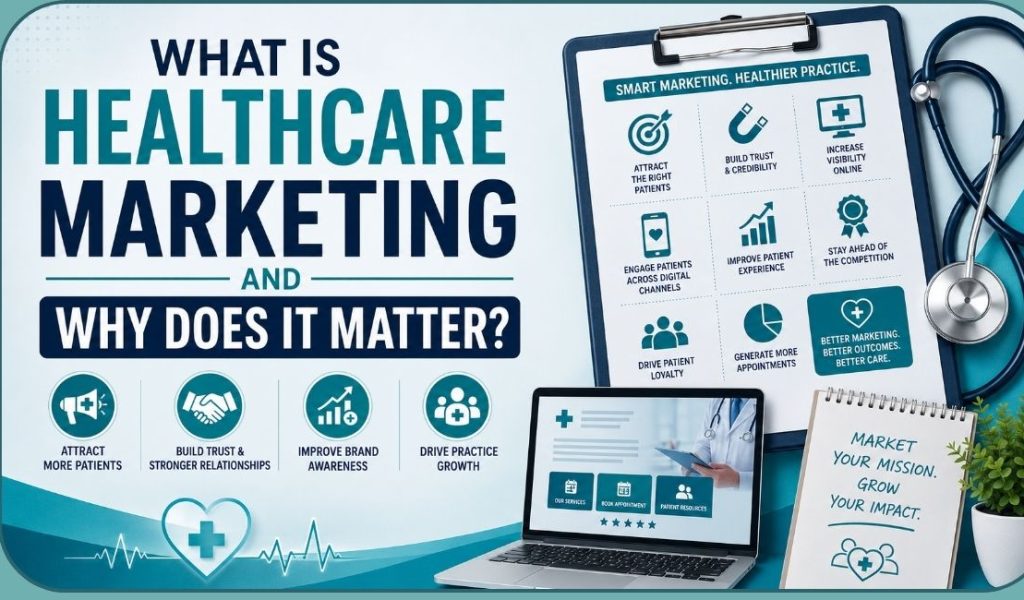
If you have ever wondered, What Is Healthcare Marketing, the answer goes far beyond advertising. It is a strategic approach that helps healthcare organizations educate patients, improve visibility, strengthen relationships, and encourage informed healthcare decisions. When done correctly, marketing supports both patient care and sustainable business growth.
Whether you manage a private clinic, specialty practice, urgent care center, or large healthcare organization, understanding modern Healthcare Marketing Strategies can help you reach the right audience while maintaining professionalism and compliance.
This guide explains what healthcare marketing is, why it matters, the most effective marketing channels, common challenges, and practical strategies healthcare organizations can use to build lasting patient relationships.
What Is Healthcare Marketing?
What Is Healthcare Marketing? Healthcare marketing is the process of promoting healthcare services, medical professionals, hospitals, clinics, and healthcare organizations through ethical communication that educates, informs, and connects with current and prospective patients.
Unlike traditional marketing, healthcare marketing focuses heavily on trust, patient education, credibility, and regulatory compliance. Instead of convincing someone to purchase a product on impulse, healthcare providers help people make informed decisions about their health.
Healthcare marketing includes activities such as:
- Building an informative website
- Publishing educational content
- Improving search engine visibility
- Managing online reviews
- Running paid advertising campaigns
- Engaging patients through social media
- Sending appointment reminders and newsletters
- Maintaining accurate provider information across online directories
The goal is not simply to increase appointments. It is to create meaningful patient relationships that begin before the first visit and continue throughout the patient’s healthcare journey.
Why Healthcare Marketing Matters More Than Ever
Patient behavior has changed dramatically over the past decade.
Instead of calling the closest clinic listed in a phone book, patients now complete much of their research online.
A typical patient journey often includes:
- Searching symptoms on Google
- Looking for specialists nearby
- Comparing provider websites
- Reading online reviews
- Checking insurance acceptance
- Verifying office hours
- Scheduling online
If your practice is difficult to find online or provides limited information, potential patients may choose another provider before ever contacting your office.
Healthcare marketing helps ensure your organization appears where patients are already searching.
It also helps healthcare providers:
- Build credibility
- Increase patient awareness
- Improve patient education
- Strengthen community trust
- Encourage preventive care
- Support practice growth
Marketing is no longer optional for healthcare organizations that want to remain competitive in an increasingly digital environment.
Healthcare Marketing vs Traditional Marketing
Although both aim to reach customers, healthcare marketing follows a different approach.
| Traditional Marketing | Healthcare Marketing |
| Focuses on selling products | Focuses on educating patients |
| Often encourages quick purchases | Encourages informed healthcare decisions |
| Emotional buying triggers are common | Trust and credibility are essential |
| Few legal restrictions | Must comply with healthcare regulations |
| Brand loyalty develops through products | Patient loyalty develops through quality care and communication |
Healthcare providers carry a higher responsibility because inaccurate information can directly affect patient health. This is why healthcare content must always prioritize accuracy and transparency.
The Evolution of Medical Marketing
Years ago, Medical Marketing consisted mainly of newspaper advertisements, billboards, physician referrals, radio spots, and community events.
While these methods still have value in some markets, digital channels now dominate patient decision making.
Several developments have transformed healthcare marketing:
Increased Internet Usage
Millions of healthcare searches happen every day.
Patients search for:
- Family physicians
- Specialists
- Emergency clinics
- Treatment options
- Insurance information
- Healthcare costs
Practices that appear prominently in search results often receive significantly more inquiries.
Mobile Devices
Most healthcare searches now begin on smartphones.
Patients expect websites that load quickly, display correctly on mobile devices, and provide simple navigation for scheduling appointments.
Online Reviews
Review platforms have become one of the strongest influences on patient decisions.
Many prospective patients compare ratings before contacting a provider.
Healthcare organizations should encourage satisfied patients to leave honest reviews while responding professionally to feedback.
Social Media
Platforms such as Facebook, Instagram, LinkedIn, and YouTube have become valuable communication tools.
Healthcare providers use these channels to:
- Share health education
- Announce services
- Introduce physicians
- Promote wellness campaigns
- Build community engagement
Rather than replacing clinical expertise, social media extends it to a broader audience.
Understanding Healthcare Digital Marketing
One of the fastest growing areas within healthcare is Healthcare Digital Marketing.
Digital marketing refers to all online strategies used to attract, educate, and retain patients.
Common digital marketing channels include:
Search Engine Optimization
Search Engine Optimization helps healthcare websites appear in search engine results when patients search relevant topics.
For example:
- Pediatrician near me
- Knee pain treatment
- Cardiology clinic
- Urgent care open now
SEO includes:
- High quality educational content
- Local optimization
- Fast website performance
- Mobile responsiveness
- Clear page structure
Good SEO improves visibility without relying entirely on paid advertising.
Google Business Profile
A properly optimized Google Business Profile helps local practices appear in map results.
Patients can quickly view:
- Address
- Phone number
- Reviews
- Business hours
- Directions
- Website
- Appointment links
Keeping this information accurate builds trust and reduces patient frustration.
Content Marketing
Educational content remains one of the most effective healthcare marketing tools.
Examples include:
- Blog articles
- Preventive care guides
- Frequently asked questions
- Patient education pages
- Treatment explanations
- Wellness resources
Helpful content demonstrates expertise while answering questions patients commonly search online.
Email Marketing
Email continues to provide value for patient communication.
Healthcare organizations often send:
- Appointment reminders
- Preventive care notifications
- Seasonal wellness advice
- Vaccination updates
- Health newsletters
These communications strengthen long term patient relationships.
Paid Advertising
Platforms such as Google Ads and Meta Ads allow healthcare providers to reach targeted audiences.
Paid campaigns may promote:
- New practice locations
- Seasonal services
- Preventive screenings
- Telehealth appointments
- Specialty clinics
Successful campaigns require careful audience targeting and compliance with advertising policies.
The Core Goals of Healthcare Marketing
Healthcare marketing should support broader organizational objectives instead of focusing only on increasing appointment numbers.
Successful organizations often pursue several goals simultaneously.
Increase Patient Awareness
Many patients simply do not know which services are available locally.
Educational campaigns help raise awareness about treatments, screenings, preventive care, and specialty services.
Build Long Term Trust
Trust develops gradually.
Publishing accurate information, maintaining transparent communication, and providing excellent patient experiences all contribute to stronger relationships.
Improve Patient Engagement
Engaged patients are more likely to:
- Attend appointments
- Follow treatment plans
- Return for preventive care
- Recommend providers to others
Marketing supports engagement by maintaining ongoing communication beyond individual visits.
Strengthen Brand Reputation
Healthcare organizations build their reputation through every patient interaction.
Marketing reinforces that reputation by presenting consistent messaging across websites, social media, online directories, and educational content.
Key Components of Effective Healthcare Marketing Strategies
Not every marketing tactic produces the same results. The strongest Healthcare Marketing Strategies combine several approaches that work together to support patient acquisition and long term retention.
Know Your Audience
Every healthcare organization serves different patient populations.
For example:
An orthopedic practice primarily reaches individuals recovering from injuries, athletes, and older adults with joint conditions.
A pediatric clinic focuses on parents seeking preventive care, vaccinations, and childhood wellness services.
A mental health provider communicates differently than an urgent care center because patient expectations and concerns vary significantly.
Understanding patient needs helps shape more relevant messaging.
Build a User Friendly Website
Your website often creates the first impression.
Patients expect:
- Fast loading pages
- Clear contact information
- Online scheduling
- Provider biographies
- Insurance information
- Educational resources
An outdated website can reduce patient confidence before the first appointment.
Focus on Local Search
Most healthcare decisions happen locally.
Optimizing location pages, maintaining accurate business listings, and collecting authentic patient reviews all contribute to stronger local visibility.
Produce Educational Content
Patients appreciate providers who explain complex medical topics in plain language.
Articles addressing common concerns improve trust while supporting search visibility.
For practices that also want to strengthen operational performance, topics related to medical billing services, revenue cycle management in South Carolina, or insurance credentialing services can help educate healthcare administrators alongside clinical audiences.
Build a Strong Online Reputation
Online reviews have become one of the first things patients evaluate before choosing a healthcare provider. A practice with consistent positive feedback often earns more confidence than one with little or no online presence.
That does not mean providers should chase perfect ratings. Patients understand that every organization receives occasional criticism. What matters is how the practice responds.
Healthcare organizations should:
- Encourage satisfied patients to leave honest reviews.
- Monitor review platforms regularly.
- Respond professionally without revealing protected health information.
- Address recurring concerns to improve the patient experience.
A thoughtful response demonstrates accountability and reinforces trust among prospective patients.
Healthcare Marketing Benefits
Many healthcare organizations initially view marketing as an expense. In reality, a well planned marketing strategy supports measurable business and patient care outcomes.
The table below highlights some of the most important Healthcare Marketing Benefits.
| Marketing Activity | Business Benefit | Patient Benefit |
| Educational content | Builds authority | Helps patients make informed decisions |
| Local SEO | Improves visibility | Makes providers easier to find |
| Online reviews | Increases trust | Offers social proof |
| Email communication | Improves retention | Provides timely reminders |
| Social media | Expands community reach | Shares reliable health information |
| Website optimization | Generates inquiries | Makes scheduling easier |
These benefits extend beyond attracting new patients. Effective marketing also strengthens long term relationships with existing patients.
Common Healthcare Marketing Channels
Healthcare organizations rarely rely on a single marketing channel. Instead, they combine several approaches that complement one another.
Search Engines
Google remains one of the most influential platforms in healthcare decision making.
Patients search for:
- Primary care physicians
- Specialists
- Medical procedures
- Symptoms
- Treatment options
- Insurance acceptance
Ranking well for relevant searches helps practices connect with patients at the moment they are actively seeking care.
Social Media
Healthcare providers increasingly use social media to educate rather than promote.
Examples include:
- Seasonal health reminders
- Preventive care tips
- Behind the scenes practice updates
- Physician introductions
- Community health events
- Frequently asked questions
Platforms such as Facebook, Instagram, LinkedIn, and YouTube each serve different audiences and communication goals.
Email Campaigns
Email remains one of the highest performing communication channels when used appropriately.
Examples include:
- Annual wellness reminders
- Flu vaccine announcements
- Preventive screening notifications
- Practice newsletters
- New physician introductions
Patients appreciate receiving relevant information that supports their ongoing care.
Video Marketing
Video allows healthcare professionals to explain complex topics in a more approachable way.
Short educational videos can cover:
- Common procedures
- Recovery expectations
- Frequently asked questions
- Preventive health advice
- Physician interviews
Video also helps patients become familiar with providers before their first appointment, reducing uncertainty and building confidence.
Community Outreach
Digital marketing should not replace community involvement.
Healthcare organizations continue to build strong local relationships through:
- Health fairs
- School partnerships
- Wellness seminars
- Charity events
- Employer wellness programs
These activities strengthen brand recognition while demonstrating genuine community commitment.
How Marketing Supports Practice Growth
Consider a newly established cardiology clinic.
The physicians are highly qualified and offer advanced diagnostic services. Despite excellent clinical care, appointment schedules remain inconsistent during the first several months.
Instead of relying solely on physician referrals, the clinic develops a structured marketing plan.
The practice:
- Launches an informative website.
- Optimizes its Google Business Profile.
- Publishes articles about heart health and preventive care.
- Creates educational videos explaining common cardiac tests.
- Encourages satisfied patients to leave reviews.
- Shares heart health awareness campaigns on social media.
- Runs targeted Google Ads for local cardiovascular services.
Over time, the clinic experiences:
- Increased website traffic
- Higher search visibility
- More appointment requests
- Improved patient engagement
- Greater community recognition
The marketing effort does not replace quality medical care. Rather, it ensures more patients become aware of the care already available.
Challenges in Healthcare Marketing
Healthcare marketing offers tremendous opportunities, but it also presents unique challenges that require careful planning.
Regulatory Compliance
Healthcare organizations must comply with regulations governing patient privacy and advertising.
In the United States, the Health Insurance Portability and Accountability Act (HIPAA) establishes strict standards for protecting patient information.
Marketing teams must ensure that:
- Patient testimonials have appropriate authorization.
- Personal health information is never disclosed improperly.
- Email communications follow privacy requirements.
- Advertising remains truthful and accurate.
Compliance should remain a priority throughout every marketing campaign.
Building Trust Takes Time
Unlike retail marketing, healthcare marketing rarely produces immediate results.
Patients often spend weeks or months researching providers before scheduling an appointment.
Consistent communication, reliable educational content, and positive patient experiences gradually strengthen trust.
Competition
Many healthcare markets have become increasingly competitive.
Patients often compare multiple providers before making a decision.
Practices that communicate clearly, maintain accurate information, and demonstrate expertise typically stand out.
Limited Internal Resources
Smaller practices may not have dedicated marketing departments.
Physicians and office managers frequently balance marketing responsibilities alongside patient care and administrative duties.
Working with experienced healthcare marketing professionals can help practices implement effective strategies without overwhelming internal staff.
Measuring Healthcare Marketing Success
Successful marketing depends on measurable outcomes rather than assumptions.
Several key performance indicators help organizations evaluate effectiveness.
Website Traffic
Google Analytics allows practices to monitor:
- Visitor numbers
- Popular pages
- Traffic sources
- Time spent on pages
- Conversion rates
These insights reveal which content resonates most with patients.
Appointment Requests
One of the clearest indicators of marketing success is an increase in appointment inquiries.
Tracking online scheduling requests, phone calls, and contact form submissions helps measure campaign performance.
Search Rankings
Improved visibility for relevant healthcare searches often leads to increased patient acquisition over time.
Monitoring keyword performance helps identify opportunities for future content.
Patient Reviews
Growing numbers of authentic positive reviews reflect strong patient satisfaction and increased community trust.
Review quality often influences future patient decisions.
Patient Retention
Marketing should not focus exclusively on attracting new patients.
Returning patients often represent greater long term value than first time visitors.
Retention can improve through ongoing communication, preventive care reminders, and exceptional patient experiences.
Technology That Supports Healthcare Marketing
Modern healthcare marketing depends on technology that improves efficiency and patient engagement.
Some commonly used platforms include:
Customer Relationship Management (CRM) Systems
CRMs help practices organize patient communication, monitor inquiries, and automate follow up messages while supporting relationship management.
Google Analytics
Google Analytics measures website performance and helps organizations understand patient behavior online.
Google Search Console
Search Console identifies website visibility issues and tracks search performance.
Marketing Automation Platforms
Platforms such as HubSpot and Mailchimp simplify email campaigns, audience segmentation, and performance reporting.
Appointment Scheduling Software
Online scheduling tools reduce administrative workload while improving convenience for patients.
Practice Management Systems
Many healthcare organizations integrate marketing efforts with scheduling, billing, and patient communication platforms to create a more seamless patient experience.
The Connection Between Marketing and Revenue Cycle Performance
Marketing attracts patients, but long term success depends on what happens after those appointments are scheduled.
An excellent patient experience can quickly be undermined by billing delays, insurance issues, or claim denials.
That is why successful healthcare organizations align marketing with operational excellence.
For example, efficient Revenue Cycle Management ensures claims are processed accurately and payments are collected promptly. Strong financial operations contribute to higher patient satisfaction because billing becomes more transparent and predictable.
Similarly, accurate Medical Billing Services SC help reduce administrative errors that can negatively affect patient trust after treatment.
Insurance participation also plays an important role in patient acquisition. Reliable Insurance Credentialing Services allow providers to appear in payer networks, making it easier for patients to verify coverage before scheduling care.
When marketing and operational processes work together, patients experience consistency from their first website visit through final payment.
Mistakes Healthcare Organizations Should Avoid
Even experienced organizations occasionally make marketing mistakes.
Some of the most common include:
- Focusing only on attracting new patients while neglecting existing ones.
- Publishing medical content that is difficult for the average patient to understand.
- Ignoring online reviews.
- Allowing outdated provider information to remain online.
- Using inconsistent branding across different platforms.
- Measuring success only by website traffic instead of patient outcomes.
- Treating marketing as a short term campaign instead of an ongoing investment.
Avoiding these mistakes helps create a stronger foundation for sustainable growth.
Future Trends in Healthcare Marketing
Healthcare marketing continues to evolve as patient expectations and technology change.
Several trends are shaping the future.
Artificial Intelligence
Artificial intelligence supports content recommendations, patient communication, scheduling assistance, and marketing analytics.
Healthcare organizations should use AI responsibly, ensuring all medical information remains accurate and professionally reviewed.
Voice Search
More patients now use voice assistants to search for healthcare providers and health information.
Content written in natural language will continue to become increasingly valuable.
Personalized Patient Communication
Patients expect communication that reflects their healthcare needs.
Personalized appointment reminders, educational resources, and follow up messages improve engagement without overwhelming patients with irrelevant information.
Telehealth Promotion
Virtual care continues to expand.
Marketing strategies increasingly highlight telehealth availability, convenience, and accessibility for appropriate medical services.
Greater Focus on Patient Experience
Marketing will continue shifting toward the complete patient journey rather than simply generating appointments.
Every interaction contributes to a patient’s perception of a healthcare organization.
Practical Steps to Build an Effective Healthcare Marketing Strategy
Healthcare marketing does not require an enormous budget to produce meaningful results. Consistency and thoughtful planning often have a greater impact than expensive campaigns.
A practical approach includes:
- Define clear business and patient care goals.
- Identify your ideal patient audience.
- Build a fast, mobile friendly website.
- Maintain an accurate Google Business Profile.
- Publish educational content regularly.
- Encourage genuine patient reviews.
- Monitor website and marketing performance.
- Refine strategies using measurable results.
- Coordinate marketing with operational excellence, including billing and patient communication.
Practices that continuously improve these areas are better positioned for sustainable growth.
Final Words
Healthcare marketing has become an essential part of modern healthcare delivery. Patients expect accurate information, convenient access, transparent communication, and providers they can trust before scheduling an appointment.
Understanding What Is Healthcare Marketing means recognizing that it is far more than advertising. It is a long term strategy for educating patients, strengthening relationships, improving visibility, and supporting better healthcare experiences.
Effective Healthcare Marketing Strategies combine informative content, local search optimization, digital communication, reputation management, and patient engagement. At the same time, successful organizations recognize that marketing works best when supported by efficient administrative operations, accurate billing, and a positive patient experience from beginning to end.
Healthcare providers that invest in ethical Medical Marketing and thoughtful Healthcare Digital Marketing are better equipped to build credibility, retain patients, and achieve sustainable growth while continuing to focus on what matters most, delivering quality care.
If your practice is looking to strengthen both patient acquisition and financial performance, States Billing Services SC provides professional support through Revenue Cycle Management, Medical Billing Services, and Insurance Credentialing Services. Combined with a strong marketing strategy, these services help create a smoother experience for providers and patients alike.