A spinal cord stimulator claim can face payment delays even when the procedure is clinically appropriate. A missing authorization, an incorrect lead placement code, or incomplete programming notes can create problems for a pain management practice.
These claims need careful attention because spinal cord stimulation often involves several stages of care. A patient may first receive a temporary trial. If the results support continued treatment, the physician may proceed with permanent implantation. Later visits may include device analysis, programming, or reprogramming.
Each stage serves a different purpose. Each must be documented and billed according to the service actually performed.
Spinal cord stimulator billing requires the billing team to connect three things: the clinical record, the correct CPT code, and the payer’s coverage requirements. When one part does not match the others, a claim may be delayed, denied, or paid incorrectly.
This guide explains the main SCS CPT codes, including 63650 billing, neurostimulator trial billing, permanent implant procedures, and reprogramming codes 95971 and 95972. It also covers prior authorization, Medicare considerations, ambulatory surgery center billing, office-based procedures, and common reimbursement errors.
The aim is to give pain management practices a clear process for reviewing SCS claims, preventing avoidable mistakes, and maintaining accurate billing records.
What Is Spinal Cord Stimulator Billing?
Spinal cord stimulator billing covers the reporting and reimbursement of services related to spinal cord stimulation therapy. These services may include patient evaluation, electrode placement, pulse generator implantation, device programming, and follow-up care.
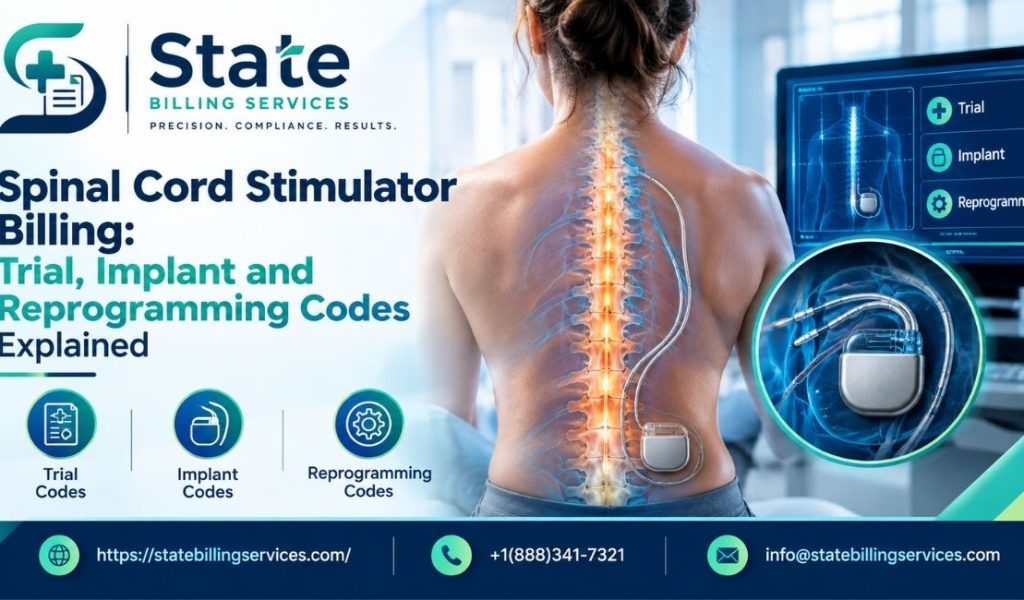
A spinal cord stimulator, also called an SCS system, delivers controlled electrical impulses through electrodes positioned near the spinal cord. These impulses change how pain signals are processed. The treatment may help selected patients with certain forms of persistent pain.
The device does not eliminate the need for careful clinical assessment. The provider must determine whether the patient is an appropriate candidate and whether the expected benefits justify the procedure.
From a billing perspective, the treatment may involve several separate encounters. The practice must identify which service occurred during each encounter and apply the relevant coding rules.
For example, a temporary trial may involve percutaneous electrode placement. A later operation may involve permanent electrodes and a pulse generator. A subsequent appointment may include device adjustments to improve stimulation.
These services should not be treated as one undifferentiated procedure.
Which Services May Appear on an SCS Claim?
Depending on the case, the billing record may involve:
- Physician evaluation and medical necessity documentation.
- Temporary or permanent electrode array placement.
- Implantation or replacement of a pulse generator.
- Device analysis and programming.
- Eligible facility and anesthesia services.
- Other separately reportable services that meet applicable coding and payer requirements.
Not every encounter includes all these services. Some charges may be included in a broader payment or subject to bundling rules. The billing team must check the current CPT instructions and the payer’s reimbursement policy before reporting each item separately.
Why SCS Claims Need Specialized Review
Spinal cord stimulation involves both procedural care and implanted technology. This creates several points where clinical documentation and billing information must remain consistent.
A procedure note may describe electrode placement, while the charge entry system contains a different procedure code. An authorization may cover the trial but not the permanent implant. A programming claim may be submitted without sufficient detail about the adjustments performed.
Each problem requires a different correction.
A reliable process therefore starts before the procedure. It continues through coding, claim submission, payment posting, and denial follow-up.
SCS CPT Codes and Their Billing Uses
CPT codes identify the professional services and procedures reported on medical claims. For spinal cord stimulation, the selected code depends on the procedure, surgical approach, and service documented in the record.
The following table summarizes several commonly relevant codes. It provides general orientation rather than a complete coding determination. Always verify the current CPT codebook and applicable payer instructions.
| CPT code | General description | Main billing consideration |
| 63650 | Percutaneous implantation of a neurostimulator electrode array | Often used for percutaneous SCS trial placement, and may apply to permanent placement when supported. |
| 63655 | Laminectomy for implantation of a neurostimulator electrode array | Requires documentation supporting the surgical approach described by the code. |
| 63661 | Removal of a spinal neurostimulator electrode array | Confirm the type of removal performed and the current code instructions. |
| 63663 | Revision, including replacement, of a spinal neurostimulator electrode array | Verify the specific revision or replacement service and applicable edits. |
| 63685 | Insertion or replacement of a spinal neurostimulator pulse generator or receiver | Report when the documented generator procedure meets the code definition. |
| 95970 | Electronic analysis of an implanted neurostimulator system without programming | The medical record must support the analysis service. |
| 95971 | Electronic analysis with simple programming | The documented programming must meet the applicable descriptor. |
| 95972 | Electronic analysis with complex programming | The record must support the level of programming reported. |
These codes do not cover every possible SCS service. Additional coding considerations may apply to related procedures, device components, and services performed during the same encounter.
CMS coverage articles can provide further guidance for Medicare claims. For example, the Medicare Coverage Database includes spinal cord stimulator billing guidance relevant to the applicable Medicare contractor. Confirm that the article and associated coverage policy apply to the claim being reviewed.
CPT 63650: Percutaneous Electrode Placement
CPT 63650 is a key code in neurostimulator trial billing. It describes percutaneous implantation of a neurostimulator electrode array.
In a typical trial, the physician places temporary electrodes through the skin and positions them in the epidural space. The system then delivers stimulation during the trial period. The clinical team evaluates whether the treatment provides meaningful pain relief or functional improvement.
However, CPT 63650 is not restricted to temporary trials. It may also apply to permanent percutaneous electrode placement when the documented procedure meets the code definition.
This distinction is important because the same code may be relevant to different stages of treatment. The billing team must review the actual procedure rather than assume that the code identifies the treatment stage by itself.
Before submitting a claim, confirm the following:
- The operative report supports percutaneous electrode array placement.
- The procedure performed matches the code descriptor.
- The number of units follows current coding instructions and payer rules.
- Any required modifier is supported by the circumstances of the service.
- The claim follows applicable bundling and place-of-service requirements.
Do not assume that the number of individual leads automatically determines the number of billable units. A lead, an electrode array, and an individual contact are not necessarily equivalent coding units.
If the operative report does not make the procedure clear, seek clarification before finalizing the claim.
CPT 63655: Laminectomy-Based Electrode Placement
CPT 63655 applies to laminectomy for implantation of a neurostimulator electrode array. It describes a different surgical approach from percutaneous electrode placement.
The physician uses a surgical approach to access the area needed for electrode placement. The documentation should describe the procedure performed and support the selected code.
A coder should not choose between 63650 and 63655 based only on a general reference to spinal cord stimulation. The operative details determine which code may apply.
Review the surgeon’s report for the approach used, the work performed, and the components implanted. Then compare those details with the current code definition.
The billing team should also check whether the selected facility and professional claim comply with the payer’s requirements.
CPT 63685: Pulse Generator Insertion or Replacement
A spinal cord stimulation system may include a pulse generator that powers the implanted electrodes. Depending on the system, the generator may be rechargeable or non-rechargeable.
CPT 63685 generally applies to insertion or replacement of a spinal neurostimulator pulse generator or receiver.
This code should be selected based on the documented procedure. The presence of a generator in the patient’s treatment plan does not, by itself, establish that the service was performed during a particular encounter.
For example, a permanent implantation procedure may involve percutaneous electrode placement and generator insertion. The coder must review the relevant code instructions and payer edits before reporting both services.
The record should identify the generator procedure and support the associated charges. Any separate device or supply reporting must also comply with the applicable reimbursement rules.
CPT 95971 and 95972: Device Programming
Device programming helps the clinical team adjust stimulation settings based on the patient’s needs and response to treatment.
CPT 95971 generally describes electronic analysis with simple programming. CPT 95972 generally describes electronic analysis with complex programming.
The choice depends on the actual service and the applicable code descriptor. It should not be based only on appointment length, device brand, or the number of symptoms discussed.
The record should describe the analysis performed, the reason for programming, the relevant adjustments, and the patient’s response when applicable.
A note that says only “SCS follow-up completed” may not support a separately billed programming service. The documentation should show what the clinician actually did.
The practice should also check payer-specific rules on frequency, medical necessity, and separate reimbursement. A programming service is not automatically payable simply because the patient has an implanted device.
The Spinal Cord Stimulator Trial-to-Permanent Billing Timeline
The SCS treatment pathway often moves through several stages. Each stage has a separate clinical purpose and may have different billing requirements.
The typical sequence includes an initial evaluation, coverage review, trial lead placement, trial outcome assessment, permanent implantation when appropriate, and later device management.
The exact sequence depends on the patient’s condition and the payer’s requirements.
Stage 1: Initial Assessment and Medical Necessity
The provider begins by reviewing the patient’s pain condition, prior treatment, functional limitations, and suitability for spinal cord stimulation.
The medical record should explain why the treatment is being considered. A diagnosis code alone may not establish that the patient meets the payer’s coverage criteria.
Relevant documentation may include the duration and impact of the pain, previous therapies, treatment outcomes, and the clinical rationale for considering SCS.
Some payers may require psychological screening or a multidisciplinary assessment. Other requirements may depend on the patient’s diagnosis and the applicable coverage policy.
The provider should address the criteria that apply to the case rather than rely on a generic statement that conservative treatment failed.
Stage 2: Coverage Verification and Prior Authorization
Before scheduling the trial, the administrative team should review the patient’s benefits and the payer’s requirements.
Commercial insurance plans may require prior authorization. Medicare coverage is governed by applicable Medicare rules and may involve national or local coverage requirements. The practice should not assume that every payer follows the same process.
The team should verify whether the planned procedure is covered, which documents are needed, and whether the selected location meets the payer’s requirements.
Authorization records should clearly identify the approved service and relevant details, such as the provider, facility, and date range, when specified by the payer.
Approval for a trial should not be interpreted as automatic approval for permanent implantation.
A structured prior authorization service can support the verification and tracking process. The practice must still confirm that the authorization matches the actual service.
Stage 3: Temporary Trial Lead Placement
The physician performs the trial procedure and documents the electrode placement.
CPT 63650 is commonly relevant when the service involves percutaneous implantation of a neurostimulator electrode array.
The medical record should support the procedure, the approach used, and the clinical reason for the trial. The claim should reflect the service performed rather than the procedure originally scheduled.
The billing team should also review applicable rules on units, trial frequency, and place of service.
For Medicare patients, the practice should check the current contractor policy for any restrictions on repeat trials or the number of covered trials. Do not rely on a limit taken from an outdated policy.
Stage 4: Trial Monitoring and Clinical Assessment
During the trial, the provider evaluates whether stimulation produces sufficient benefit to justify permanent implantation.
Pain scores may be useful, but the assessment should not be limited to a single number. The team may also review medication use, functional ability, sleep, and the patient’s experience during normal activities.
The provider should document the outcome and explain the recommendation for the next step.
Some Medicare contractor policies use a threshold of at least 50% pain relief or a reduction in analgesic medication, together with evidence of functional improvement. Requirements can vary, so the practice must check the applicable policy before relying on a particular threshold.
A clear trial assessment supports clinical decision-making and helps establish why permanent implantation may be appropriate.
Stage 5: Permanent Implantation
If the trial produces an acceptable outcome, the provider may recommend a permanent system.
The procedure may involve percutaneous electrode placement or laminectomy-based placement, along with pulse generator insertion when indicated.
The billing team must identify the procedures performed and select codes accordingly. It should not assume that every permanent implantation uses the same combination of codes.
Before the procedure, confirm any required authorization for permanent implantation. Check the approved service, provider, location, and date details.
The permanent implant record should support the actual procedure. If the planned approach changes, the coding and authorization requirements should be reviewed.
Stage 6: Follow-Up and Reprogramming
After implantation, the patient may need device analysis, adjustments, or further clinical assessment.
Some visits may involve routine postoperative care. Others may include a separately reportable programming service. The distinction depends on the actual work performed and the applicable billing rules.
The provider should document the purpose of the visit and any device-related services. If programming is performed, the note should support the selected code.
The billing team should then review the claim for coding accuracy, frequency restrictions, and any applicable payment edits.
A clear record helps the practice distinguish routine follow-up from a separately reportable service.
ASC vs. Office-Based Spinal Cord Stimulator Billing
The place where an SCS procedure takes place can affect billing and reimbursement. An ambulatory surgery center and a physician’s office operate under different facility and payment rules.
The physician’s professional claim must also be distinguished from the facility claim. Even when both claims relate to the same procedure, each billing entity must follow the rules that apply to its services.
Billing for Procedures in an Ambulatory Surgery Center
An ambulatory surgery center, or ASC, provides selected surgical services without an inpatient hospital admission. Some SCS procedures may be performed in this setting when the payer’s coverage and facility requirements are met.
The ASC may bill eligible facility services. The physician may submit a separate professional claim when permitted. Anesthesia services may also involve separate billing.
Before submitting claims, the team should confirm that the procedure is covered in the selected setting. It should also verify facility eligibility, coding requirements, and applicable payment rules.
The facility and professional claims should reflect their respective services. Charges must not be duplicated or separately reported when the applicable payment rules include them in another service.
Billing for Office-Based Procedures
Some payers allow SCS trials in a physician’s office under specified conditions.
The practice should verify whether the applicable policy permits the planned service in that setting. Requirements may address equipment, staff qualifications, infection control, patient monitoring, and arrangements for follow-up care.
An office-based trial is not automatically covered because the physician is qualified to perform it. The practice must meet the payer’s requirements.
Permanent implantation may have different setting restrictions. Some Medicare policies require particular procedures to be performed in a hospital or ASC. The exact rule depends on the applicable policy and procedure.
Example: Preventing a Place-of-Service Denial
Suppose a pain management practice schedules an SCS trial in its office. The physician documents the procedure correctly, and the coding team selects a code that matches the operative note.
However, the payer requires the procedure to be performed in an approved surgical setting.
The claim may still be denied because the place of service does not meet the payer’s requirements.
This example shows why coding accuracy alone is not enough. Staff should verify the location, coverage conditions, and authorization requirements before the procedure whenever possible.
SCS Prior Authorization: A Practical Checklist
Prior authorization can be a major source of delays in spinal cord stimulator billing. These procedures may involve implanted devices, surgical resources, and several stages of treatment. Payers may request detailed clinical evidence before approving coverage.
The required documents vary by plan and procedure. A consistent review process helps staff identify missing information early.
Prepare the Clinical Documentation
The authorization request should address the payer’s criteria. Depending on the case, the required records may include:
- The diagnosis and history of the pain condition.
- Previous treatments and the patient’s response.
- The clinical reason for requesting spinal cord stimulation.
- Psychological screening or multidisciplinary assessment, when required.
- Relevant imaging or procedure information.
- The proposed procedure and treatment setting.
- Supporting clinical notes requested by the payer.
The objective is to show why the requested service meets the applicable criteria. Sending a large collection of records without addressing those criteria may create additional review work.
Check the Approved Service
The authorization must be reviewed against the actual procedure.
Confirm the approved service, provider, facility, and dates when those details are included in the authorization. Determine whether the approval covers the trial, the permanent implant, or another specific service.
If the treatment plan changes, staff should contact the payer when needed to determine whether the authorization must be updated.
Track Pending Requests and Decisions
A request that remains pending can delay scheduling. An approval that expires before the procedure can create another problem.
Maintain a record of the submission date, reference number, requested documents, payer response, and authorization period. Assign responsibility for following up on unresolved requests.
The same information should be available to the scheduling, clinical, and billing teams.
For additional guidance, review common prior authorization mistakes. The principles of accurate documentation and approval tracking are relevant to SCS cases, although the specific clinical requirements differ by procedure.
Neurostimulator Implant Reimbursement: What Determines Payment?
The amount a practice receives for an SCS procedure depends on more than the CPT code.
Payment may depend on the payer’s coverage policy, the patient’s benefits, the provider’s contract, the place of service, and the services reported. Device costs and facility payment rules may also affect the financial result.
A correctly coded claim can still be denied if a coverage requirement is not satisfied.
Professional and Facility Payment
Professional and facility services may be reimbursed separately. The physician’s claim represents eligible professional work. The facility’s claim represents services covered under its own billing and payment rules.
Payment methodologies can differ between Medicare and commercial insurers. Commercial plans may also have contracted rates that vary by facility, provider, and procedure.
Practices should therefore avoid relying on one standard reimbursement estimate for every SCS case.
Instead, verify the applicable fee schedule or contract terms and determine how the payer processes the service in the relevant setting.
Device and Supply Charges
A spinal cord stimulation system may contain electrodes, a pulse generator, and other components. The exact configuration depends on the device selected.
However, the presence of several components does not mean each component can be billed separately. Some costs may be included in a facility payment or subject to specific reporting instructions.
The billing team should review the payer’s policy before reporting device-related supplies as separate charges.
The record should also support the items reported. Manufacturer documentation may help identify the system, but it does not replace official coding and payment rules.
Medicare and Commercial Insurance Differences
Medicare coverage may depend on national coverage requirements, local coverage determinations, and associated billing articles. Commercial insurers may apply separate medical policies and authorization procedures.
These differences can affect trial eligibility, documentation, place of service, programming frequency, and reimbursement.
A practice should maintain payer-specific guidance and review it when policies change. Staff should not assume that a rule used for one insurer applies to all other plans.
How Medtronic, Abbott, and Boston Scientific Fit Into SCS Billing
Manufacturers such as Medtronic, Abbott, and Boston Scientific provide spinal cord stimulation technologies used in pain management.
Their systems may differ in lead design, generator features, stimulation options, and programming interfaces.
These differences matter to clinical care and device documentation. They do not independently determine which CPT code should be reported.
Document the Device and the Service
The medical record should identify the implanted system when relevant and document the components used during the procedure.
For a programming visit, the note should describe the work performed. It should explain the reason for the analysis or adjustments and support the reported level of programming.
A system with advanced features does not automatically justify CPT 95972. The provider must perform and document a service that meets the code descriptor.
Likewise, the use of a particular manufacturer does not guarantee insurance coverage. Medical necessity, authorization, documentation, and payer rules remain central to reimbursement.
Review New Technologies Before Changing Coding Practices
When a practice begins using a new device or programming method, staff should review the associated documentation and billing workflow.
Manufacturer materials can help explain device functions. Current CPT guidance and payer policies must still determine how the services are reported.
Avoid building billing rules around brand names alone. The procedure performed and the service documented should remain the starting point.
Common Spinal Cord Stimulator Billing Errors
SCS claims can encounter problems at several points in the revenue cycle. Some errors involve code selection. Others arise from missing documentation, authorization gaps, or incorrect claim details.
The following issues deserve particular attention.
1. Selecting the Wrong Electrode Placement Code
CPT 63650 and CPT 63655 describe different approaches to electrode placement.
Choosing a code based only on a general reference to SCS can result in an inaccurate claim.
Prevention: Review the operative report and identify the approach used. Match the documented procedure to the current code descriptor.
2. Treating Trial and Permanent Implantation as the Same Service
The trial assesses whether stimulation provides an acceptable clinical benefit. Permanent implantation is a separate treatment stage.
The documentation and authorization requirements may differ.
Prevention: Maintain separate records for the trial, trial outcome, permanent implant approval, and implantation procedure. Confirm the requirements that apply to each stage.
3. Submitting Claims Without Sufficient Medical Necessity Evidence
A diagnosis alone may not show that the patient qualifies for the procedure under the payer’s policy.
The record may need to address previous treatments, clinical findings, trial outcomes, or other criteria.
Prevention: Review the applicable coverage policy and confirm that the documentation addresses its requirements before claim submission.
4. Reporting Programming Without Supporting Notes
A routine device check does not automatically support a separately billed programming code.
The note must show what the provider did and support the selected level of service.
Prevention: Document the analysis performed, the reason for programming, the relevant adjustments, and the patient’s response when applicable.
5. Reporting Incorrect Units or Modifiers
Electrode arrays, leads, and individual contacts can create confusion. Payers may also apply specific unit limits, modifiers, and code edits.
Prevention: Check the current CPT instructions and applicable payer guidance. Do not copy unit or modifier patterns from another claim without confirming that they apply.
6. Using Incorrect Place-of-Service Information
A claim may fail when the reported location does not match the actual service or does not meet payer requirements.
Prevention: Verify the place of service before submission. Review the requirements for professional and facility claims separately.
7. Failing to Investigate Repeated Denials
Correcting one claim may not solve a recurring problem.
Repeated denials can indicate that staff are missing the same authorization detail, using an incorrect code, or submitting incomplete notes.
Prevention: Group denials by reason and identify the underlying cause. A structured denial management process can help the practice review rejected claims, prepare appropriate appeals, and prevent repeated errors.
A Step-by-Step SCS Billing Workflow
A clear workflow helps the clinical, administrative, and billing teams share accurate information. It also makes it easier to identify errors before they affect reimbursement.
Before the Procedure
Start with insurance verification and coverage review. Confirm the patient’s benefits and determine whether prior authorization is required.
Check that the clinical record supports the planned service. If the payer requires previous treatment records, psychological assessment, or other supporting documents, confirm that they are available.
The scheduling team should verify the planned procedure and location. Any unresolved authorization or coverage issue should be addressed before the procedure whenever possible.
On the Procedure Date
The provider should document the work performed and the approach used. The operative note should reflect the actual procedure, including relevant electrode and generator details.
If the procedure differs from the original plan, the clinical and billing teams should review the change. They should determine whether the authorization or coding process needs to be updated.
The facility should also capture its charges according to the rules that apply to its claim.
During Coding and Charge Review
The coder should compare the operative report with the proposed CPT codes.
Review the electrode placement method, generator insertion or replacement, and any separately reported programming services. Confirm the units, modifiers, and code combinations under current guidelines.
Do not assign codes based only on the scheduled procedure. The final code selection must reflect the service documented in the medical record.
Before Submitting the Claim
Complete a claim review before transmission. Check patient details, provider information, date of service, diagnosis codes, procedure codes, authorization details, and place-of-service information.
Review potential duplicate charges and applicable bundling edits. Confirm that the record supports each service being reported.
Automated claim edits can identify some errors. They cannot replace a review of medical necessity, operative documentation, or payer-specific coverage rules.
After Submission
Monitor the claim until the payer issues a final decision. Review claim acknowledgments, status updates, remittance advice, and any denial notices.
If the payment differs from the expected amount, compare it with the applicable contract or fee schedule. Determine whether the adjustment is correct or requires follow-up.
When a claim is denied, identify the reason before taking action. A corrected claim may be appropriate for a billing error. An appeal may be necessary when the practice disputes a coverage or payment decision. Follow the payer’s instructions and filing deadlines.
Track recurring issues so the practice can improve its workflow rather than repeatedly correcting individual claims.
How to Audit SCS Claims for Better Billing Accuracy
A focused audit helps a pain management practice identify errors that might otherwise remain hidden.
The review should include a sample of trial claims, permanent implantation claims, generator procedures, and programming visits. Compare each claim with the medical record, authorization information, payer response, and final payment.
Review CPT Code Accuracy
Check whether the codes match the procedures performed.
Pay particular attention to the distinction between percutaneous and laminectomy-based electrode placement. Review generator procedures and programming services separately.
Confirm that units and modifiers follow the applicable instructions. Investigate any code combinations that may be affected by bundling edits.
Review Authorization and Coverage
Compare the authorized service with the procedure that actually occurred.
Confirm that the authorization applies to the correct procedure and other relevant details. For Medicare claims, identify the coverage guidance that applies to the service and location.
If a policy has changed, update the practice’s internal billing guidance. Avoid relying on an outdated policy document or an old authorization checklist.
Analyze Denials and Payment Differences
Denial patterns can reveal problems in the billing process.
For example, repeated authorization denials may indicate that staff are not checking approval details before scheduling. Frequent programming denials may point to incomplete notes. Place-of-service denials may indicate that the team needs clearer setting-specific procedures.
Useful measures include:
- First-pass claim acceptance rate.
- Denial rate by payer and SCS service.
- Number of claims requiring correction.
- Average time from submission to payment.
- Outstanding accounts receivable by age.
- Underpayments identified during payment review.
These measures should be evaluated in context. A single percentage does not explain why a problem occurs.
Correct the Underlying Problem
Audit findings should lead to specific changes.
If authorization errors recur, revise the pre-procedure checklist. If operative notes do not clearly describe the approach, work with the clinical team to improve documentation. If programming claims lack sufficient detail, provide focused documentation guidance.
After implementing changes, review new claims to see whether the errors have decreased.
This process helps the practice maintain consistent billing standards and reduces the need for repeated claim corrections.
Improve Accuracy Across Every Stage of SCS Billing
Spinal cord stimulator billing requires a consistent process from the initial evaluation through permanent implantation and follow-up care.
The most important step is to match every claim to the service performed. CPT 63650 may apply to percutaneous electrode placement, CPT 63655 describes laminectomy-based electrode placement, and CPT 63685 generally applies to pulse generator insertion or replacement. CPT 95971 and 95972 address device analysis with simple or complex programming, respectively, when the documented service meets the applicable code definition.
Practices should also treat the trial and permanent implant as separate stages. Each requires appropriate documentation and review of the applicable coverage and authorization requirements.
To strengthen billing accuracy, pain management teams should focus on four priorities:
- Verify coverage, benefits, and authorization before scheduling.
- Match procedure codes to the operative report and current coding guidance.
- Check documentation, place of service, modifiers, and payer edits before submission.
- Monitor denials and payment differences, then correct recurring problems.
A structured process helps staff identify errors earlier and maintain better control over the revenue cycle.
For additional guidance on preventing claim errors, review this resource on medical claims scrubbing. You can also refer to the eBridge RCM for related billing and revenue cycle resources.
Need help with complex pain management claims? States Billing Services SC supports medical billing, coding review, prior authorization, and denial management workflows. Visit States Billing Services to discuss your practice’s billing needs and improve the consistency of your SCS claims process.
Disclaimer: This article provides general educational information. CPT descriptors, Medicare coverage policies, commercial payer requirements, and reimbursement rules may change. Verify the current official guidance and payer policy before submitting claims. Coding decisions must reflect the documented service and applicable billing requirements.