
A patient arrives for a routine follow up. They have been seen a dozen times before. Nothing seems different, so the front desk waves them through without checking coverage again.
Three weeks later, the claim comes back denied. The patient’s employer switched insurance carriers at the start of the month. Nobody caught it, because the front desk assumed a returning patient meant unchanged coverage. Now the billing team is chasing payment from a patient who thought everything was handled.
This scenario plays out constantly in practices across South Carolina and beyond. It rarely comes from carelessness. It comes from treating insurance verification as a one time task instead of a routine part of patient care. Coverage changes more often than most front office teams expect.
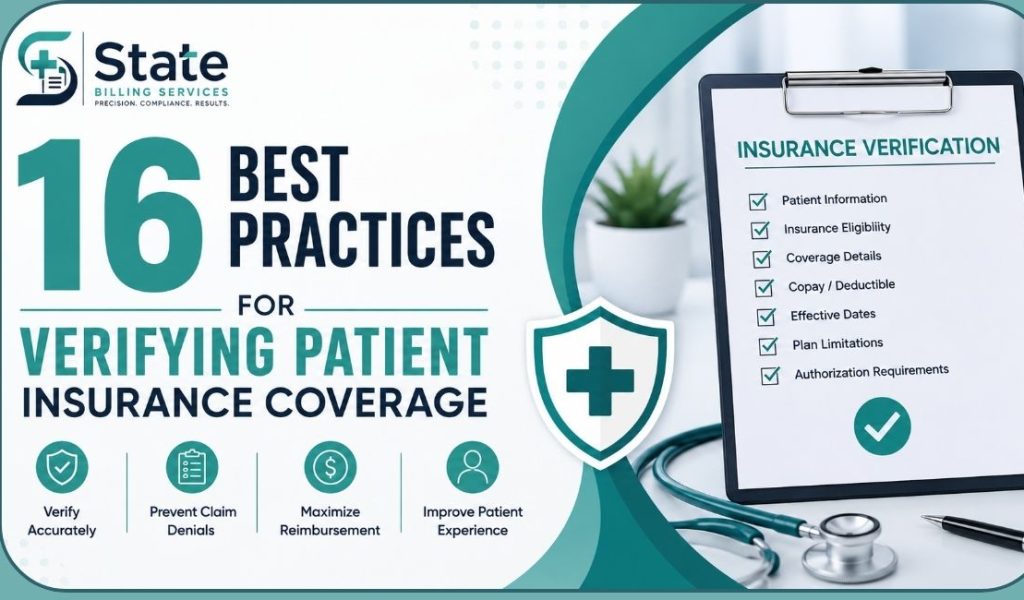
This article covers 16 best practices for verifying patient insurance coverage. It explains what to check, when to check it, and how to build a process that catches problems before they become denied claims or surprise patient bills.
Why Insurance Verification Deserves More Attention
Verification often gets treated as a quick administrative step. In reality, it is one of the most effective prevention points in the entire revenue cycle.
Most billing problems trace back to a coverage detail that changed, or one that was never confirmed accurately. A strong verification process protects the practice financially. It also protects the patient experience, since patients who understand their coverage before a visit are less likely to feel blindsided later.
A few reasons verification matters more than it gets credit for:
- It catches coverage changes before a claim is ever submitted
- It reduces staff time spent reworking denied claims
- It sets clear financial expectations for patients upfront
- It protects revenue that would otherwise be written off or delayed
Best Practices Before the Appointment
1. Verify Coverage for Every Visit
Do not skip verification just because a patient is familiar. Insurance changes happen through new jobs, open enrollment, or life events. Checking every visit, every time, closes this gap.
Some practices build this step directly into check in software. Others use a simple manual prompt on the scheduling screen. Either way, the goal is the same: no visit should proceed on an assumption.
2. Confirm Eligibility Close to the Appointment Date
A check done a week or two out can go stale fast. Confirm eligibility within 24 to 48 hours of the visit when possible. Many practices build this into a reminder call or an automated system check the day before.
This timing window matters most for patients with employer sponsored plans, since coverage can shift right at the start of a new month. A check done too early misses these changes entirely.
3. Check Both Primary and Secondary Payers
When a patient has more than one plan, coordination of benefits matters as much as basic eligibility. Confirm which plan is primary and which is secondary. This prevents claims from going to the wrong payer first, a common and avoidable denial cause.
Patients themselves are not always aware of which plan is primary. Confirming this directly with the payer, rather than asking the patient to guess, avoids a costly assumption.
4. Confirm Plan Type and Network Status
Not every plan under the same carrier name works the same way. Two patients with the same insurance company can have very different coverage rules. Some things to confirm here:
- Whether the plan is an HMO, PPO, or another structure
- Whether a referral is required before a specialist visit
- Whether the provider is actually in network for that specific plan
Skipping this step often leads to a claim that processes correctly on paper but pays at an unexpected, lower rate once the network status becomes clear.
5. Verify Coverage for the Specific Service Scheduled
General eligibility confirms active insurance. It does not confirm that a specific service is covered. Check coverage at the service level, not just the plan level, to catch exclusions or limits early.
This matters most for services that plans frequently limit or exclude, such as certain imaging studies, specialty procedures, or elective services. A quick service level check prevents a denial that a general eligibility check would have missed entirely.
6. Check Prior Authorization Requirements at the Same Time
Verification and authorization go hand in hand. Many services that need authorization only become obvious once a plan is reviewed closely. Building this check into the same workflow avoids confirming active insurance while missing a separate approval requirement. Reviewing common prior authorization mistakes alongside a verification checklist helps staff see how closely these two processes need to work together.
Treating these as two separate, disconnected tasks often means one gets done well while the other gets rushed. Combining them into a single step keeps both consistent.
Best Practices During Check In
7. Confirm Costs Upfront
Confirm copay, deductible status, and coinsurance before the visit. This lets front desk staff collect the right amount at time of service instead of discovering a balance weeks later.
Patients tend to respond well to this kind of transparency, even when the news is a higher balance than expected. What frustrates patients most is not the cost itself, but being surprised by it after the fact.
8. Document Verification Details Clearly
Record the date checked, the tool or representative used, and any reference number. Note specific limitations or authorization requirements. Clear documentation protects the practice if a payer later disputes what was confirmed.
Without this record, a practice has little recourse if a payer claims verification never happened, even when staff know it did.
9. Communicate Coverage Details to the Patient
Tell patients what to expect financially before they arrive, not at checkout. A short pre visit message summarizing expected costs builds trust and reduces confusion.
This step also reduces awkward conversations at checkout, where staff and patients both feel rushed and a billing surprise is harder to explain calmly.
10. Use Real Time Eligibility Tools
Manual phone calls still matter for complex questions. But real time eligibility tools built into most practice management systems handle routine checks faster and with fewer errors.
Watch for these signs a practice needs to lean on these tools more:
- Staff spending long stretches on hold with payers for routine checks
- Frequent gaps between what a phone rep said and what the claim later shows
- Patient volume high enough that manual checks are hard to sustain
Investing time in learning a portal’s full feature set often pays off, since many tools return more detail than staff realize if they only check the basic status line.
Building a Sustainable Verification Process
11. Train Staff to Read Full Verification Responses
Eligibility responses often include more than an active or inactive status. They may list exclusions or authorization notes buried further down. Staff trained to read past the headline status catch more problems.
A quick glance is often not enough. Building in a habit of scrolling through the full response, every time, catches details that a rushed check would miss.
12. Re-verify Coverage for Recurring Patients
Patients in ongoing treatment, such as physical therapy, sometimes go months without a fresh check. Build in periodic re-verification even for familiar, regular patients.
A simple rule, such as re-verifying every 30 or 60 days for long term patients, keeps this from being forgotten during a busy schedule.
13. Watch for Seasonal Coverage Risk
Certain times of year carry higher risk of coverage changes:
- The start of a new calendar year
- Open enrollment periods
- Medicaid redetermination cycles
Increasing verification vigilance during these windows catches more changes before they hit a claim. Some practices flag their entire patient panel for a quick re-check during these specific periods rather than waiting for individual appointments to trigger it.
14. Confirm Referral Requirements for Specialists
Some plans require a referral from a primary care provider before covering a specialist visit. Confirm the referral is on file, not just that the insurance itself is active.
This step often gets missed when a patient self schedules through an online portal, since the referral requirement is not always obvious from the scheduling screen itself.
15. Build a Standardized Checklist
Consistency matters more than individual skill. A written checklist, followed in the same order every time, reduces the chance a step gets skipped during a busy day. It also speeds up training for new front desk staff.
A checklist works best when it lives somewhere staff actually see it during the workflow, not buried in a manual nobody opens after the first week.
16. Track Verification Related Denials
Even a strong process will miss something occasionally. Track which denials trace back to verification specifically. Reviewing healthcare claim denial reasons with an eye on eligibility issues shows where the current process needs reinforcement.
Over time, this tracking often reveals a specific payer, service type, or staff shift where errors cluster, giving the practice a clear place to focus improvement efforts.
What Poor Verification Actually Costs a Practice
It helps to see the numbers behind this, not just the frustration. Consider a practice seeing 100 patients a week. If even 5 percent run into a coverage issue that a thorough check would have caught, that is five problem claims every week, or roughly 250 a year.
Each one of those claims takes staff time to investigate, correct, and resubmit. Depending on the complexity, that can run anywhere from 15 minutes to well over an hour per claim. Multiply that across hundreds of claims a year, and the labor cost alone becomes significant, even before counting the revenue that gets delayed or written off entirely.
There is also a slower, harder to measure cost. Patients who get surprised by an unexpected bill often become more hesitant about scheduling future visits, or they shop around for a different provider next time. A verification process that protects patients from these surprises protects the practice’s reputation just as much as its cash flow.
A few common signs a practice is absorbing this hidden cost include:
- Billing staff spending more time on rework than on new claims
- A steady stream of patient complaints about unexpected balances
- Front desk staff unsure which checks are actually required for which payers
Why Consistency Beats Individual Effort
It is tempting to solve verification problems by asking staff to simply be more careful. In practice, this rarely holds up over time. Busy days, short staffing, and competing priorities all chip away at even the most careful individual’s attention.
A process built around consistent steps, rather than individual vigilance, holds up better under pressure. This is part of why a written checklist, paired with clear timing rules, tends to outperform good intentions alone. The goal is a system that works the same way on a slow Tuesday and a chaotic Monday morning.
| Verification Step | When to Complete | Why It Matters |
| Confirm active coverage | 24 to 48 hours before visit | Catches recent plan changes |
| Check coordination of benefits | Before scheduling, for multi plan patients | Prevents wrong payer order |
| Verify service specific coverage | Before scheduling | Confirms the planned service is included |
| Confirm authorization needs | Same time as eligibility check | Avoids missed approval requirements |
| Document verification details | At time of check | Protects against later disputes |
A Closer Look at a Common Verification Gap
Consider an internal medicine practice with a steady mix of new and returning patients. For years, staff verified new patients thoroughly but only glanced at insurance cards for anyone already in the system.
This worked until a batch of Medicaid redeterminations went through during a routine annual review cycle. Several long standing patients lost coverage without realizing it themselves. The practice kept seeing these patients as scheduled, since nothing looked unusual, and claims went out assuming coverage was still active.
Weeks later, a wave of denials came back citing inactive coverage. The billing team had to sort through which visits were affected, contact each patient, and either rebill under a new payer or arrange a payment plan. The financial hit mattered, but the bigger cost was staff time spent untangling a problem routine verification would have caught upfront.
Medicaid managed care plans go through periodic redetermination cycles that can shift coverage with little notice to the practice. A process that assumes stability for existing patients is more exposed to this kind of disruption than one that checks consistently.
How Verification Needs Differ Across Specialties
Verification priorities shift depending on the type of care.
Radiology practices need to confirm coverage for specific imaging studies. Many payers only cover certain scans under particular clinical circumstances.
Cardiology practices often see patients with multiple ongoing tests. Periodic re-verification matters given how coverage can shift between visits scheduled months apart.
Orthopedic practices frequently manage prior authorizations for surgeries, imaging, durable medical equipment (DME), and physical therapy. They also need to verify plan-specific benefit limits, not just active insurance coverage, since coverage caps can vary by payer. Because of these complexities, many providers rely on Orthopedic billing SC specialists to help track authorization requirements, reduce claim denials, and improve reimbursement accuracy.
Mental health practices deal with visit limits and authorization renewal cycles more than most specialties. Tracking session counts alongside coverage windows becomes a core part of their workflow.
Internal medicine practices coordinate a wide range of services, from lab work and diagnostic testing to specialist referrals. Because they manage such a diverse patient population, a standardized prior authorization checklist helps ensure coverage requirements are verified before services are provided. Many practices also rely on Internal medicine RCM SC solutions to streamline authorization tracking, reduce administrative workload, and improve claim accuracy across a broad range of services.
Urgent care practices face a unique challenge, since patients often arrive without any advance scheduling at all. Verification here has to happen quickly, sometimes within minutes, which makes fast, reliable eligibility tools especially important compared to specialties with more predictable, scheduled visits.
The Role of Technology and Clearinghouses
Practice management systems and clearinghouses have made real time eligibility checks far faster than they were a few years ago. Most systems return a coverage status within seconds, compared to the minutes or longer a phone call to a payer can take.
That speed matters most during busy check in periods. But automated tools are not perfect. A few limits worth knowing:
- Some payers return incomplete benefit details through automated checks
- Service level coverage and authorization requirements sometimes still need a phone call or portal login
- Staff who rely only on automated tools can end up with false confidence about coverage that turns out incomplete
Clearinghouses also flag issues during claims submission, cross referencing coverage details on file against what the claim actually shows. Combining upfront verification with this secondary check catches more problems than relying on either step alone.
The Role of Staff Training in Verification Accuracy
Good tools still depend on staff who know how to use them well. Training should cover:
- How to run a basic eligibility check correctly
- How to interpret the details that come back, not just the status line
- How to document findings consistently
- How to explain coverage information to patients clearly
Payer systems and portal interfaces change periodically. Staff who learned a process a year ago may not know about recent updates. Periodic refresher training, even brief, keeps the whole front office aligned.
Cross training matters too, especially in smaller practices where one or two people handle all insurance checks. If that person is out during a busy stretch, verification quality often drops until they return. Training a second team member on the full workflow protects against this kind of single point of failure.
A short written guide, even a single page, helps this cross training stick. New staff and backup staff alike benefit from having something concrete to reference rather than relying purely on verbal instructions passed along during a quick shift handoff.
When Verification Gaps Point to a Bigger Process Problem
Recurring coverage related denials despite reasonable staff effort often point to something structural, not individual error. This could mean:
- The workflow lacks a clear, standardized checklist
- The tools in use are outdated or hard to interpret
- Staffing levels make thorough verification difficult during high volume periods
Recognizing this distinction matters. A structural gap needs a different fix than simply reminding staff to be more careful. Practices facing consistent challenges sometimes benefit from comparing their approach against broader eligibility verification practices used across the industry, since an outside view often reveals blind spots that are hard to see from inside daily operations.
Bringing in a fresh set of eyes, even briefly, often uncovers small workflow gaps that staff have grown used to working around rather than fixing directly.
Practical Next Steps for Strengthening Verification
Improving verification does not require a full system overhaul. A good starting point:
- Review the last few months of denied claims tied to eligibility issues
- Build or refine a standardized checklist based on what those denials reveal
- Reinforce staff training on reading full verification responses
- Set clear timing standards for when checks should happen
Consistency is the real differentiator. Practices that rarely see coverage related denials run the same process every time, regardless of who is at the front desk that day. Practices that struggle tend to rely on memory or assumptions about returning patients instead.
If your practice is dealing with frequent coverage related denials or an inconsistent front desk workflow, working with an experienced partner can help build a more reliable process. States Billing Services SC supports practices with insurance verification, denial management, and broader revenue cycle oversight, helping reduce the back and forth that comes from coverage issues caught too late.