A denied claim sits in a queue for three weeks. A biller reworks it, resubmits it, and waits again. Meanwhile, the practice is still waiting to get paid for care it already delivered. This cycle repeats thousands of times a day across clinics and hospitals in the United States.
This is the reality of medical billing without automation. Manual entry, repetitive checks, and slow follow up drain time and money from practices that are already stretched thin. Staff spend hours on tasks that do not require human judgment, while the tasks that do need attention, like appeals and patient communication, get pushed aside.
AI in medical billing is changing that pattern. Artificial intelligence is not replacing billing teams. It is removing the repetitive work that slows them down, so claims move faster and revenue becomes more predictable.
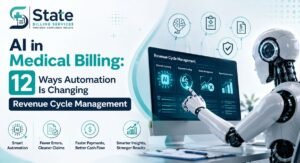
This article walks through 12 practical ways AI is reshaping revenue cycle management today, with real scenarios showing how each application works in daily practice.
Why Medical Billing Needs Automation Now
Billing has always involved repetitive, rules-based work: entering codes, checking eligibility, matching payments, tracking denials. These are exactly the kinds of tasks that automation handles well.
At the same time, payer rules keep changing. CMS updates guidelines. Commercial payers adjust their own requirements. Keeping up manually means constant retraining and a higher chance of error.
A few pressures are pushing practices toward AI-driven revenue cycle technology:
- Staffing shortages in billing and coding roles
- Rising claim denial rates across specialties
- Payer requirements that shift faster than manual processes can track
- Patients expecting clear, simple billing communication
Automated claims processing and billing automation address these pressures directly. They do not eliminate the need for skilled billing staff. They give that staff better tools, so their time goes toward decisions that actually need human review.
1. AI-Assisted Medical Coding
Medical coding requires matching clinical documentation to the correct CPT, ICD-10, and HCPCS codes. This step is detailed and easy to get wrong, especially with complex visits or evolving code sets.
AI-assisted coding tools scan clinical notes and suggest codes based on the documented diagnosis and procedures. A coder reviews the suggestion instead of building the code from scratch. This cuts research time and reduces the chance of missed or mismatched codes.
For example, a cardiology practice handling a mix of diagnostic and procedural visits can use AI coding support to flag codes that commonly get bundled incorrectly. The coder still makes the final call, but the tool narrows the options and highlights risk areas before submission.
This is especially useful in specialty settings. Practices offering cardiology billing services in SC often deal with codes that carry stricter documentation requirements, so early flagging matters.
There is also a training benefit that gets overlooked. New coders learn faster when they can see why a system suggested a specific code, along with the supporting note language it pulled from. Over time, this shortens the ramp-up period for staff who are still building specialty-specific coding knowledge, since the tool acts as a second reference point rather than leaving them to work from memory or a manual alone.
It is worth noting that AI coding suggestions are only as reliable as the documentation behind them. If a provider’s notes are vague or incomplete, the tool has less to work with, and the suggestion quality drops. This is one reason coding automation tends to work best alongside a clear documentation standard, not as a replacement for one.
2. Automated Claims Scrubbing and Submission
Before a claim reaches a payer, it needs to pass basic accuracy checks: correct patient information, valid codes, matching modifiers, and proper formatting. This process is called claims scrubbing.
AI-based scrubbing tools check claims against payer-specific rules automatically. They catch missing fields, invalid code pairings, and formatting errors before submission, not after a rejection notice arrives.
This directly supports clean claim submission, which means fewer claims bounce back for correction. A clean first-pass rate has a direct effect on how quickly a practice gets paid.
Automated claims processing also speeds up the physical act of submission. Instead of manually uploading batches, the system submits claims on a set schedule or as soon as they pass validation.
Consider a multi-provider orthopedic group submitting a mix of surgical and evaluation claims each week. Without scrubbing, a modifier mismatch might not surface until a payer rejects the claim days later. With AI scrubbing in place, that same mismatch gets caught within seconds of the claim being generated, well before it ever leaves the practice’s system. This kind of early catch matters more in orthopedic RCM in SC, where bundled procedures and modifier rules are common sources of rejection.
The time saved compounds. A biller who used to spend an hour manually checking a batch of thirty claims can instead review a short list of flagged exceptions, usually just two or three claims that genuinely need a second look.
3. Real-Time Eligibility and Benefits Verification
Verifying a patient’s insurance eligibility used to mean a phone call or a manual portal check for every visit. AI-driven eligibility tools now pull this information in real time, often before the patient even checks in.
This reduces two common problems: claims submitted for inactive coverage, and patients surprised by costs they did not expect. When front desk staff know coverage details ahead of time, they can explain out-of-pocket costs clearly during check-in instead of after the visit.
Practices that rely on high patient volume, such as urgent care settings, benefit the most from this kind of speed. Real-time checks matter for urgent care billing, where patients often arrive without appointments and staff need answers within minutes.
Verification automation also reduces a specific type of denial that is entirely preventable: claims submitted for coverage that had already lapsed or changed before the visit. These denials are frustrating because they have nothing to do with clinical accuracy. They happen simply because eligibility was not checked, or was checked too far in advance to still be accurate. Building eligibility verification into the front-end workflow, supported by automation, closes this gap before a claim is ever generated.
A useful habit for front desk teams is treating eligibility checks as a same-day task rather than something done a week ahead. AI tools make this realistic, since the check takes seconds instead of the minutes a manual portal lookup or phone call would require.
4. Prior Authorization Automation
Prior authorization is one of the most time-consuming parts of the billing process. Staff have to confirm which services require approval, submit documentation, and follow up until a decision comes back.
AI tools now flag which procedures need prior authorization based on payer rules tied to the specific CPT code and plan type. Some systems can also pre-fill authorization requests using data already stored in the EHR, cutting down on manual data entry.
This does not remove the approval step, since payers still make the final decision. But it removes the guesswork about which services need authorization and reduces delays caused by incomplete submissions.
Radiology practices see a heavy authorization burden because so many imaging services require pre-approval. Automation here has a measurable effect on how quickly services get scheduled and billed, which is part of why radiology RCM services increasingly include this kind of workflow support.
Mental health practices face a similar authorization burden, though for different reasons. Many behavioral health plans require ongoing authorization renewals for extended treatment courses, not just a single approval at intake. AI tools that track renewal deadlines and flag them ahead of time prevent a common problem: a patient’s care continuing past their approved session count without anyone noticing until a claim gets denied. This kind of proactive tracking is a meaningful part of mental health billing in South Carolina, where treatment plans often extend over months.
Common prior authorization mistakes, like submitting incomplete clinical justification or missing a renewal window, are avoidable with the right tracking system in place, whether that system is automated or built around a strict manual checklist.
5. Predictive Denial Management
Denial management has traditionally been reactive. A claim gets denied, staff research the reason, then rework and resubmit it. This costs time and delays payment.
Predictive AI models flip this sequence. They analyze historical claims data to identify patterns that typically lead to denials, such as certain code combinations, missing documentation types, or payer-specific quirks. The system flags high-risk claims before submission, not after rejection.
This shifts denial management from correction to prevention. It also helps billing teams prioritize their time, since not every denial carries the same financial weight.
| Denial Management Approach | Typical Timeline | Staff Involvement |
| Manual review after denial | Days to weeks | High, reactive |
| AI-flagged pre-submission review | Minutes to hours | Lower, targeted |
Reducing denials at the source protects both revenue and staff time. Practices working through recurring denial issues can review common patterns in medical claim denial reasons to understand where AI flagging typically has the biggest impact.
6. AI-Driven Payment Posting
Payment posting involves matching incoming payments, whether from insurance or patients, to the correct claims and accounts. Done manually, this is slow and prone to mismatched entries, especially with high claim volume.
AI tools automate this matching using remittance data. They read electronic remittance advice (ERA) files, match payments to open claims, and flag discrepancies like underpayments or unexpected adjustments for human review.
This keeps accounts receivable accurate in near real time, instead of staff discovering posting errors weeks later during reconciliation.
7. Revenue Forecasting and Analytics
One of the more overlooked applications of AI in healthcare billing is forecasting. RCM platforms with built-in analytics can project expected revenue based on claims in the pipeline, historical payment timelines, and payer trends.
This gives practice administrators a clearer view of cash flow instead of relying on guesswork. If a payer typically takes 45 days to pay a certain claim type, the system factors that into projections rather than treating every claim the same.
Forecasting also helps identify healthcare revenue leakage, meaning revenue that should have been collected but was lost due to underbilling, missed charges, or uncollected patient balances. Spotting these gaps early lets practices correct the underlying workflow instead of losing the same revenue repeatedly.
Practices tracking performance closely often pair this kind of forecasting with structured medical billing KPIs to measure whether automation is actually improving collection speed over time.
8. Natural Language Processing for Clinical Documentation
Natural language processing (NLP) allows AI systems to read unstructured clinical notes and extract relevant billing information. This matters because a large amount of clinical documentation is written in free text, not structured fields.
NLP tools can identify diagnoses, procedures, and severity indicators directly from provider notes, then suggest supporting codes. This is particularly useful in specialties where documentation style varies widely between providers, such as internal medicine.
For practices managing broad patient panels, this kind of support fits naturally into internal medicine RCM workflows, where visit complexity and documentation volume are both high.
9. Automated Patient Billing and Communication
Patient billing has become more complex as high-deductible health plans shift more cost onto patients directly. AI tools now help generate clear, itemized statements and can even predict which patients are likely to need payment plans based on account history.
Some systems use automated messaging to answer common patient billing questions, such as balance explanations or payment due dates, before a phone call is even needed. This reduces the volume of routine calls billing staff have to handle manually.
Clearer communication also reduces disputes. When patients understand their bill the first time, fewer accounts end up stuck in collections or repeated correction cycles.
10. Fraud Detection and Compliance Monitoring
AI models are effective at spotting patterns that suggest billing errors or, in rarer cases, fraud. This includes unusual code frequency, mismatched provider and service patterns, or billing volume that does not align with typical practice activity.
Compliance monitoring tools flag these patterns for internal review before claims go out, which protects practices from costly audits or clawbacks later. This is not about assuming bad intent. Most flagged issues turn out to be simple documentation gaps that get corrected quickly.
Routine internal review, supported by automated flagging, is also a practical way to prepare for a formal medical billing audit without last-minute scrambling. If that page does not exist yet, this workflow still applies directly to general audit readiness practices.
11. Integration With EHR and RCM Platforms
AI billing tools work best when they connect directly with EHR systems and revenue cycle management platforms, rather than operating as a separate step. This integration allows clinical data to flow into billing workflows automatically, cutting down on duplicate entry.
For example, when a provider closes a note in the EHR, an integrated AI coding tool can generate code suggestions immediately, rather than waiting for a separate export and review process. This shortens the time between service delivery and claim submission.
Strong integration also supports better data accuracy across the entire billing workflow, since information is not being manually retyped between systems at each stage.
12. Continuous Learning and Ongoing RCM Optimization
Unlike static software, AI models improve as they process more claims data. Over time, a well-integrated system learns which claim types are more likely to face delays, which documentation patterns support faster approval, and which payer behaviors are changing.
This creates a feedback loop. Billing teams get sharper flagging over time, not just a fixed set of rules. Practices that review this feedback regularly can adjust their internal medical billing workflow based on real patterns instead of assumptions.
This is where AI moves from a single tool to an ongoing part of revenue cycle strategy, supporting steady improvement rather than a one-time fix.
What AI Does Not Replace in Medical Billing
It is worth being direct about the limits here. AI reduces manual work, but it does not remove the need for experienced billing and coding professionals.
- Complex appeals still require human judgment and payer-specific negotiation
- Coding decisions involving clinical ambiguity need a trained coder’s review
- Patient communication around sensitive financial situations benefits from a human touch
- Compliance decisions ultimately require staff sign-off, not automated approval alone
The goal of automation is to handle repetitive, rules-based tasks accurately and quickly, so trained staff can focus on judgment calls that genuinely need their expertise.
Common Challenges When Adopting AI in Billing
Adopting AI tools is not automatic or instant. A few challenges come up consistently:
Data quality issues. AI tools depend on clean, structured data. If EHR documentation is inconsistent, code suggestions and denial predictions will be less accurate.
Integration gaps. Tools that do not connect well with existing EHR or RCM platforms create extra manual steps instead of removing them.
Staff training. Teams need time to learn how to review AI suggestions effectively, rather than either ignoring them or accepting them without question.
Ongoing monitoring. AI models need periodic review to confirm they are still performing accurately as payer rules and coding guidelines change.
None of these challenges are reasons to avoid automation. They are reasons to plan the transition carefully, ideally with a billing partner that already has experience managing this kind of system change.
How Practices Can Start Using AI in Medical Billing
Moving toward AI-supported billing does not require replacing an entire system overnight. A practical path usually looks like this:
- Review current claim denial rates and identify the most common denial reasons
- Assess whether the existing RCM platform supports AI-based coding, scrubbing, or eligibility checks
- Start with one high-impact area, such as claims scrubbing or eligibility verification, before expanding further
- Track results using clear metrics like clean claim rate, days in accounts receivable, and denial rate
- Adjust the workflow based on what the data shows, rather than assuming the first setup is final
Practices that already struggle with inconsistent medical billing reports often find that automation surfaces gaps in reporting that were previously hidden in manual processes.
AI Applications by Billing Function
| Billing Function | Primary AI Application |
| Coding | Code suggestion from clinical notes |
| Claims submission | Automated scrubbing and validation |
| Eligibility | Real-time coverage verification |
| Authorization | Requirement flagging and pre-fill |
| Denials | Predictive risk flagging before submission |
| Payment posting | Automated remittance matching |
| Forecasting | Revenue and cash flow projection |
This table is a starting reference. The right mix of tools depends on practice size, specialty, and current pain points.
Where This Fits Into the Bigger Picture
AI in medical billing is part of a broader shift toward automated, data-driven revenue cycle technology. It touches nearly every stage of the process, from the moment a patient schedules a visit to the moment a claim is fully paid.
This shift also connects to wider healthcare trends. As CMS and commercial payers continue updating documentation and billing standards, practices that already use AI-supported workflows are better positioned to adapt quickly. Staying current with medical billing news today helps practices understand how these regulatory shifts intersect with the tools they already use.
For practices weighing whether to manage this transition internally or bring in outside support, it helps to compare the real costs involved. The hidden costs of in-house medical billing often include the time and expense of evaluating, training on, and maintaining new billing technology, which is a factor worth weighing honestly before deciding how to move forward.
Common Questions About AI in Medical Billing
Is AI in medical billing accurate enough to trust without review?
AI tools are accurate for repetitive, rules-based tasks like flagging missing fields or predicting denial risk. They are not accurate enough to replace human review on complex or ambiguous cases. The safest approach treats AI output as a suggestion that trained staff confirm before submission.
Does AI billing automation require replacing an existing EHR or RCM platform?
Not usually. Most AI billing tools are designed to integrate with existing EHR and RCM platforms rather than replace them. The main requirement is that the existing system supports data exchange with the AI tool, often through an API connection.
How does AI reduce claim denials specifically?
AI reduces denials mainly through prediction and prevention. It analyzes past claims to identify patterns that led to denials before, then flags similar claims before they are submitted, giving staff a chance to correct issues in advance instead of after rejection.
Can small practices use AI billing tools, or is this only practical for large systems?
Smaller practices can use AI billing tools, often through the RCM platform or billing service they already work with, rather than building custom systems. Many automated claims scrubbing and eligibility verification tools are already built into standard billing software.
Practical Takeaway
AI in medical billing is not a single product. It is a set of tools working across coding, claims, denial management, payment posting, and forecasting to reduce manual work and speed up payment. The practices seeing the most benefit are not the ones chasing every new tool. They are the ones starting with a clear problem, like high denial rates or slow eligibility checks, and applying automation where it solves that problem directly.
Automation works best when it is paired with experienced billing oversight, not left to run without review. The technology handles repetition. Skilled staff still handle judgment.
If your practice is dealing with rising denials, slow reimbursements, or a billing team stretched too thin, it may be time to look at how automation fits into your current workflow.
States Billing Services SC works with practices across specialties to build revenue cycle processes that combine the right technology with experienced billing support.