
Every healthcare practice depends on a steady flow of revenue to continue delivering quality patient care. Physicians, nurses, and clinical staff work tirelessly to serve patients, but even excellent medical care can result in financial losses if the billing process is inefficient. Claims that are submitted late, coding errors, missing documentation, and delayed follow-up can all interrupt the revenue cycle and create cash flow challenges that affect the entire practice.
Many practice owners focus on the number of patients they see each day while paying less attention to what happens after a patient leaves the office. The reality is that every appointment begins a financial process that continues until the claim is paid in full. If that process breaks down at any stage, reimbursements slow down, accounts receivable increase, and administrative costs continue to rise.
This is where medical billing KPIs become essential. Key performance indicators provide measurable insights into every stage of the billing process, from patient registration and insurance verification to coding, claim submission, payment posting, and collections. Rather than relying on assumptions, practice owners can use these metrics to identify operational weaknesses, monitor progress, and make informed decisions that improve financial performance.
Whether you operate an independent physician practice, a specialty clinic, or a growing healthcare organization, regularly monitoring Medical billing performance metrics helps create a healthier revenue cycle. Small improvements in billing efficiency often lead to faster reimbursements, lower denial rates, improved cash flow, and greater financial stability.
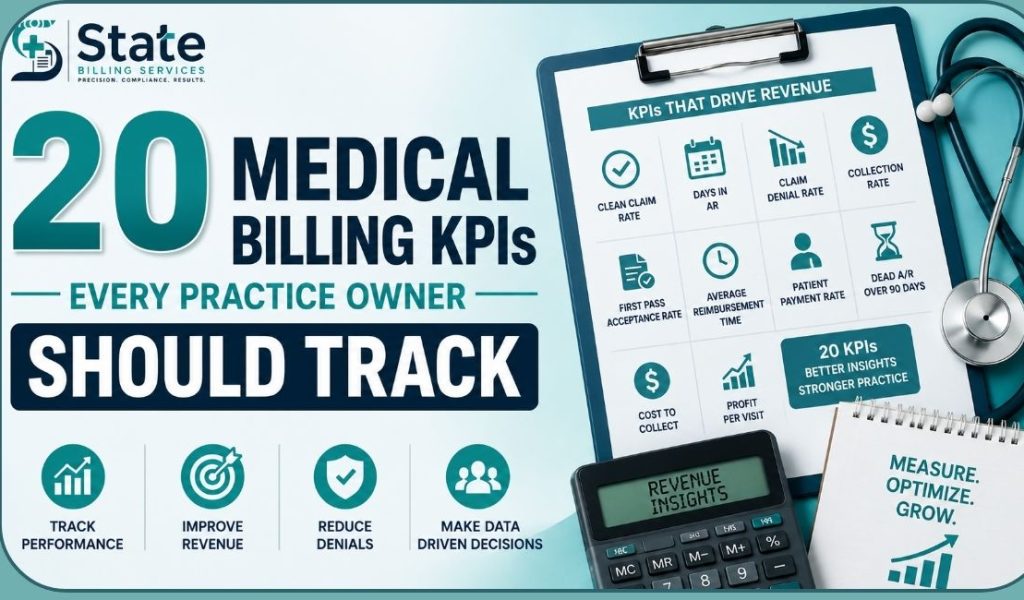
In this guide, you’ll learn about the 20 most important Revenue cycle management KPIs, why each one matters, what benchmarks to aim for, and how they work together to strengthen your practice’s financial health.
Why Tracking Medical Billing KPIs Is Essential
Revenue cycle management involves much more than submitting insurance claims. It is a continuous process that starts before the patient arrives and ends only when every payment has been collected and accurately posted. Each stage of this process generates valuable data that can help practices evaluate performance and identify opportunities for improvement.
Without reliable performance indicators, it becomes difficult to answer important questions. Are claims being submitted accurately? Are insurers taking longer to process payments? Is the coding team creating unnecessary denials? Are patient balances being collected efficiently? Financial reports alone rarely provide these answers.
Healthcare organizations that consistently review Healthcare billing key performance indicators are generally better positioned to identify billing issues before they become significant financial problems. Instead of reacting to declining revenue months later, they can detect unfavorable trends early and implement corrective measures.
For example, a practice may notice that its monthly revenue has decreased even though patient volume has remained stable. A closer review of billing KPIs may reveal that the decline is caused by an increase in claim denials, slower payment posting, or extended days in AR. Without these metrics, the underlying problem could remain hidden for months.
Modern practice management systems and electronic health record platforms make KPI tracking easier than ever. Solutions such as Epic, athenahealth, AdvancedMD, Kareo, and eClinicalWorks provide reporting dashboards that allow practice managers to monitor financial performance in real time. These Medical billing dashboard metrics help leadership teams make informed operational decisions based on actual performance rather than assumptions.
While technology plays an important role, improving performance ultimately depends on consistent monitoring, staff accountability, and well-defined billing processes.
1. Clean Claim Rate
Among all medical billing KPIs, the clean claim rate is often considered one of the most valuable indicators of billing efficiency. It measures the percentage of insurance claims that are accepted by the payer on the first submission without requiring corrections, edits, or additional information. Every clean claim represents a smoother reimbursement process, less administrative work, and faster payment.
The formula is straightforward:
Clean Claims ÷ Total Claims Submitted × 100
Most high-performing practices aim for a clean claim rate of at least 95 percent. Achieving this benchmark requires close coordination between front-desk staff, medical coders, providers, and billing specialists. A mistake made during patient registration can easily result in claim rejection several weeks later.
Low clean claim rates are commonly linked to incomplete documentation, inaccurate patient demographics, incorrect insurance information, coding errors, or missing modifiers. Even small mistakes, such as an incorrect member identification number or an outdated insurance policy, can prevent a claim from being processed.
Improving this metric begins long before the claim is submitted. Insurance eligibility should be verified before every visit, providers should complete documentation promptly, and certified coders should review complex encounters carefully. Practices that invest in quality assurance typically see fewer rejected claims, reduced administrative costs, and more predictable reimbursements.
Because the clean claim rate influences several other Revenue cycle management KPIs, improving this single metric often produces positive results throughout the billing process.
2. First Pass Resolution Rate
The first pass resolution rate measures the percentage of claims that are paid in full after the initial submission without requiring appeals, corrected claims, or additional follow-up. While it is closely related to the clean claim rate, this KPI focuses on successful payment rather than simply claim acceptance.
A strong first pass resolution rate reflects the combined effectiveness of patient registration, insurance verification, medical coding, clinical documentation, and billing accuracy. When these processes work together efficiently, insurers have fewer reasons to delay or deny payment.
For practice owners, this KPI provides valuable insight into operational efficiency. Every claim that requires resubmission increases administrative expenses and extends reimbursement timelines. Staff members must spend additional time researching denials, communicating with insurance companies, correcting errors, and tracking appeals. These activities consume resources that could otherwise support patient care or practice growth.
Improving first pass resolution begins with identifying recurring issues. Many practices discover that specific payers deny claims for similar reasons each month. Monitoring these patterns allows billing teams to implement targeted improvements before claims are submitted.
Organizations that use comprehensive revenue cycle management solutions often establish routine quality reviews to identify coding inconsistencies, documentation gaps, and payer-specific requirements. These proactive measures help increase first pass resolution rates while reducing unnecessary administrative work.
3. Denial Rate
The denial rate measures the percentage of submitted claims that insurance companies refuse to pay during the initial review. Every denied claim represents delayed revenue and additional administrative effort. While some denials are unavoidable, a consistently high denial rate usually indicates underlying process issues that require immediate attention.
The formula is:
Denied Claims ÷ Total Submitted Claims × 100
Although acceptable benchmarks vary by specialty, many successful practices strive to maintain denial rates below five percent. Higher percentages often signal problems within registration, documentation, coding, authorization, or payer compliance.
Common denial reasons include incomplete patient information, expired insurance coverage, missing prior authorization, coding inaccuracies, duplicate claims, and insufficient documentation supporting medical necessity. Federal programs such as Medicare and Medicaid, along with commercial insurers, regularly update billing policies, making ongoing staff education essential.
Instead of viewing denials as isolated events, practices should analyze denial trends. If one payer repeatedly rejects claims for the same reason, the underlying workflow may require adjustment. Likewise, if denials increase after coding guideline updates, additional coder training may be necessary.
Practices facing persistent reimbursement challenges often benefit from dedicated denial management services that focus on identifying root causes, improving appeal success rates, and preventing recurring errors before they affect future claims.
Lower denial rates contribute directly to healthier cash flow, reduced administrative expenses, and stronger overall revenue cycle performance.
4. Days in AR
Among all financial indicators, days in AR remains one of the most closely monitored Healthcare billing key performance indicators. It measures the average number of days required for a practice to collect payment after services have been provided.
The formula is generally calculated as:
Total Accounts Receivable ÷ Average Daily Charges
Most healthcare organizations aim to keep days in accounts receivable between 30 and 40 days, although acceptable benchmarks vary depending on specialty, payer mix, and patient population.
An increase in days in AR often signals inefficiencies somewhere within the billing process. Delayed claim submission, incomplete documentation, slow payer response times, unresolved denials, or inadequate follow-up procedures can all contribute to aging receivables.
Practice owners should avoid viewing this KPI in isolation. Rising days in AR frequently coincide with declining clean claim rates, increasing denials, or slower payment posting. Examining these metrics together provides a more accurate understanding of revenue cycle performance.
Reducing days in AR usually requires a coordinated effort across multiple departments. Claims should be submitted promptly after encounters, denied claims should be addressed without delay, and unpaid balances should receive timely follow-up. Even modest reductions in average collection time can significantly improve monthly cash flow without increasing patient volume.
5. Net Collection Rate
The net collection rate measures how effectively a practice collects the reimbursement it is contractually entitled to receive. Unlike gross collections, this KPI excludes contractual adjustments and focuses only on collectible revenue.
The calculation is:
Payments Received ÷ Adjusted Charges × 100
Many financially healthy practices maintain a net collection rate above 95 percent. A lower percentage may indicate revenue leakage somewhere within the billing process rather than insufficient patient volume.
Several factors can reduce net collections, including unresolved claim denials, untimely filing, inadequate follow-up, coding inaccuracies, incorrect payment posting, or unnecessary write-offs. Even small operational inefficiencies can accumulate over hundreds or thousands of claims each month.
Monitoring this KPI helps practice owners distinguish between unavoidable contractual reductions and preventable revenue losses. If the net collection rate begins declining, reviewing payer performance, denial trends, and collection workflows can often reveal the source of the problem.
Practices that consistently monitor this metric alongside other Medical billing performance metrics are better equipped to maintain stable cash flow and protect long-term financial performance.
6. Gross Collection Rate
The gross collection rate measures the percentage of total charges collected before contractual adjustments are considered. Although this metric does not provide as complete a financial picture as the net collection rate, it still offers useful insight into overall collection performance.
A high gross collection rate generally reflects effective billing operations, but it should never be interpreted without considering payer contracts and allowable adjustments. Practices serving different patient populations may have significantly different gross collection percentages simply because of variations in reimbursement agreements.
Monitoring this KPI over time helps identify long-term trends rather than short-term fluctuations. A gradual decline may indicate increasing collection challenges, while consistent improvement often reflects stronger billing processes and better financial controls.
Because gross collections do not account for contractual obligations, they should always be evaluated together with the net collection rate to provide a balanced assessment of reimbursement performance.
7. Average Reimbursement per Encounter
Average reimbursement per encounter measures how much revenue the practice receives, on average, for each completed patient visit. While patient volume remains an important performance indicator, this KPI helps determine whether each encounter is generating appropriate reimbursement based on the services provided.
Changes in reimbursement per encounter may reflect several factors, including payer contract updates, coding accuracy, documentation quality, shifts in service mix, or changes in patient insurance coverage. For example, a specialty clinic that begins treating more complex cases may naturally experience higher average reimbursements, while coding errors could cause the opposite effect.
Practice owners should review this KPI alongside provider productivity and payer mix to identify meaningful trends. Significant changes deserve investigation, particularly if patient volume has remained stable.
Accurate coding, timely documentation, and regular contract reviews all contribute to maintaining appropriate reimbursement levels. Many practices also perform periodic coding audits to ensure that services are accurately documented and billed according to current CPT, ICD-10-CM, and payer guidelines.
8. Charge Lag
Charge lag measures the amount of time between the date a patient receives medical services and the date those charges are entered into the billing system. Although this metric may seem minor compared to collections or denials, it has a direct impact on the speed of the entire revenue cycle. Every day that charges remain unentered is another day before a claim can be submitted, processed, and reimbursed.
Most well-managed practices aim to keep charge lag within one to three days, though the ideal timeframe depends on the specialty and documentation requirements. Surgical practices and hospitals may require additional documentation before charges can be finalized, while many outpatient clinics can submit claims within 24 hours of the patient encounter.
Extended charge lag is commonly caused by incomplete provider documentation, delayed coding, staffing shortages, or inefficient communication between clinical and billing teams. For example, if a physician waits several days to complete encounter notes, coders cannot assign accurate CPT and ICD-10-CM codes, preventing the billing department from submitting the claim.
Reducing charge lag begins with standardized workflows. Providers should complete documentation promptly after each visit, coders should review records daily, and billing teams should monitor outstanding encounters through their practice management software. Even reducing charge lag by a single day across hundreds of monthly claims can significantly improve cash flow by accelerating reimbursements throughout the revenue cycle.
9. Claim Submission Time
Claim submission time measures how quickly completed claims are transmitted to insurance companies after charges have been entered and coding has been finalized. While charge lag focuses on internal delays before billing begins, claim submission time evaluates how efficiently the billing department moves claims to the payer.
Submitting claims promptly reduces the risk of missed filing deadlines and allows practices to receive payments sooner. Most successful organizations aim to submit clean claims within 24 to 48 hours after coding is complete.
Delays often result from manual workflows, incomplete documentation, missing patient information, or unresolved insurance verification issues. Some practices also experience delays when claims require additional clinical documentation before submission.
Monitoring claim submission time helps identify operational bottlenecks that might otherwise go unnoticed. A practice may have excellent coding accuracy but still experience delayed reimbursements because claims remain in internal work queues for several days.
Automated claim scrubbing tools available in many electronic health record and practice management platforms can help reduce submission delays by identifying errors before claims are sent to payers. These systems also allow billing teams to prioritize high-value claims and address exceptions more efficiently.
When combined with a high clean claim rate, prompt claim submission shortens reimbursement cycles and contributes to healthier overall Medical billing dashboard metrics.
10. Accounts Receivable Aging
While days in AR provides an overall average, accounts receivable aging offers a more detailed picture by categorizing unpaid balances according to how long they have remained outstanding. This KPI helps billing teams identify whether receivables are being collected within reasonable timeframes or gradually becoming more difficult to recover.
A healthy aging report should contain the majority of outstanding balances in the youngest category. As claims move beyond 60 or 90 days, the likelihood of successful collection generally decreases.
| Aging Category | Recommended Goal |
| 0 to 30 Days | Highest percentage |
| 31 to 60 Days | Moderate |
| 61 to 90 Days | Low |
| Over 90 Days | Minimal |
Large balances in the older aging categories often indicate unresolved denials, insufficient follow-up, payer disputes, or delayed patient payments. Without regular review, these accounts can eventually become write-offs that reduce practice revenue.
Billing managers should review aging reports at least monthly and prioritize high-value accounts that have remained unpaid for extended periods. Assigning follow-up tasks based on aging categories helps staff focus on claims that require immediate attention rather than treating every outstanding balance equally.
Practices with consistently aging receivables often benefit from specialized AR recovery services that focus on resolving long-standing insurance balances before they become uncollectible.
11. Bad Debt Rate
No healthcare practice collects every dollar it bills, but monitoring the bad debt rate helps determine whether uncollectible accounts remain within acceptable limits. This KPI measures the percentage of revenue that must ultimately be written off because collection efforts were unsuccessful.
Some bad debt is unavoidable. Patients may relocate, experience financial hardship, or become unreachable despite repeated collection attempts. However, an increasing bad debt rate often signals preventable weaknesses elsewhere in the revenue cycle.
Poor insurance verification, delayed billing, unclear patient financial policies, and inconsistent collection procedures all contribute to rising bad debt. Practices that wait several months before contacting patients about outstanding balances generally experience lower collection success than those that communicate promptly after insurance processing.
Improving this KPI begins before treatment is provided. Verifying insurance eligibility, discussing estimated patient responsibility, collecting copayments at check-in, and offering convenient payment options all reduce the likelihood of unpaid balances later.
Regularly reviewing bad debt trends also helps practice owners evaluate whether current financial policies remain effective. A sudden increase may indicate the need to strengthen front-end financial counseling or improve follow-up procedures.
12. Insurance Verification Accuracy
Insurance verification is one of the earliest steps in the revenue cycle, yet it has a significant influence on many downstream medical billing KPIs. Verifying eligibility before every patient visit helps confirm active coverage, identify referral requirements, determine patient financial responsibility, and reduce avoidable claim denquiries.
Errors made during registration often create expensive administrative work later. Incorrect policy numbers, inactive coverage, missing subscriber information, or outdated insurance plans can all result in rejected or denied claims.
Monitoring verification accuracy allows practices to identify registration issues before they affect reimbursement. Front-desk staff should verify eligibility for every visit rather than relying on previous records, as insurance coverage can change between appointments.
Many organizations use automated eligibility verification tools that connect directly with payer databases, allowing staff to confirm benefits in real time. These systems reduce manual entry errors while improving efficiency.
Practices with high patient volumes or multiple payer contracts often strengthen front-end performance by using professional eligibility verification services. Improving verification accuracy not only reduces denials but also enhances the patient experience by providing clearer information about expected out-of-pocket costs before treatment begins.
13. Prior Authorization Approval Rate
Many medical procedures, diagnostic imaging services, specialty medications, and surgical interventions require prior authorization before insurers agree to provide reimbursement. The prior authorization approval rate measures how successfully a practice obtains these approvals before services are delivered.
A declining approval rate often leads directly to increased claim denials and delayed reimbursements. It may also create scheduling disruptions if procedures must be postponed while authorization requests are processed.
Several factors affect this KPI, including incomplete clinical documentation, incorrect diagnosis coding, late submissions, or failure to meet payer-specific medical necessity requirements. Because every insurer maintains its own authorization policies, billing staff must remain current with changing requirements.
Successful practices establish standardized workflows that begin the authorization process as soon as treatment is scheduled. Dedicated staff members track pending requests, communicate with providers regarding missing documentation, and monitor approval deadlines to prevent unnecessary delays.
Organizations that perform high volumes of procedures often rely on prior authorization services in South Carolina to manage complex payer requirements efficiently. A structured authorization process reduces administrative burden while protecting reimbursement for medically necessary services.
14. Coding Accuracy Rate
Accurate medical coding forms the foundation of every successful billing operation. The coding accuracy rate measures how consistently diagnosis and procedure codes correctly reflect the clinical services documented in the patient’s medical record.
Errors in coding affect far more than reimbursement. Incorrect coding can increase claim denials, trigger payer audits, create compliance risks, and expose practices to financial penalties. Conversely, undercoding may result in legitimate revenue being left uncollected.
Medical coders rely on standardized coding systems such as ICD-10-CM, CPT, and HCPCS Level II while following guidance published by organizations including the American Medical Association and the Centers for Medicare & Medicaid Services. Because coding rules evolve regularly, ongoing education is essential.
Routine coding audits help identify recurring issues before they become widespread. Reviewing provider documentation alongside assigned codes allows practices to determine whether clinical records adequately support billed services.
Practices seeking to improve coding quality often supplement internal expertise with professional medical coding services, particularly when managing complex specialties or adapting to annual coding updates. Strong coding accuracy supports higher clean claim rates, lower denial rates, and more reliable reimbursement across the entire revenue cycle.
15. Payment Posting Accuracy
Payment posting is often viewed as a routine administrative task, but it plays a vital role in maintaining accurate financial records. This KPI measures how accurately insurance payments, patient payments, adjustments, contractual allowances, and remaining balances are entered into the practice management system. Even small posting errors can create reporting inaccuracies that affect multiple medical billing KPIs.
When payments are posted incorrectly, billing staff may mistakenly believe claims remain unpaid, resulting in duplicate follow-up efforts or incorrect patient statements. Likewise, underpayments may go unnoticed if posted without comparing the payment to the contracted reimbursement amount.
Practices should reconcile payments daily using Electronic Remittance Advice (ERA), Explanation of Benefits (EOB), and bank deposits to ensure every transaction is recorded correctly. Regular reconciliation also helps identify payer underpayments that deserve further review.
Automation has significantly improved payment posting accuracy. Many billing platforms import ERA files directly from insurance carriers, reducing manual data entry while minimizing posting errors. However, automated posting should still be monitored through routine audits to verify adjustments and payment allocations.
High payment posting accuracy contributes to more reliable financial reporting, cleaner accounts receivable records, and better decision-making. Practices experiencing frequent reconciliation issues often benefit from dedicated payment posting services that ensure every payment is recorded accurately and consistently.
16. Patient Collection Rate
Over the past decade, patient financial responsibility has continued to increase because of higher deductibles, copayments, and coinsurance requirements. As a result, patient collections now represent a larger percentage of total practice revenue than ever before. The patient collection rate measures how effectively a practice collects the amounts patients owe after insurance processing.
Unlike insurance reimbursement, patient payments depend heavily on communication and convenience. Patients are more likely to pay when they clearly understand their financial responsibility before treatment begins. Confusing billing statements or unexpected balances often delay payment and increase collection costs.
Successful practices establish financial policies that explain payment expectations during scheduling or registration. Staff members verify insurance eligibility before appointments, estimate out-of-pocket expenses when possible, and collect copayments at check-in rather than waiting until after the visit.
Technology also supports stronger patient collections. Online payment portals, automated reminders, text message payment links, and flexible payment plans encourage faster payments while improving the patient experience.
Monitoring this KPI helps practice owners evaluate whether front-office financial procedures are working effectively. A declining patient collection rate may indicate the need for improved communication, updated billing statements, or additional staff training on discussing financial responsibility with patients.
17. Write-Off Percentage
Every healthcare practice records write-offs, but not all write-offs are created equally. Some adjustments are expected because of contractual agreements with insurance companies, while others represent preventable revenue loss. Tracking the write-off percentage helps distinguish between normal business operations and avoidable financial leakage.
Contractual adjustments are negotiated reductions agreed upon in payer contracts and should not be viewed as lost revenue. Preventable write-offs, however, often result from missed filing deadlines, unresolved denials, billing errors, or ineffective collection efforts. These losses directly affect practice profitability.
Regular review of write-off reports helps management identify unusual trends. For example, if write-offs increase substantially after implementing a new billing workflow, the practice should investigate whether staff training, coding accuracy, or payer compliance contributed to the change.
Documentation is equally important. Every write-off should include a clear explanation, supporting documentation, and management approval when appropriate. This process promotes accountability while reducing the risk of inappropriate adjustments.
Monitoring write-off percentages alongside net collection rate, days in AR, and denial rate provides a more complete picture of overall revenue cycle performance.
18. Cost to Collect
Revenue generation is important, but understanding how much it costs to collect that revenue is equally valuable. The cost to collect measures the administrative expense associated with recovering each dollar of reimbursement. This KPI includes staffing expenses, billing software, clearinghouse fees, office overhead, training, and outsourced billing services.
A practice with rising collection costs may still generate healthy revenue, but declining efficiency can gradually reduce profitability. Increasing expenses without corresponding improvements in collections often indicate operational inefficiencies that deserve attention.
Comparing collection costs over time allows practice owners to evaluate workflow improvements and technology investments. For example, implementing electronic claims submission or automated payment posting may reduce administrative workload while improving reimbursement speed.
Many organizations also compare the cost of maintaining an in-house billing department with outsourcing portions of the revenue cycle. Depending on claim volume and staffing needs, outsourcing may improve both efficiency and financial performance.
Practices evaluating these options may find additional guidance in When to Outsource Medical Billing, which discusses factors to consider when deciding whether internal or external billing support is the better long-term solution.
19. Revenue per Provider
Revenue per provider measures the average amount of revenue generated by each physician or healthcare professional within the practice. This KPI helps leadership evaluate productivity while considering patient volume, service mix, documentation quality, and reimbursement patterns.
The goal is not to compare providers unfairly. Different specialties naturally generate different reimbursement levels, and even physicians within the same specialty may care for different patient populations. Instead, this metric helps identify operational trends that deserve further investigation.
For example, if one provider consistently generates lower reimbursement despite maintaining a similar patient schedule, the cause may involve documentation delays, coding differences, scheduling inefficiencies, or payer mix rather than clinical performance.
Monitoring this KPI also supports workforce planning. Practice owners can better evaluate staffing requirements, scheduling capacity, and opportunities for operational improvements across departments.
When analyzed together with coding accuracy, claim submission time, and reimbursement per encounter, revenue per provider offers valuable insight into the financial performance of the practice without focusing solely on appointment volume.
20. Revenue Cycle Turnaround Time
Revenue cycle turnaround time measures the complete journey from the patient’s visit until the final payment has been received and accurately posted. Unlike individual KPIs that evaluate specific stages of the billing process, this metric reflects the overall efficiency of the entire revenue cycle.
A shorter turnaround time generally indicates strong operational coordination between registration staff, providers, coders, billers, and collections teams. Delays at any stage increase the overall cycle length and reduce cash flow.
Improving turnaround time requires practices to examine the revenue cycle as a connected system rather than a series of independent tasks. Faster documentation supports quicker coding. Better coding improves the clean claim rate. Higher clean claim rates reduce the denial rate, which shortens days in AR and improves the net collection rate.
Because these indicators influence one another, reviewing them collectively provides a more meaningful assessment than evaluating individual metrics in isolation.
Organizations that regularly monitor complete Medical billing dashboard metrics can identify bottlenecks early, measure the impact of workflow improvements, and maintain more predictable reimbursement timelines.
How Medical Billing KPIs Work Together
No single metric tells the complete story of a practice’s financial health. The greatest value comes from understanding how these indicators influence one another throughout the revenue cycle.
For example, improving insurance verification accuracy often increases the clean claim rate because fewer claims contain eligibility errors. Higher clean claim rates typically reduce denials, which shortens days in accounts receivable. Faster payments improve cash flow and contribute to a stronger net collection rate.
Likewise, improving coding accuracy reduces payer questions and minimizes the need for corrected claims. Better documentation supports medical necessity, increases first-pass payment rates, and reduces administrative work associated with appeals.
Practice owners should avoid focusing exclusively on one KPI while ignoring others. Instead, they should review monthly reports to identify patterns and determine where process improvements will have the greatest overall impact.
The following example demonstrates how coordinated workflow improvements can strengthen several important metrics simultaneously.
| KPI | Before Improvement | After Process Changes |
| Clean Claim Rate | 90% | 97% |
| Denial Rate | 12% | 5% |
| Days in AR | 58 Days | 34 Days |
| Net Collection Rate | 89% | 97% |
In this example, better eligibility verification, more accurate coding, and structured denial follow-up produced measurable improvements across multiple KPIs without increasing patient volume.
Best Practices for Tracking Medical Billing KPIs
Tracking medical billing KPIs consistently is more valuable than reviewing them only when financial problems arise. Practices that establish routine reporting schedules are better positioned to identify trends before they become significant revenue issues.
Several practical habits support more effective KPI management.
- Review KPI reports every month rather than waiting until the end of the year.
- Compare performance against previous months and specialty benchmarks instead of focusing on isolated numbers.
- Investigate significant changes promptly to identify their root causes.
- Share KPI reports with providers, coders, billing staff, and leadership to encourage accountability.
Technology should also support continuous improvement. Modern billing software can automate reporting, identify denial trends, and provide real-time dashboards that help management make informed operational decisions.
Common Mistakes Practice Owners Should Avoid
Many practices collect large amounts of billing data but fail to use it effectively. Reviewing reports without taking corrective action limits the value of performance measurement.
Common mistakes include relying only on revenue reports, overlooking payer-specific denial patterns, delaying follow-up on aging accounts, and failing to educate staff about changing billing requirements. Another frequent mistake is treating billing as an isolated administrative function rather than recognizing that registration, documentation, coding, and collections all contribute to financial performance.
Regular workflow reviews, staff education, and proactive communication between departments help prevent these issues while supporting stronger long-term results.
Using Technology to Improve KPI Performance
Technology has transformed healthcare billing by providing greater visibility into revenue cycle performance. Electronic health record systems, practice management software, and billing analytics platforms allow practices to monitor claims, collections, denials, and reimbursement trends in real time.
Platforms such as Epic, athenahealth, AdvancedMD, Kareo, and NextGen Healthcare offer reporting tools that help managers identify operational bottlenecks before they affect revenue. Automated claim scrubbing, eligibility verification, payment posting, and reporting dashboards reduce manual work while improving data accuracy.
Technology alone, however, is not enough. Meaningful improvement still depends on experienced billing professionals who can interpret reports, identify root causes, and implement process improvements based on the data.
Practices seeking comprehensive support often benefit from partnering with an experienced provider of Revenue Cycle Management SC solutions that combine technology with knowledgeable billing expertise.
Final Thoughts
Monitoring medical billing KPIs is one of the most effective ways to improve financial performance without increasing patient volume. Metrics such as days in AR, clean claim rate, denial rate, and net collection rate provide valuable insight into every stage of the revenue cycle, allowing practice owners to identify inefficiencies before they become costly problems.
Rather than viewing these indicators independently, successful healthcare organizations evaluate them together to understand how registration, coding, claim submission, payment posting, and collections influence one another. Small operational improvements made consistently often produce significant gains in cash flow, reimbursement speed, and long-term financial stability.
Whether your practice is managing billing internally or evaluating outside support, regularly reviewing these Healthcare billing key performance indicators creates a stronger foundation for sustainable growth.
If your organization is looking to improve billing efficiency, reduce claim denials, or strengthen overall revenue cycle performance,States Billing Services SC provides comprehensive support tailored to healthcare practices of all sizes.
From Medical Billing Services to specialty revenue cycle solutions, experienced professionals can help optimize your billing workflows and improve financial outcomes. For additional guidance, you may also find these resources helpful: Medical Claim Denial Reasons. This completes the full article with only two tables, minimal bullet points, natural internal linking, and a comprehensive, reader-friendly structure suitable for publication.