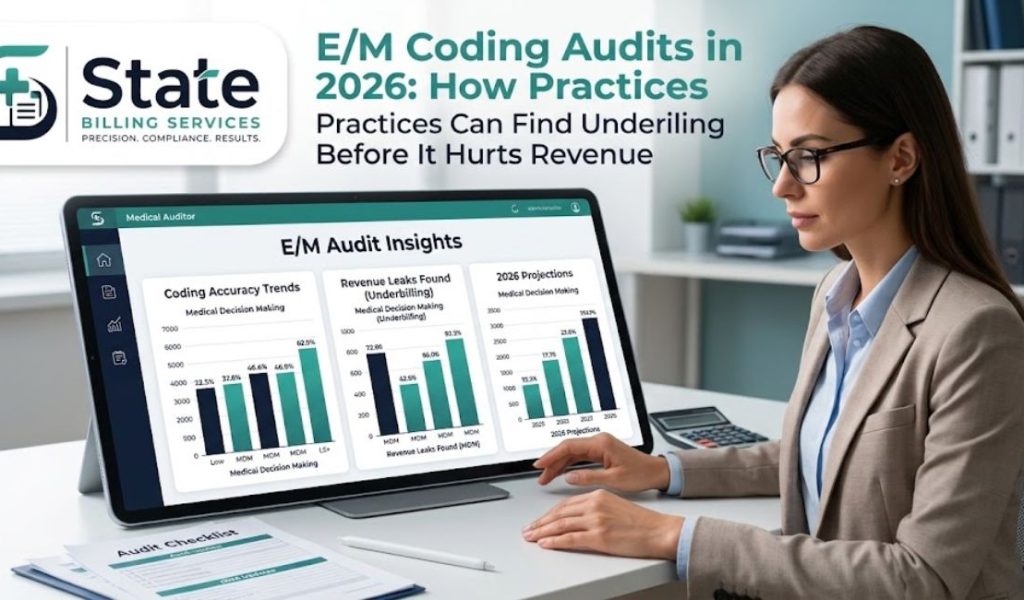
Most billing conversations focus on denials. Claims rejected, resubmitted, delayed. But there is a quieter revenue problem that rarely gets discussed: undercoding. A provider documents a visit thoroughly, then bills it one level lower than what the documentation actually supports. The claim gets paid. Nobody flags it. Revenue disappears without a trace.
This is the core reason E/M coding audits matter in 2026, not just for compliance, but for finding revenue a practice already earned and never collected. This guide walks through how to run an E/M audit focused specifically on underbilling, using AMA and CMS guidelines correctly.
Why Undercoding Gets Overlooked
Overcoding gets attention because it carries obvious compliance risk. Audits, recoupments, and penalties follow overcoded claims, so practices train providers to avoid it carefully.
Undercoding carries no such immediate consequence. The claim is paid. Nothing looks wrong on the surface. This is exactly why it persists. Providers, especially those cautious about compliance, often default to a lower E/M level when uncertain, assuming this is the safer choice.
It is safer in terms of audit risk. It is not safer for practice revenue. Over a year, consistent undercoding by even one level across a portion of visits adds up to significant lost income, income the practice has already earned through documented, medically necessary care.
Understanding E/M Coding Levels Under Current Guidelines
E/M coding for office and outpatient visits changed significantly under the 2021 AMA guideline revision, which shifted the basis for code selection to either medical decision making or total time, rather than the older history and exam-based framework. These guidelines remain the foundation for E/M coding in 2026, with CMS following AMA CPT guidance for code definitions.
Under medical decision making, code level is based on three components:
- The number and complexity of problems addressed
- The amount and complexity of data reviewed and analyzed
- The risk of complications, morbidity, or mortality from patient management
Under the time-based option, code level is based on total time spent by the provider on the date of the encounter, including both face-to-face and certain non-face-to-face activities related to that visit.
Undercoding often happens because providers default to counting only the most obvious component, like a single diagnosis discussed, without fully accounting for data reviewed or the actual complexity of management decisions made during the visit.
The Real Cost of Undercoding
Consider a practical example. A provider sees a patient with two chronic conditions, reviews recent lab results, and adjusts medication dosage based on those results and the patient’s reported symptoms. This visit likely supports a moderate complexity level under medical decision making. If the provider bills it as a lower complexity visit out of caution, the practice loses the reimbursement difference between those two levels.
Multiply this across a full patient panel and a full year, and the loss becomes substantial. Unlike a denial, this loss never appears on a denial report. It simply never gets billed in the first place, which is exactly why targeted E/M audits are necessary to find it.
How to Structure an E/M Audit Focused on Underbilling
Most internal audits focus on compliance risk, meaning they look for overcoding. An audit focused on underbilling requires a different lens.
Step One: Select a Representative Sample
Pull a sample of recent visits across different providers and visit types. Include both straightforward and complex cases. A sample that only includes simple visits will not reveal meaningful undercoding patterns.
Step Two: Compare Documentation Against Billed Code Level
For each visit, review the documentation independently of the code that was billed. Determine what level the documentation actually supports under current AMA guidelines, based on either medical decision making or time, whichever method the provider used or should have used.
Step Three: Identify the Gap
Compare the independently determined code level against what was actually billed. A consistent pattern of documentation supporting a higher level than what was billed points to systemic undercoding, not isolated cases.
Step Four: Investigate the Root Cause
Undercoding usually stems from one of a few causes: provider uncertainty about current guidelines, outdated internal training materials, overly conservative coding culture, or documentation that technically supports a higher level but is not written clearly enough for coders to confidently select it.
A Sample Audit Comparison Table
| Documented Element | Supports This Level | Actually Billed | Revenue Gap |
|---|---|---|---|
| Two chronic conditions, lab review, medication adjustment | Moderate complexity | Low complexity | Yes |
| Single acute problem, no data review, low risk management | Low complexity | Low complexity | No |
| Three chronic conditions, specialist coordination, new medication | High complexity | Moderate complexity | Yes |
This kind of comparison, applied across a meaningful sample size, quickly reveals whether undercoding is an isolated issue or a systemic pattern across the practice.
Common Undercoding Patterns to Watch For
A few specific patterns show up repeatedly during E/M underbilling audits.
Data review not fully credited. Providers often review labs, imaging, or prior records without documenting this clearly enough for the coder to count it toward the data complexity component. The review happened. The documentation does not reflect it fully.
Risk level underestimated. Medication management involving drugs that require intensive monitoring, or decisions involving significant risk of morbidity, are sometimes coded as lower risk than the guidelines actually support.
Time-based visits undercounted. When billing based on time, providers sometimes only count the portion of time spent directly with the patient in the room, forgetting to include qualifying non-face-to-face time performed on the same date, such as chart review or care coordination.
Chronic condition complexity underestimated. A visit addressing multiple stable chronic conditions still involves ongoing management complexity that supports a higher level than providers sometimes assume, particularly when compared to a single new acute problem.
Balancing Compliance and Revenue Recovery
An audit focused on underbilling must still respect compliance boundaries. The goal is not to push every visit to the highest possible level. It is to ensure the level billed accurately reflects what the documentation genuinely supports, based on current guidelines, nothing more and nothing less.
This distinction matters. A compliance program built only around avoiding overcoding, without equal attention to accurate coding in both directions, is incomplete. Accurate coding protects the practice from both types of risk: audit exposure from overcoding, and quiet revenue loss from undercoding.
Training Providers Without Creating New Risk
Once an audit identifies undercoding patterns, provider education needs careful framing. The goal is not to tell providers to “code higher.” It is to help them recognize when documentation already supports a higher level, and to document more completely so that support is clear.
Effective training typically covers:
- Specific examples from the practice’s own audit findings, not generic case studies
- A clear walkthrough of how data review and risk should be documented to support accurate coding
- Guidance on including qualifying time components when time-based coding applies
This approach improves both coding accuracy and documentation quality, which protects the practice in future audits from any payer, not just internal review.
Connecting E/M Audits to Broader Revenue Cycle Health
E/M underbilling audits work best as part of a broader monthly medical billing audit process, rather than a one-time project. Coding patterns drift over time as providers change, guidelines get updated, or documentation habits shift gradually without anyone noticing.
Practices with strong SC medical coding services in place tend to catch undercoding earlier, since ongoing coder review naturally surfaces documentation and code level mismatches before they become a year-long pattern.
This also ties directly into overall quality of medical billing services in South Carolina, since accurate E/M coding is often the single largest revenue category for primary care and many specialty practices. Getting it right consistently has more financial impact than most other billing improvements combined.
A Practical First Step
Practices unsure where to start do not need a full audit immediately. A useful first step is pulling twenty recent visits from a single provider, reviewing documentation against billed levels using the comparison method described above, and calculating the estimated revenue gap, if any.
This small-scale check often reveals quickly whether a deeper audit across the full practice is warranted, without committing significant time upfront.
Medical Decision Making Table Elements in Practice
The medical decision making framework uses defined categories for each of its three components, and understanding these categories in practical terms helps identify undercoding more precisely.
For problems addressed, a single stable chronic condition typically supports a lower complexity level than multiple chronic conditions, or a chronic condition with exacerbation. A new problem with uncertain diagnosis often supports higher complexity than a straightforward, previously diagnosed condition, since it involves more diagnostic uncertainty.
For data reviewed and analyzed, categories include reviewing prior external records, ordering or reviewing unique tests, and independent interpretation of tests performed elsewhere. Providers frequently perform this level of data review without documenting it in a way that clearly maps to these categories, which is one of the most common sources of undercoding identified during audits.
For risk of complications, categories range from minimal risk, such as over-the-counter medication management, to high risk, such as decisions involving drug therapy requiring intensive monitoring for toxicity, or major surgery considerations. Providers managing patients on medications like anticoagulants or certain psychiatric medications should ensure this risk level is clearly reflected in documentation, since it often supports higher complexity than initially coded.
Time-Based Coding: What Actually Counts
When using time as the basis for E/M code selection, providers can count both face-to-face time with the patient and other qualifying activities performed on the date of the encounter. This includes reviewing the patient’s chart before the visit, ordering tests or medications during the encounter period, documenting the visit, and coordinating care with other providers on the same date.
A common undercoding pattern involves providers who only track the minutes spent physically with the patient, ignoring qualifying pre-visit chart review or post-visit documentation and coordination time performed the same day. When this additional time is properly tracked and documented, many visits support a higher time-based code than initially billed.
Practices should train providers to briefly note total time spent on the encounter, including these qualifying activities, rather than only the face-to-face portion, whenever time is being used as the basis for code selection.
The Role of Templates and EHR Documentation Habits
Electronic health record templates can unintentionally contribute to undercoding. Templates built around older documentation standards, particularly those still oriented toward the pre-2021 history and exam framework, may not prompt providers to document the specific data review and risk elements that current guidelines actually require.
Reviewing whether EHR templates align with current medical decision making documentation needs is a practical step that often reveals why undercoding persists across an entire provider group, rather than being isolated to individual habits. A template redesign, even a modest one, can meaningfully improve documentation completeness without requiring providers to change how they practice medicine.
Auditing Across Specialties
E/M undercoding does not appear equally across all specialties. Primary care and internal medicine, which manage high volumes of chronic condition patients, often show the clearest undercoding patterns, since the complexity of managing multiple stable chronic conditions is easy to underestimate without careful documentation review.
Specialty practices with high acuity patients, such as those managing complex medication regimens or coordinating care across multiple providers, should also review their E/M coding carefully, since the complexity of coordination itself often supports higher levels than providers realize when they focus primarily on the primary complaint discussed during the visit.
Setting Up Ongoing Monitoring, Not Just a One-Time Audit
A single audit identifies a snapshot of undercoding at one point in time. Sustained improvement requires ongoing monitoring, since documentation habits can drift back to old patterns without regular reinforcement.
Practical ongoing monitoring includes periodic sampling of visits each quarter, tracking average E/M level distribution by provider over time to spot unusual shifts, and reviewing a small number of visits during new provider onboarding to catch documentation gaps early, before they become an established habit.
This kind of ongoing review connects naturally to broader tracking of medical billing trends within the practice, giving leadership visibility into coding patterns alongside other revenue cycle metrics, rather than treating E/M accuracy as a separate, occasional concern.
What to Do When an Audit Reveals Significant Undercoding
If an audit reveals a consistent pattern of undercoding across a provider or the practice as a whole, the appropriate response is forward-looking correction, not retroactive rebilling of already-paid claims in most circumstances. Practices should focus corrective effort on improving documentation and coding accuracy going forward, while consulting compliance guidance on how to handle any identified pattern appropriately.
The larger value of the audit lies in preventing continued revenue loss moving forward, not in revisiting every past claim, which is rarely practical or necessary unless the pattern involves a compliance concern requiring separate review.
Involving Coders in the Audit Process
Certified coders often notice undercoding patterns before anyone formally audits for them, simply through routine claim review. Building a feedback channel where coders can flag visits that appear undercoded, without it feeling like criticism of the provider, creates an early warning system that catches issues before they become entrenched habits.
This works best when framed as collaborative documentation improvement rather than provider correction. Coders reviewing documentation against current guidelines and flagging potential gaps for provider clarification, rather than silently accepting whatever level was initially selected, strengthens both compliance and revenue accuracy simultaneously. This kind of collaborative review is a core part of well-run medical coding services.
Documentation Language That Supports Accurate Coding
Small changes in how providers phrase documentation can significantly affect whether a coder can confidently select a higher, accurate code level. Vague phrases like “discussed labs” provide less support than specific language such as “reviewed CBC and metabolic panel results, adjusted dosage based on findings.”
Similarly, documenting risk considerations explicitly, such as noting that a medication requires ongoing monitoring due to toxicity risk, gives coders clear support for the risk component of medical decision making. Providers do not need to write substantially longer notes. They need to write more specific ones, capturing the clinical reasoning that already occurred during the visit rather than summarizing it away.
Working With External Auditors for an Independent View
While internal audits catch many issues, periodic external audit review offers an independent perspective that can be harder to achieve internally, particularly in smaller practices where the same staff handle both coding and audit review. An external reviewer with no familiarity with the practice’s existing habits sometimes identifies undercoding patterns that internal staff have grown accustomed to overlooking.
This does not need to happen constantly. An annual or semi-annual external review, focused specifically on underbilling rather than only compliance risk, often surfaces findings that justify the cost through recovered revenue alone, separate from the compliance value of an independent check.
Frequently Asked Questions on E/M Underbilling
Is undercoding actually a compliance concern too?
In most cases, undercoding itself does not create compliance risk in the way overcoding does, since payers are not harmed financially by a lower bill. However, wildly inconsistent coding patterns, even in the conservative direction, can still draw scrutiny if they suggest a lack of coding process rigor overall.
Should every visit be reviewed, or only a sample?
A representative sample is generally sufficient to identify systemic patterns without requiring a full review of every visit, which is rarely practical for an ongoing monitoring process. Full review makes more sense for a focused, time-limited audit investigating a specific concern.
Can undercoding be corrected through additional provider training alone?
Training helps, but pairing it with documentation template improvements and periodic coder feedback tends to produce more durable results than training delivered as a single one-time session.
Building a Culture That Supports Accurate Coding
Long-term success in reducing undercoding depends less on any single audit and more on the culture a practice builds around documentation and coding. Providers need to feel that accurate, complete documentation is valued and supported, not just tolerated as an administrative burden separate from clinical care.
Practices that regularly share positive audit findings, not just corrective ones, help reinforce this culture. When a provider’s documentation clearly supports accurate coding, acknowledging that reinforces the behavior just as much as correcting undercoding does. Over time, this balanced approach tends to produce more consistent, defensible coding across the entire practice, benefiting both compliance posture and captured revenue simultaneously.
Measuring the Return on an E/M Audit Investment
Practices weighing whether to invest time or resources into an E/M underbilling audit can approach this as a straightforward calculation. Estimate the revenue gap identified in a sample, project that gap across the full annual visit volume for the relevant provider or specialty group, and compare that projected recovery against the cost of conducting the audit and implementing corrective training.
In most practices with an established but never formally audited E/M coding process, this calculation favors conducting the audit, since even a modest per-visit gap compounds meaningfully across a full year of claims. Framing the audit this way, as a revenue recovery project with a measurable return, often makes it easier to secure the internal support needed to conduct it thoroughly.
Final Thoughts
E/M coding audits are usually framed around compliance risk alone. That framing misses half the picture. Undercoding represents real, earned revenue that quietly disappears because providers default to caution rather than accuracy. Finding and correcting this pattern does not require aggressive coding practices. It requires accurate documentation review against current AMA and CMS guidelines, applied consistently.
Practices that build this review into their regular process, rather than treating it as a one-time compliance exercise, recover revenue they have already earned through the care they provide.
If your practice wants a clear picture of whether undercoding is affecting your revenue, State Billing Services SC can run a focused E/M documentation review and show you exactly where the gaps are. Visit us to talk with our coding team.