
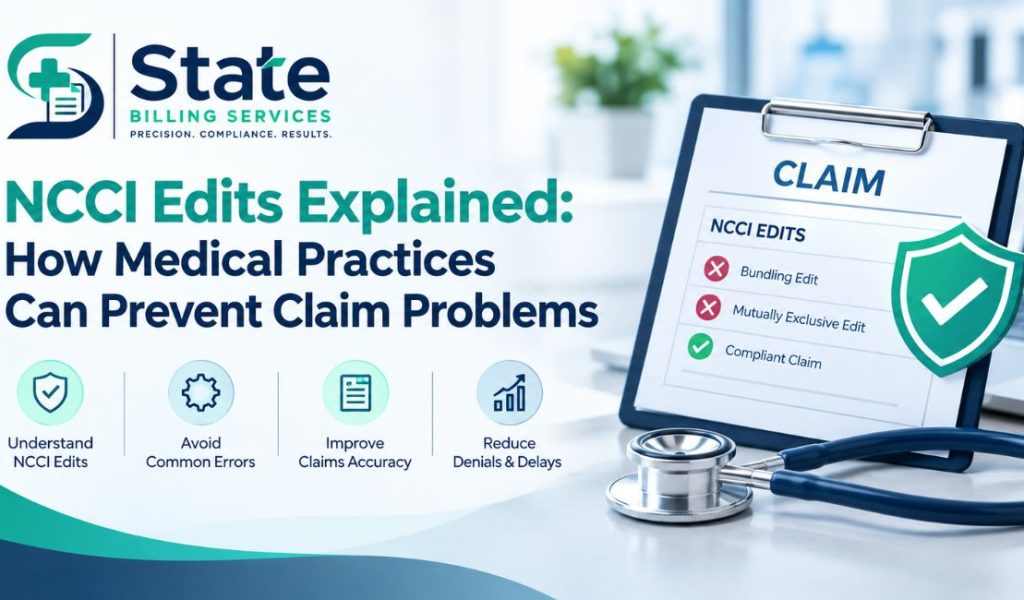
A practice bills two procedure codes for the same patient visit. Both are correct. Both are documented. Yet only one gets paid. The other comes back denied, with a remark code that means almost nothing to the front office staff reading it.
This is usually the work of a National Correct Coding Initiative (NCCI) edit. These edits sit quietly inside every payer system, checking code combinations before a claim ever reaches a human reviewer. Most billing teams only learn about them after a denial shows up.
This guide explains how NCCI edits work, why the Centers for Medicare and Medicaid Services (CMS) built them, and what a practice can do to stop them from becoming a repeated source of lost revenue.
Why NCCI Edits Exist
CMS introduced the National Correct Coding Initiative to reduce improper coding that led to duplicate or inflated payments. Before these edits existed, a provider could bill two codes for what was really one service, and there was no automatic system to catch it.
NCCI edits give payers a structured way to compare code pairs before payment. If one code is considered part of another, or if billing both together suggests overcoding, the edit blocks or reduces payment on one of them. This protects the payer from overpayment, but it also protects honest practices, since it creates a consistent, published set of rules instead of inconsistent manual review.
Without a published rule set, two practices billing the identical procedure combination could see completely different outcomes depending on which reviewer handled the claim. NCCI edits remove much of that inconsistency, since the same logic applies whether the claim comes from a large hospital system or a small independent office.
How NCCI Edits Actually Work
NCCI edits compare two CPT or HCPCS codes billed for the same patient, same date of service, same provider. The system checks these pairs against a published edit table maintained by CMS and updated on a quarterly basis.
When a pair appears on this table, one code is designated the column one code and the other the column two code. In most cases, the column two code is considered part of the column one service and will not be paid separately unless a valid modifier applies and the documentation supports it.
Procedure to Procedure Edits
Procedure to procedure (PTP) edits are the most common type. These edits identify code pairs that should not normally be billed together on the same date of service because one service is considered included in the other.
Medically Unlikely Edits
Medically unlikely edits (MUEs) work differently. Instead of comparing two different codes, an MUE sets a maximum number of units for a single code that would be considered medically reasonable for one patient on one day. Billing beyond that limit triggers a denial or partial payment, even without a second code involved.
Procedure to Procedure Edits vs. Medically Unlikely Edits
These two edit types get confused often, since both fall under the NCCI umbrella but work on different logic.
| Factor | PTP Edits | Medically Unlikely Edits |
|---|---|---|
| What it checks | Two different codes billed together | Unit count for a single code |
| Common cause of denial | Bundled code pair without a valid modifier | Units billed above the allowed maximum |
| Modifier relevance | Modifier 59 or an X modifier may apply | Rarely resolved with a modifier alone |
| Update frequency | Quarterly | Quarterly |
CPT, HCPCS, and How Code Sets Interact with NCCI
NCCI edits apply across both CPT and HCPCS Level II code sets. CPT codes, maintained by the American Medical Association, describe most physician services and procedures. HCPCS Level II codes cover supplies, durable medical equipment, and certain services not found in CPT.
A practice billing both code types for the same encounter, such as a procedure code alongside a supply code, still needs to check whether an edit applies. NCCI does not treat HCPCS codes as automatically exempt simply because they come from a different code set.
When a Modifier Can Bypass an NCCI Edit
Not every NCCI edit allows a modifier override. CMS classifies edits by an indicator that shows whether a modifier can separate the two codes for payment. Some edits are absolute and cannot be overridden under any circumstance, since the two codes almost always represent the same work.
For edits that do allow an override, Modifier 59 or one of the more specific X modifiers can be applied when the documentation shows the two services were genuinely distinct, such as different sites, different sessions, or unrelated procedures performed during the same visit. Applying a modifier without that support does not fix the claim. It only delays the eventual denial or invites closer review.
A Real World Example of an NCCI Edit at Work
A provider performs two procedures during the same visit that fall under an active PTP edit. The claim goes out without a modifier, since the biller assumes both procedures are billable together. The payer processes the column one code and denies the column two code as bundled.
The billing team reviews the chart and finds that the two procedures were performed on different anatomical sites, supporting separate reporting. After confirming the edit allows a modifier override, the team resubmits the column two code with Modifier 59 and includes clear documentation. The claim reprocesses and pays. Without that documentation, the same resubmission likely fails a second time.
Common Reasons NCCI Edits Cause Claim Denials
Certain patterns show up again and again when practices struggle with NCCI related denials.
Billing software that does not stay current with the quarterly edit updates is one frequent cause. A code pair that was billable together last quarter may now fall under a new edit, and outdated scrubbing rules will miss it. Another common cause is coders applying a modifier automatically whenever a claim gets flagged, without confirming the documentation actually supports separate reporting. This approach might get a claim paid initially, but it creates exposure during a payer audit later.
A less obvious cause involves MUE denials. Practices sometimes assume a denial tied to unit limits is a data entry mistake and resubmit the exact same claim, not realizing the payer’s limit reflects a fixed CMS policy that will not change on resubmission alone.
Steps to Prevent NCCI Related Denials
A practice does not need a large compliance department to manage NCCI edits well. A consistent, repeatable process covers most of the risk.
- Confirm billing software or clearinghouse edit tables update every quarter, not annually
- Review any claim flagged for a bundling edit against the actual chart before applying a modifier
- Track which procedure pairs trigger edits most often in your specialty and build internal alerts for them
- Separate MUE related denials from PTP related denials, since the fix for each is different
- Keep a short reference list of your most common edit related code pairs for new coding staff
How Often NCCI Edits Change
CMS updates the NCCI edit tables four times a year. These updates can add new bundled pairs, remove others, or change whether a modifier override is allowed for a specific combination. A code pair that was billable together with Modifier 59 last year might become a stricter, non overridable edit after an update, or the reverse.
Practices that rely on a billing system without regular updates risk submitting claims against outdated rules. This is one reason ongoing medical coding services in South Carolina work involves more than initial code selection. It requires monitoring rule changes that can affect claims a practice has billed the same way for years.
The Role of Documentation in Every NCCI Decision
Every NCCI related decision, whether it involves applying a modifier or accepting a bundled payment, comes back to documentation. A payer reviewing a claim with a modifier override wants to see the clinical reasoning in the chart, not just the biller’s judgment call.
Providers who understand which procedure combinations commonly trigger edits can document more clearly at the point of care. Noting separate anatomical sites, separate sessions, or distinct clinical indications directly in the note gives coders what they need without having to query the provider after the fact.
Building NCCI Review Into Your Revenue Cycle
NCCI related denials are rarely random. They tend to cluster around specific specialties, specific providers, or specific procedure combinations. A practice that reviews its denial data regularly can spot these clusters and correct them at the source, rather than reworking the same type of claim every month.
This kind of pattern recognition fits naturally into broader denial management services in SC, where denial codes get grouped and analyzed instead of handled one at a time. It also supports SC AR recovery services, since claims stuck in bundling disputes often sit in accounts receivable longer than claims with straightforward errors.
A practice that reviews its accounts receivable aging report with NCCI denials tagged separately usually finds these claims cluster in a specific age range. They are rarely the oldest claims, since most get caught within the first appeal cycle, but they are also rarely the newest, since the initial denial and internal review both take time before resubmission happens.
Some practices find it useful to review outside perspectives on payment reconciliation as part of this process. Guidance from firms such as eBridge RCM on payment posting and reconciliation reinforces a similar point: catching payment variances early, including those tied to bundling edits, prevents small issues from becoming larger revenue gaps.
Training Staff to Recognize Edit Patterns
Coders who understand the logic behind NCCI edits make fewer reflexive mistakes than those who only memorize which codes to avoid pairing. Explaining why an edit exists, not just that it exists, helps staff apply judgment correctly when a new or unusual code combination comes up.
Short, regular case reviews work well here. Walking through one or two recent NCCI denials as a team, including what documentation would have supported an override and what would not, builds practical understanding faster than a general policy memo ever could. Rotating this review among different staff members, rather than leaving it to one senior coder, also spreads the knowledge more evenly across the team and reduces the risk of errors when that one person is out.
Keeping Providers in the Loop on Edit Trends
Providers rarely see denial data directly, since it usually stops at the billing desk. Sharing a brief quarterly summary of NCCI related denials with providers, focused on the specific code pairs affecting their own patients, closes that gap.
This does not need to be a lengthy report. A short note showing which procedure combinations triggered denials, and what documentation detail would have resolved them, gives providers a concrete way to adjust their charting without feeling audited. Practices that share this feedback consistently tend to see documentation improve faster than those that only mention it during annual reviews.
Frequently Asked Questions
Do NCCI edits apply to all payers or only Medicare?
NCCI edits originated with Medicare, but many Medicaid programs and commercial payers apply similar or identical logic. Some payers publish their own variations, so it is worth confirming policy details for major payers a practice bills frequently.
Can a denied NCCI claim always be appealed?
Not always successfully. If the edit is classified as non overridable, no amount of documentation will separate the two codes for payment. Reviewing the edit indicator before appealing saves time that could go toward claims with a real chance of reversal.
How can a small practice keep up with quarterly updates without a dedicated compliance team?
Many clearinghouses and practice management systems apply updates automatically. The key is confirming this happens on schedule and periodically spot checking a few recent claims against the current edit tables, rather than assuming the system is current by default.
Does an NCCI edit mean the second procedure was billed incorrectly?
Not necessarily. The procedure itself may be entirely appropriate. The edit only reflects how the payer’s system evaluates that code pair on the same date of service. Whether the claim should be paid separately depends on the documentation, not on whether the procedure was medically reasonable.
Who should review NCCI related denials inside a practice?
A certified coder or billing specialist familiar with the practice’s common procedure combinations is usually best positioned to review these denials. Involving the treating provider becomes necessary only when the documentation itself needs clarification before a resubmission can move forward.
How NCCI Edits Differ from Coverage Policies
Billing teams sometimes lump NCCI edits together with coverage policies, such as Local Coverage Determinations or National Coverage Determinations. These are separate systems that answer different questions.
An NCCI edit asks whether two codes can be billed together on the same claim. A coverage policy asks whether a service is covered at all for a given diagnosis. A claim can pass every NCCI check and still deny for lack of medical necessity under a coverage policy, or vice versa. Treating a coverage denial as an NCCI issue, or the reverse, sends staff down the wrong troubleshooting path and wastes time that could go toward the actual fix.
How NCCI Edits Show Up Differently Across Specialties
Some specialties encounter NCCI edits far more often than others, simply based on how frequently they bill multiple procedure codes for the same visit. Orthopedic and surgical practices often deal with PTP edits tied to related procedures performed during the same operative session. Practices offering injections, minor procedures, or same day diagnostic and therapeutic services also see these edits regularly.
Specialties that bill mostly single evaluation and management codes, such as some primary care visits, see fewer PTP edits but may still run into MUE limits on certain diagnostic or lab related codes. Understanding which edit type is more common for a given specialty helps a practice focus its internal review where it matters most, rather than treating every code combination as equally risky.
The Cost of Letting NCCI Denials Go Unresolved
An unresolved NCCI denial does not just cost the value of one procedure code. It also costs staff time spent investigating the denial, determining whether an appeal is possible, and either resubmitting with proper documentation or writing off the balance.
Practices that do not track these denials separately from other denial types often underestimate how much revenue sits in this category. Grouping NCCI related denials into general reporting hides the pattern. Once a practice pulls these denials into their own report, it usually becomes clear whether the issue is a documentation gap, an outdated edit table, or a specific provider’s coding habits.
This kind of focused reporting also helps justify process changes to providers. A short report showing that a specific procedure pairing caused a defined dollar amount in denials over a quarter tends to get more attention than a general reminder about coding accuracy.
What This Means for Everyday Claim Submission
NCCI edits are not designed to punish practices. They exist to keep code pairing consistent across a payment system that processes millions of claims. Once a billing team understands the logic behind PTP edits and MUEs, these edits stop feeling like random denials and start looking like a predictable part of claim review.
Practices that build a habit of checking documentation before applying an override modifier, and that stay current with quarterly rule changes, tend to see fewer of these denials over time. The ones that treat every bundling denial as a one off mystery keep making the same mistake, quarter after quarter.
Choosing Billing Software That Handles NCCI Edits Well
Not every practice management system handles NCCI edits with the same level of detail. Some only flag a basic bundling conflict without indicating whether a modifier override is even allowed for that pair, leaving the coder to research it separately.
When evaluating billing software or a clearinghouse, it helps to ask a few direct questions: how often the edit tables update, whether the system distinguishes between overridable and non overridable edits, and whether it flags MUE limits separately from PTP conflicts. A system that answers these clearly saves significant review time compared to one that returns a single generic bundling warning.
When Outsourcing NCCI Review Makes Sense
Some practices manage NCCI compliance well in house, particularly smaller ones with a stable set of frequently billed procedures. Others, especially those adding new service lines or expanding into procedures they have not billed before, benefit from outside support during that transition period.
An experienced billing partner has already seen how specific code pairs behave across many practices and payers, which shortens the learning curve considerably. This does not replace the need for good documentation at the point of care, but it does reduce the number of denials a practice has to learn from through trial and error.
Working NCCI Checks Into Daily Workflow
The practices that manage NCCI edits best do not treat them as a special project handled once a year during a compliance review. They build a short check into daily claim submission, so bundling conflicts get caught before a claim leaves the building rather than weeks later when the remittance comes back.
This can be as simple as a coder glancing at any claim with more than one procedure code before it submits, confirming the code pair against a known edit list, and flagging anything unfamiliar for a second review. Over time, this habit becomes fast and mostly automatic, especially once a practice has documented its most common edit scenarios.
Pairing this daily habit with quarterly awareness of CMS updates keeps the process current. A short fifteen minute review of the newest edit changes, done each quarter when CMS releases them, is usually enough to catch anything that affects a practice’s typical billing patterns.
Turning NCCI Compliance Into a Routine, Not a Crisis
NCCI edits will not disappear, and CMS will keep updating them every quarter. The practices that manage them well are not the ones with the fewest procedures billed together. They are the ones with a clear process: check the edit, check the documentation, and apply a modifier only when both genuinely support it.
Reviewing NCCI related denials as part of routine reporting, alongside other medical claim denial reasons, turns a confusing payer rule into a manageable part of daily billing work.
If NCCI edits keep slowing down your claims, a billing team that tracks these updates closely can make a real difference. We help practices review coding patterns, resolve bundling denials, and keep claims moving through payer systems. Visit States Billing Services SC to see how our team can support your billing workflow.