
A new physician joins a practice ready to see patients. The exam rooms are booked. The schedule is full. Then the first insurance claim gets denied. The reason is simple and frustrating. The provider is not credentialed with that payer yet. Weeks pass. Then months. Revenue that should be coming in stays stuck, because credentialing was treated as paperwork instead of a process with its own timeline.
This happens more often than most practices expect. Provider credentialing is not a single form. It is a sequence of steps that involve verification, payer review, and committee approval. Each stage takes time, and each one can stall if a detail is missing. Understanding the real timeline, not the optimistic version, helps practices plan hiring, onboarding, and cash flow with fewer surprises.
This guide breaks down each stage of the credentialing process, gives realistic time estimates for every step, and explains what typically causes delays. It also covers what providers and administrators can do to keep the process moving.
Why the Credentialing Timeline Matters More Than People Think
Credentialing is not just an administrative checkbox. It determines when a provider can legally bill insurance payers for services rendered. Until credentialing and payer enrollment are complete, claims submitted under that provider’s name are often denied or held.
For a solo practitioner or a group adding new physicians, this creates a direct revenue gap. A provider can be seeing patients for weeks or months before their claims are payable. That gap has to be planned for, not discovered after the fact.
The timeline also affects staffing decisions. Practices that assume credentialing takes a few weeks often schedule a new hire’s first patient day too soon. When enrollment takes longer than expected, the practice either delays the provider’s start date or absorbs the cost of unbillable visits. Neither option is ideal, but knowing the real timeline in advance makes both easier to manage.
What Provider Credentialing Actually Involves
Credentialing is the process of verifying a provider’s qualifications, including education, training, licensure, and work history. Payer enrollment is a separate but connected process. It is how a credentialed provider gets added to an insurance payer’s network so claims can be billed and paid.
Several organizations and systems play a role in this process. CAQH, the Council for Affordable Quality Healthcare, maintains a centralized database that most major payers use to pull provider information instead of requesting separate paperwork from each one. CMS, the Centers for Medicare and Medicaid Services, oversees enrollment for Medicare and works with state agencies on Medicaid enrollment. Every provider also needs an active NPI, or National Provider Identifier, which is a unique number used to identify them in every billing transaction. Insurance payers, including commercial carriers and government programs, each run their own credentialing committee and enrollment review, which is why timelines can vary from one payer to the next.
The Credentialing Timeline Stage by Stage
Credentialing rarely follows a single fixed number of days. It moves through distinct stages, and the total timeline depends on how quickly each one is completed.
Stage 1: Gathering Documentation (1 to 2 weeks)
Before anything can be submitted, the provider needs to gather core documents. This includes a medical license, DEA registration, board certification, malpractice insurance information, a current CV, and proof of education and residency. Missing or outdated documents at this stage are one of the most common causes of delay later in the process. A provider who keeps these documents organized and current can often complete this stage in a week.
Stage 2: CAQH Profile Setup and Attestation (1 to 3 weeks)
Most payers require a completed and attested CAQH profile before they will begin reviewing an application. This profile includes work history, malpractice history, references, and the documents gathered in stage one. The profile needs to be re-attested periodically, and an expired attestation can quietly stall an otherwise complete application. Providers who have never used CAQH before should expect this step to take longer than those simply updating an existing profile.
Stage 3: NPI Verification and Application Submission (1 to 2 weeks)
With CAQH complete, the practice submits credentialing applications to each target payer, referencing the provider’s NPI. Some payers pull directly from CAQH, while others require additional forms specific to their own systems. Errors here, such as a mismatch between the NPI registry and the CAQH profile, are a frequent source of rejected applications that have to be resubmitted.
Stage 4: Primary Source Verification (2 to 4 weeks)
This is where payers and credentialing committees verify the information submitted, including checking directly with medical schools, licensing boards, and previous employers rather than relying on the documents alone. This step is thorough by design, since it protects patients and payers from fraudulent credentials. It is also one of the stages providers have the least control over, since the pace depends on how quickly outside institutions respond to verification requests.
Stage 5: Payer Committee Review and Approval (30 to 90 days)
Once verification is complete, the application goes to the payer’s credentialing committee. Committees often meet on a set schedule, sometimes monthly, which means a fully verified application can still wait several weeks simply because it missed a meeting cutoff by a few days. This stage typically represents the largest portion of the overall timeline and varies the most between payers.
Stage 6: Contracting and Effective Date Assignment (2 to 6 weeks)
After committee approval, the payer issues a contract and assigns an effective date, which is the date the provider can officially begin billing that payer. Some payers backdate the effective date to the application submission date, while others do not, so this detail is worth confirming for every payer individually, since it directly affects how much revenue can be recovered from the credentialing period.
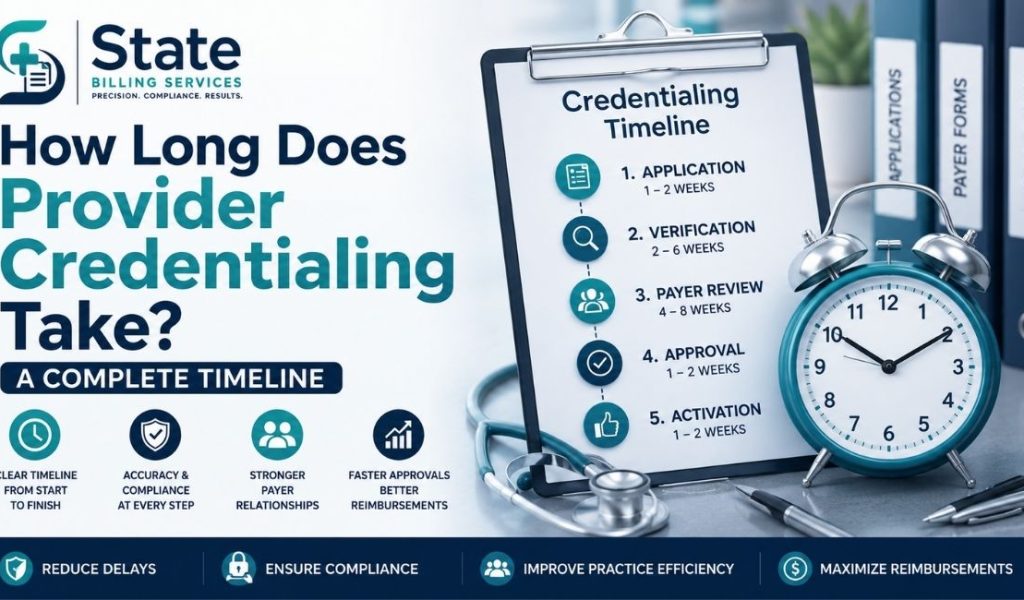
Adding these stages together, most providers can expect a full credentialing and enrollment timeline of 90 to 150 days per payer, though some payers move faster and others take longer.
| Stage | Typical Timeframe | Main Risk of Delay |
| Documentation Gathering | 1 to 2 weeks | Missing or expired documents |
| CAQH Setup and Attestation | 1 to 3 weeks | Incomplete or expired profile |
| NPI Verification and Submission | 1 to 2 weeks | Data mismatches between systems |
| Primary Source Verification | 2 to 4 weeks | Slow response from outside institutions |
| Committee Review | 30 to 90 days | Missed meeting cutoffs |
| Contracting and Effective Date | 2 to 6 weeks | Unclear backdating policy |
Common Reasons Credentialing Takes Longer Than Expected
Even experienced administrators run into delays that push the timeline past the typical range. A few patterns show up repeatedly.
- Incomplete CAQH profiles that sit unattested for weeks without anyone noticing
- Mismatched information between the NPI registry, state license records, and the CAQH profile
- Applications submitted just after a payer’s committee meeting, adding a full cycle of wait time
- Malpractice history or work gaps that trigger additional review
- Multiple payers requested at once without a clear tracking system, causing some to fall behind
None of these issues are unusual on their own. What makes them costly is when they go unnoticed until a claim gets denied, at which point the practice is troubleshooting after revenue has already been lost.
How Providers and Practices Can Speed Up the Process
While parts of the credentialing timeline are outside anyone’s direct control, several practical steps consistently shorten the overall process.
Start the Process Early, Not at the Provider’s Start Date
Credentialing should begin as soon as a hire is confirmed, ideally 90 to 120 days before the provider’s expected start date. Waiting until onboarding week guarantees a revenue gap, since the timeline simply does not compress to match a shorter runway.
Keep the CAQH Profile Current at All Times
A CAQH profile that is attested and current at the moment of submission avoids one of the most common bottlenecks. Practices that manage multiple providers benefit from setting calendar reminders tied to each attestation deadline, rather than reacting after a payer flags it as expired.
Track Every Payer Application Separately
Each payer has its own timeline, its own committee schedule, and sometimes its own portal. A shared tracking system that lists submission dates, verification status, and expected committee dates for every payer prevents applications from quietly falling behind.
Confirm Backdating Policies Before Submission
Ask each payer directly whether the effective date can be backdated to the submission date. This single question can affect thousands of dollars in claims that would otherwise be written off as unbillable during the credentialing period.
Consider Support From Experienced Credentialing Staff
Credentialing involves enough moving parts that dedicated support often pays for itself in recovered time and reduced errors. Practices working through multiple payer enrollments at once can review how insurance credentialing in South Carolina helps manage documentation, submissions, and follow up across payers without adding that workload to clinical staff. This kind of support pairs naturally with broader revenue cycle management in SC efforts, since credentialing delays directly affect claims and collections downstream.
What Happens If a Provider Sees Patients Before Credentialing Is Complete
This is one of the most common questions practices ask, and the answer depends on the payer and the service arrangement. In some cases, an already credentialed provider in the same group can bill under their own name for services rendered by a provider still in process, depending on payer rules and supervision requirements. In other cases, claims simply need to wait until the effective date is assigned, then get submitted retroactively if the payer allows backdating.
What should not happen is billing under an uncredentialed provider’s NPI to a payer that has not approved them. This creates compliance risk and can result in claim recoupment even after payment is initially made. Confirming the correct approach with each payer, rather than assuming one policy applies across the board, avoids this problem before it starts.
Credentialing and Eligibility Verification Work Together
Credentialing determines whether a provider can bill a payer at all. Eligibility verification determines whether a specific patient’s coverage is active and what it covers for a given visit. These are different processes, but they intersect constantly in daily practice operations. A newly credentialed provider still needs every patient’s coverage checked before each appointment, since network status and individual eligibility are not the same thing. Practices refining this side of their front office workflow can review best practices for patient insurance verification alongside their credentialing planning, since both processes affect whether a claim gets paid on the first submission.
Planning Around Multiple Payers at Once
Most practices do not credential with a single payer. A typical provider might need enrollment with five to ten commercial payers plus Medicare and Medicaid, and each one runs on its own timeline. This means the full credentialing picture for a new provider is not one 90 to 150 day window, but several overlapping windows that finish at different times.
A practical way to manage this is grouping payers by priority based on patient volume. If a specific payer covers a large share of the practice’s existing patient base, prioritizing that application first reduces the revenue impact sooner. Lower volume payers can follow once the highest impact applications are moving through committee review.
Practices scaling up or adding multiple providers at once sometimes find it useful to compare in-house credentialing management against outsourced support, since the administrative load grows quickly with each additional provider and payer combination. For practices weighing that decision more broadly across billing operations, this guide on when to outsource medical billing covers similar tradeoffs that apply to credentialing workload as well.
A Realistic Way to Think About the Timeline
Rather than expecting a single fixed number, it helps to think of provider credentialing as a range that depends on preparation and payer mix.
| Scenario | Estimated Timeline | Notes |
| Well prepared provider, single payer | 60 to 90 days | Complete documents, current CAQH profile |
| Well prepared provider, multiple payers | 90 to 150 days | Timeline set by slowest payer |
| Incomplete documentation at start | 120 to 180 days | Delays compound across every stage |
| Provider new to CAQH system | Add 2 to 4 weeks | First time profile setup takes longer |
These ranges are estimates based on typical stage timing, not guarantees, since individual payer processes and committee schedules vary and can shift without notice.
Bringing It All Together
Provider credentialing is rarely fast, and it is rarely as simple as filling out one form. It moves through distinct stages, from document gathering and CAQH setup to primary source verification and payer committee review, and each stage carries its own risk of delay. Understanding this timeline in advance, rather than discovering it during a revenue gap, gives practices the ability to plan hiring, onboarding, and cash flow with far fewer surprises.
The practices that manage this process well share a few habits. They start early. They keep documentation and CAQH profiles current at all times. They track every payer application individually instead of treating credentialing as one combined task. And they confirm effective date policies before assuming anything about backdated revenue.
If your practice is bringing on new providers and wants to avoid the revenue gap that comes with credentialing delays, State Billing Services SC helps practices manage documentation, payer submissions, and follow up from start to finish.