A practice submits forty claims in a week. Thirty five get paid within two weeks. The other five sit untouched for a month, then come back denied or flagged for review. Nobody on staff can pinpoint exactly why, so the claims get resubmitted as is, and the same five come back denied again. This cycle repeats for months before anyone traces the problem back to its actual source: a small, repeated coding error that nobody caught because it looked routine on paper.
This is a common story in medical practices across South Carolina and beyond. Coding errors rarely look dramatic. They show up as a wrong modifier, a code that does not quite match the documentation, or a diagnosis code that was accurate last year but got replaced in the most recent ICD-10 update. Individually, these mistakes seem minor. Collectively, they slow down payments, increase administrative workload, and chip away at revenue that a practice has already earned.
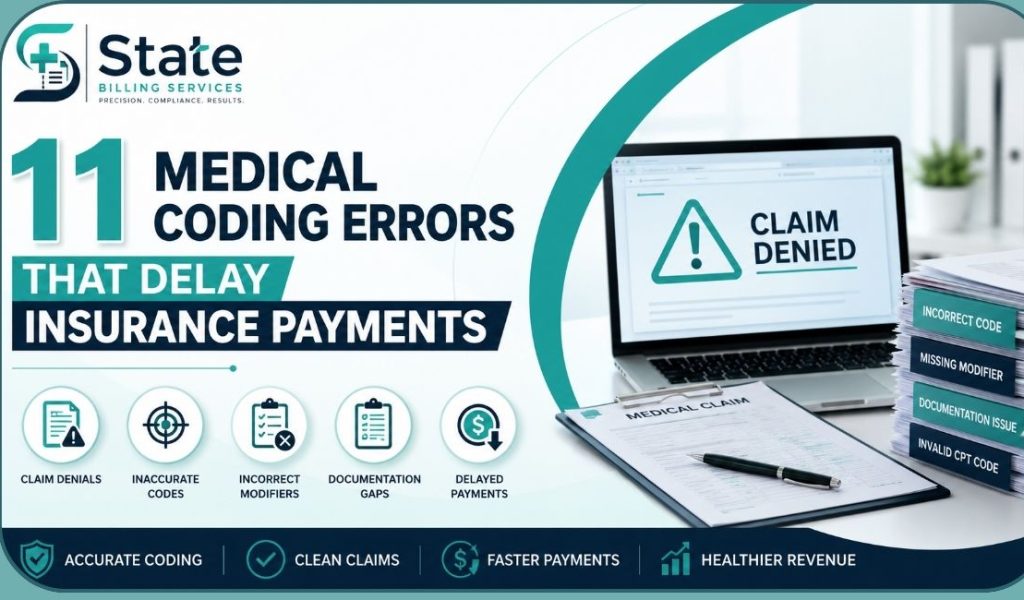
Understanding what these errors look like and why they happen is the first step toward preventing them. This article walks through eleven of the most common medical coding errors that delay insurance payments, explains why each one causes trouble, and outlines what a practice can do to catch these mistakes before they cost real money.
Why Coding Errors Have Such an Outsized Impact
A claim is only as accurate as the codes behind it. ICD-10 codes describe the diagnosis. CPT codes describe the procedure or service performed. Together, these codes tell the payer’s system exactly what happened during a patient visit and why it was medically necessary. If either code set contains an error, the payer’s system either rejects the claim outright or denies it after review, and in both cases, the practice does not get paid on schedule.
The financial effect compounds quickly. A single denied claim requires staff time to investigate, correct, and resubmit. Multiply that across dozens of claims a month, and coding errors become one of the largest hidden costs in a practice’s revenue cycle. Days in accounts receivable stretch longer than they should, and staff spend hours on rework instead of processing new claims.
1. Mismatched ICD-10 and CPT Codes
One of the most frequent errors happens when the diagnosis code does not logically support the procedure code billed. Payers check for this connection automatically, since a procedure needs a documented medical reason behind it. If a coder assigns a diagnosis that does not justify the billed procedure, the claim gets denied for lack of medical necessity.
This often happens when documentation is vague or when a coder works quickly through a high volume of charts without cross checking that the diagnosis and procedure align. A patient treated for a sprained ankle should not be billed with a diagnosis code describing an unrelated condition, even if that condition appears elsewhere in the patient’s chart.
2. Missing or Incorrect Modifiers
Modifiers add critical context to CPT codes, indicating things like which side of the body a procedure was performed on, whether multiple procedures happened during the same visit, or whether a service was distinct from another billed on the same day. Missing a required modifier, or using the wrong one, is one of the most common CPT coding errors seen across specialties.
For example, orthopedic practices frequently bill procedures on paired body parts, and a missing modifier indicating laterality can cause a payer to assume duplicate billing, resulting in an automatic denial. Cardiology practices run into similar issues when multiple diagnostic tests are performed together and need modifiers to indicate they were not bundled incorrectly.
3. Upcoding
Upcoding happens when a claim is billed at a higher level of complexity or service than what the documentation actually supports. Sometimes this is unintentional, resulting from a coder misreading a note or applying a default code without checking the specifics of the visit. Other times it results from pressure to maximize reimbursement without proper documentation to back it up.
Upcoding does not just delay payment. It creates compliance risk, since payers routinely audit for patterns of inflated coding, and Medicare in particular has strict guidelines around evaluation and management code levels. A pattern of upcoded claims can trigger a broader audit that affects far more than just the flagged claims.
4. Undercoding
The opposite problem, undercoding, happens when a coder assigns a lower level code than what the documentation actually supports, often out of caution or uncertainty. While undercoding avoids compliance risk, it directly costs the practice revenue it has legitimately earned. A provider who documents a complex visit thoroughly deserves accurate reimbursement for that complexity, and undercoding quietly erodes income over time without ever showing up as a denial.
5. Unbundling Procedures
Unbundling occurs when a coder bills separately for procedures that should be reported together under a single comprehensive code. Payers maintain bundling edits, often referred to as National Correct Coding Initiative edits, that flag these combinations automatically. When a claim triggers an unbundling edit, the payer denies the additional line items or reduces payment, and the practice has to determine which codes should have been combined in the first place.
This error tends to show up in specialties with multiple related services performed during a single visit, such as radiology, where several imaging views might be billed separately when payer rules require a single bundled code instead.
6. Truncated or Outdated ICD-10 Codes
ICD-10 codes update annually, and outdated code sets are a recurring source of coding mistakes. A truncated code, meaning one that lacks the necessary level of specificity, such as missing a required seventh character for certain injury codes, gets automatically rejected by most payer systems. Coders who do not stay current with the latest ICD-10 revision risk applying codes that were valid the previous year but have since been replaced or expanded.
A few signs that outdated coding practices might be affecting a practice include:
- A sudden spike in rejections for codes that were previously accepted without issue
- Denial reason codes referencing invalid or deleted diagnosis codes
- Coders relying on memorized codes rather than checking the current code set during high volume periods
7. Insufficient Documentation to Support the Code
Even a technically correct code can lead to a denial if the supporting documentation does not clearly justify it. Payers increasingly request medical records to verify that the level of service billed matches what was actually documented. If a provider’s notes are brief or lack specific detail, a coder has limited ability to select an accurate, defensible code, and the resulting claim becomes vulnerable to denial or later audit.
This is less a coding error in the traditional sense and more a documentation gap that coding cannot fully compensate for. Strong coding depends on strong clinical documentation working together.
8. Duplicate Coding or Billing
Duplicate billing happens when the same service gets coded and submitted more than once, whether due to a system glitch, a miscommunication between front office and billing staff, or a claim resubmission that was not properly flagged as a correction. Payers have automated systems designed to catch exact duplicates, and these claims get denied immediately, but the investigation required to sort out a duplicate from a legitimate resubmission still consumes staff time.
9. Incorrect Place of Service Codes
Place of service codes indicate where a service was performed, such as a physician’s office, an outpatient facility, or an urgent care center. Reimbursement rates often differ based on place of service, and using the wrong code can result in incorrect payment or an outright denial if the code does not match the type of provider or facility submitting the claim. Urgent care practices, in particular, need to apply place of service codes carefully, since these visits sometimes get confused with standard office visit billing in payer systems.
10. Failure to Code to the Highest Level of Specificity
ICD-10 rewards specificity. Many diagnosis codes require additional detail, such as which side of the body is affected, whether a condition is acute or chronic, or the exact stage of a disease process. Coding to a general, unspecified level when more specific information is available in the documentation often results in a lower reimbursement rate or a request for additional information before the claim gets processed.
Internal medicine practices deal with this frequently, since patients often present with multiple chronic conditions that require precise coding to reflect the full complexity of the visit.
11. Coding Errors Related to Time Based Services
Certain CPT codes, particularly in mental health billing, are based on the length of a session or service, such as a 30 minute versus a 60 minute therapy session. Coding the wrong time based code, whether by rounding incorrectly or misreading session documentation, leads to claims that do not match what payers expect to see for that service type. Since many payers set strict limits on how frequently time based codes can be billed, an error here often triggers both a denial and a flag for further review.
How Medical Coding Errors Vary Across Specialties
Medical coding challenges are not the same across every healthcare specialty. Each field has its own documentation requirements, coding guidelines, and payer expectations, which means the most common billing mistakes also differ. Understanding these specialty-specific patterns allows practices to focus audits, staff training, and quality assurance on the areas that have the greatest impact on claim acceptance and revenue.
Cardiology: Bundling Errors and Missing Modifiers
Cardiology claims often involve multiple services performed during the same patient visit, such as diagnostic tests alongside evaluation and management (E/M) services. Because these procedures are frequently billed together, incorrect code bundling and missing modifiers are common causes of claim denials.
For example, if a patient receives both an echocardiogram and a stress test on the same day, the claim must accurately distinguish each service using the appropriate CPT codes and modifiers. Without proper coding, the payer may interpret one service as a duplicate and deny reimbursement.
Orthopedics: Laterality and Procedure Accuracy
Orthopedic billing and coding relies on laterality and anatomical precision. Many diagnoses and procedures involve a specific side of the body, a particular joint, or an exact spinal level.
Even a small documentation mismatch, such as failing to indicate whether a procedure was performed on the left or right knee, can delay claim processing. Coders should verify operative reports and physician documentation carefully before assigning diagnosis and procedure codes.
Internal Medicine: Diagnosis Specificity
Internal medicine providers frequently manage patients with multiple chronic conditions during a single visit. As a result, coding accuracy depends on selecting the highest level of diagnosis specificity supported by the documentation.
Using broad or unspecified ICD-10 codes when more detailed options are available can affect medical necessity reviews, reimbursement levels, and claim approval. Thorough documentation review is essential to ensure the diagnosis accurately reflects the patient’s condition.
Urgent Care: Fast-Paced Visits Increase Coding Risk
Urgent care centers handle a high volume of patients with a wide variety of medical conditions, often combining evaluation and management services with minor procedures during the same encounter.
This fast-paced environment increases the likelihood of:
- Missing modifiers for separately identifiable services
- Incorrect place of service (POS) codes
- Incomplete documentation supporting procedures
- Errors when reporting multiple services performed during one visit
Strong coding workflows and routine claim reviews help reduce these preventable mistakes.
Radiology: Comprehensive Coding and Bundling
Radiology practices commonly encounter coding issues related to imaging bundles. Many diagnostic imaging radiology billing services include multiple views or technical components that should be reported under a single comprehensive CPT code rather than as separate line items.
Submitting individual component codes when a bundled code is required may trigger automated payer edits, resulting in denials or payment reductions.
Why Specialty-Specific Coding Reviews Matter
A one-size-fits-all coding audit rarely addresses the unique risks faced by different medical specialties. Cardiology practices may benefit from modifier audits, orthopedic clinics should prioritize laterality checks, while internal medicine practices often need greater focus on ICD-10 specificity.
By identifying the coding errors most common within their specialty, healthcare organizations can provide targeted staff training, improve coding accuracy, reduce claim denials, and accelerate insurance reimbursement. Routine specialty-focused audits also help maintain compliance while protecting long-term practice revenue.
The Role of Technology in Catching Errors Early
Modern billing software and clearinghouses include automated edit checks designed to catch many coding errors before a claim ever reaches the payer. These systems flag issues like invalid code combinations, missing modifiers, and mismatches between diagnosis and procedure codes. While this technology has reduced the volume of certain types of errors reaching payers, it does not eliminate the need for skilled human review.
Automated systems are good at catching structural errors, such as a code that does not exist or a modifier applied to a code that does not accept it. They are far less effective at catching errors of judgment, such as whether a diagnosis truly supports medical necessity for a given procedure, or whether documentation actually justifies the level of specificity a code claims. These judgment based errors still require a trained coder or a careful audit process to catch reliably.
Some practices have started using coding assistance tools built on natural language processing, which scan physician documentation and suggest likely codes based on the language used in the notes. These tools can speed up the initial coding process, but they still require a human coder to confirm accuracy, particularly for complex visits involving multiple diagnoses or procedures performed together.
| Coding Error | Common Cause | Typical Payer Response |
| Mismatched ICD-10 and CPT codes | Diagnosis does not support procedure | Denial for lack of medical necessity |
| Missing or incorrect modifiers | Overlooked detail during coding | Denial or automatic underpayment |
| Upcoding | Overstated service complexity | Denial, audit risk, compliance flag |
| Unbundling | Procedures billed separately in error | Reduced payment or line item denial |
| Outdated ICD-10 codes | Failure to update annually | Automatic rejection |
| Insufficient documentation | Vague or incomplete clinical notes | Request for records, possible denial |
How These Errors Show Up in Real Practice
Consider a radiology practice that regularly bills multiple imaging views for the same study. If a coder unintentionally unbundles these views into separate line items instead of applying the correct comprehensive code, the payer denies the extra charges. The practice’s billing team then has to research the denial, confirm the correct bundling rule, and resubmit a corrected claim. This single error, repeated across dozens of similar studies each month, can quietly cost a practice thousands of dollars in delayed or lost revenue.
A different scenario plays out in a mental health practice. A therapist documents a 45 minute session, but the coder applies the code associated with a 60 minute session out of habit. The payer’s system flags the mismatch between documented time and billed code, resulting in a denial that requires the practice to correct the code and resubmit, delaying payment for a service that was otherwise perfectly valid.
The Compliance Side of Coding Errors
Coding errors are not purely a revenue issue. Persistent patterns, especially around upcoding or inconsistent documentation, can draw attention from payers and regulators. Medicare and Medicaid both run audit programs specifically designed to detect coding patterns that suggest either intentional fraud or systemic carelessness. A practice with a strong pattern of coding errors, even unintentional ones, increases its exposure to these audits.
This is one of the reasons accurate documentation and current coding knowledge matter so much. A coder who understands the latest ICD-10 and CPT updates, and who consistently double checks documentation against code selection, reduces both the financial risk of denied claims and the compliance risk of audit exposure.
Preventing Coding Errors Before They Reach a Claim
Most coding errors are preventable with the right processes in place. A few practical steps help reduce the frequency of these mistakes:
- Schedule regular coding audits to catch patterns before they affect a large volume of claims
- Keep coders updated on annual ICD-10 and CPT changes through ongoing training
- Encourage clear, specific clinical documentation that gives coders enough detail to code accurately
- Build a second review step for high risk or high dollar claims before submission
Practices that maintain strong healthcare coding services internally or through a trusted partner tend to catch these issues earlier, since experienced coders are more likely to recognize when a diagnosis and procedure do not align or when documentation falls short of what a specific code requires.
What Happens After a Coding Error Causes a Denial
Once a coding error leads to a denial, the claim moves into the denial management process. This involves identifying the specific reason code the payer provided, correcting the underlying coding issue, and resubmitting or appealing the claim depending on the payer’s rules. Reviewing recurring medical claim denial reasons helps practices spot whether their denials cluster around specific coding categories, which often points to a training gap or a documentation issue that needs to be addressed at the source.
Strong denial management processes do more than fix individual claims. They track denial trends over time, which helps a practice identify whether a particular coder, provider, or service type is generating a disproportionate share of coding related denials.
Building a Culture of Coding Accuracy
Reducing coding errors is not just a technical fix. It requires consistent communication between providers, coders, and billing staff. Providers benefit from understanding basic coding concepts well enough to document thoroughly, even if they never code a claim themselves. Familiarity with common medical billing terms helps providers and front office staff speak the same language as coders and billers, which reduces the back and forth that often delays claim correction.
Coders, in turn, benefit from direct feedback when a pattern of errors emerges, rather than learning about a problem only after months of denials have accumulated. Practices that build in regular check ins between clinical and billing teams tend to catch small errors before they become expensive habits.
Practical Next Steps for Reducing Coding Errors
Coding errors will never disappear entirely, since human review is still central to accurate coding, and no system is completely immune to mistakes. But the frequency and financial impact of these errors can be reduced significantly with the right combination of training, documentation standards, and review processes.
A useful starting point is reviewing the past three months of denied claims and sorting them by denial reason. This simple exercise often reveals a small number of recurring coding issues responsible for a disproportionate share of delayed payments. From there, targeted training or a documentation improvement effort can address the specific gap rather than treating coding accuracy as a vague, general goal.
Practices that want a broader view of their coding and billing accuracy at States Billing can also benefit from a structured audit that compares documentation, codes, and submitted claims side by side, revealing exactly where errors originate and what changes would have the greatest impact on payment speed.
Coding errors that delay insurance payments are almost always fixable once identified clearly. The challenge is usually not a lack of coding knowledge but a lack of consistent review, updated training, and clear communication between the people documenting care and the people translating that documentation into billable codes.
If your practice is dealing with recurring denials, slow payments, or uncertainty about where coding errors are originating, working with an experienced billing partner can help identify the root cause quickly. States Billing Services SC works with practices across specialties to improve coding accuracy, reduce denials, and speed up reimbursement through careful review and consistent process improvement. Reach out through statebillingservices.com to see how a dedicated coding and billing review can strengthen your practice’s revenue cycle.