A payment lands in the practice bank account. The amount looks right, but nobody on the billing team can say exactly which claims it covers. The explanation of benefits arrived days earlier by mail, and the electronic remittance never got matched to the deposit.
This kind of gap happens constantly in medical billing, and it usually comes down to confusion between three terms that sound related but serve different purposes: ERA, EOB, and EFT. Each one plays a specific role in getting a claim from submission to a reconciled payment, and mixing them up during daily reconciliation is one of the more overlooked medical billing workflow problems practices deal with.
This guide breaks down what each term means, how they connect, and what a billing team needs to do to keep payment posting accurate instead of guesswork after the fact.
What Is an ERA (Electronic Remittance Advice)
An electronic remittance advice, or ERA, is a digital file a payer sends to explain how a claim was processed. It shows the billed amount, the allowed amount, any adjustments, the patient responsibility, and the final payment for each claim line.
ERAs follow a standardized format known as the 835 transaction set, defined under the Health Insurance Portability and Accountability Act (HIPAA). This standardization means a practice management system can read an ERA automatically and post payments without a person retyping numbers from a paper document.
Because the format is standardized, ERAs are built for automation. A billing system can match an ERA to the original claim, apply the payment, and flag any denied or adjusted lines for review, all without manual entry.
What Is an EOB (Explanation of Benefits)
An explanation of benefits, or EOB, contains much of the same information as an ERA, but it is written for a person to read rather than a system to process. Payers send EOBs to patients to explain what was billed, what the plan covered, and what the patient may owe.
Some payers also send a provider facing version of the EOB, sometimes as a paper document or a PDF, especially for payers that have not fully adopted electronic remittance. When a practice only receives an EOB and no matching ERA, someone has to manually enter that payment information into the billing system, which takes longer and introduces more room for error.
The EOB is not inherently less accurate than an ERA. The difference is format and audience. An EOB speaks to a patient’s coverage. An ERA speaks to a billing system’s posting logic.
What Is an EFT (Electronic Funds Transfer)
An electronic funds transfer, or EFT, is the actual movement of money from the payer to the provider’s bank account. It replaces the paper check that practices used to wait for in the mail.
An EFT by itself carries very little detail. A bank deposit might show a payer name and a dollar amount, but it will not explain which claims that amount covers. This is exactly why the ERA matters so much. Without it, an EFT is just an unexplained deposit sitting in the bank account.
ERA vs. EOB vs. EFT: The Key Differences
Seeing these three side by side makes the distinction much clearer than reading each definition separately.
| Factor | ERA | EOB | EFT |
|---|---|---|---|
| What it is | Electronic claim payment detail | Human readable payment explanation | Actual money transfer |
| Primary audience | Billing system or biller | Patient, sometimes provider | Provider’s bank account |
| Format | Standardized 835 transaction | Paper or PDF, varies by payer | Bank transaction, often via ACH |
| Automation level | High, built for system posting | Low, often needs manual review | Automatic once enrolled |
How These Three Work Together in the Payment Cycle
A clean payment cycle involves all three pieces lining up. The payer processes a claim, generates an ERA with the line by line detail, and sends an EFT to move the money. The EOB, when applicable, goes to the patient separately to explain their portion.
Problems start when these pieces arrive out of sync. An EFT might post to the bank account before the matching ERA arrives, leaving the deposit unexplained for a day or more. Some payers still send EOBs by mail even when they support ERA and EFT for the same claim, creating an extra document that does not always match perfectly with the electronic version.
The Role of Clearinghouses in ERA Delivery
Most practices do not receive ERAs directly from every payer. A clearinghouse usually sits between the payer and the practice management system, collecting ERAs from multiple payers and delivering them in a consistent format the practice’s software can read.
This matters because payer enrollment for electronic remittance is not automatic. A practice typically has to enroll separately with each payer, sometimes through the clearinghouse, to start receiving ERAs and EFTs instead of paper checks and mailed EOBs. Skipping this enrollment step is one of the most common reasons a practice ends up manually posting payments that could have been automated.
HIPAA and Standardized Electronic Transactions
HIPAA established standard formats for electronic healthcare transactions, including the 835 transaction set used for ERAs. This standardization exists so that a payment file from one payer looks structurally the same as a payment file from another, even though the actual payment amounts and adjustment codes differ.
This same standardization effort covers claim submission (the 837 transaction) and eligibility checks, creating a consistent electronic data interchange framework across the industry. For billing teams, understanding that ERAs follow this same HIPAA standard explains why most modern practice management systems can automatically parse them, regardless of which payer sent the file.
Common Reconciliation Problems When Posting Payments
Even with standardized formats, reconciliation problems still show up regularly in day to day billing work.
A frequent issue is a lump sum EFT that covers dozens of claims across multiple patients, while the corresponding ERA arrives late or gets misrouted. Staff see money in the bank with no explanation and either wait for the ERA or begin guessing which claims it might cover, both of which slow down the process.
Another common problem involves partial matches, where an EFT amount does not equal the sum of the ERA lines a team has already posted. This can happen when a payer bundles multiple ERAs into one payment, or when a small adjustment or recoupment reduces the deposit without a separate line item explaining it clearly.
A Practical Reconciliation Workflow
A consistent daily process prevents most of the confusion between these three pieces of the payment puzzle.
| Step | Action | Why It Matters |
|---|---|---|
| 1 | Download and post all available ERAs daily | Keeps claim status current and reduces backlog |
| 2 | Match each EFT deposit to its corresponding ERA total | Confirms the bank deposit reflects posted claims |
| 3 | Flag unmatched deposits for follow up within 48 hours | Prevents unexplained money from sitting unreconciled |
| 4 | Compare any paper EOBs against the electronic ERA for the same claim | Catches payer discrepancies early |
| 5 | Review denied or adjusted lines from the ERA the same day | Speeds up appeals and resubmissions |
Why Payment Posting Accuracy Affects the Whole Revenue Cycle
Payment posting sits in the middle of the revenue cycle, not at the end of it. An inaccurate or delayed posting throws off accounts receivable reports, making it look like a claim is still outstanding when it has actually been paid, or the reverse.
This matters directly for payment posting services, since the accuracy of this single step determines whether every downstream report, from AR aging to monthly revenue summaries, reflects reality. A practice cannot manage how to reduce accounts receivable in medical billing effectively if the posting data feeding those reports is unreliable. Clean, current posting also supports faster insurance reimbursements overall, since staff can spend their time chasing genuine outstanding balances instead of untangling posting errors first.
Enrollment Steps for ERA and EFT
Practices that still receive paper checks and mailed EOBs from major payers are usually missing an enrollment step rather than facing a technical limitation. Most payers offer ERA and EFT enrollment through their provider portal or through a clearinghouse.
The enrollment process typically requires the practice’s National Provider Identifier, banking information for EFT, and confirmation of which payer identification numbers should route through the clearinghouse. This is closely related to eligibility verification services in South Carolina, since both processes depend on accurate payer and provider identifiers being set up correctly from the start.
When Manual EOB Entry Is Still Necessary
Not every payer has moved fully to electronic remittance. Some smaller payers, certain workers compensation carriers, and a handful of out of state plans still rely on paper EOBs and checks. In these cases, manual entry remains part of the workflow, and accuracy depends on a consistent data entry process rather than automation.
Practices that handle a mix of electronic and paper remittance often benefit from separating these two workflows clearly, so staff are not trying to apply the same automated matching logic to a paper document that was never designed for it. Assigning one staff member to own the paper remittance queue, rather than splitting it across the whole team, also tends to reduce the error rate, since that person becomes familiar with which specific payers still send paper and what their EOB format typically looks like.
Training Billing Staff on the Differences
New billing staff often use these three terms interchangeably until a reconciliation problem forces them to learn the distinction the hard way. A short training session covering what each document represents, and how they should line up during daily reconciliation, prevents a lot of confusion later.
This training works best when it uses real examples from the practice’s own payer mix rather than generic definitions alone. Reviewing an actual ERA next to its matching EFT deposit, and pointing out where a paper EOB might diverge from the electronic version, gives new staff a concrete reference point.
Understanding Adjustment Codes on the ERA
Every ERA includes standardized codes that explain why a payment differs from the billed amount. Claim Adjustment Reason Codes (CARCs) describe the general reason for an adjustment, such as a contractual discount, a bundled service, or patient responsibility. Remittance Advice Remark Codes (RARCs) add further detail alongside a CARC when more explanation is needed.
Billing staff who can read these codes quickly move through payment posting far faster than those who have to look up every code manually. Building a quick reference sheet of the codes a practice sees most often, tied to the payers it works with most, saves real time during daily posting.
Misreading these codes is also a common source of posting errors. A CARC indicating a contractual write off looks very different from one indicating patient responsibility, and treating one as the other throws off both the practice’s revenue figures and the patient’s statement.
Why an EFT Sometimes Arrives Before the ERA
Timing mismatches between an EFT and its ERA happen for a few predictable reasons. Some payers process the financial transaction and the remittance data through separate internal systems, which do not always sync perfectly. A clearinghouse delay on the remittance side can also hold up ERA delivery by a day or two even though the bank transfer completes on schedule.
When this happens, the safest approach is to hold the deposit as unapplied cash in the practice management system rather than guessing which claims it covers. Posting payments to the wrong claims to make the numbers balance temporarily creates more reconciliation work later, once the correct ERA finally arrives.
Automating ERA and EFT Matching
Many practice management systems and clearinghouses offer automated matching between EFT deposits and ERA files, often called auto posting. When configured correctly, this feature can post the majority of straightforward payments without any manual entry, leaving staff to focus only on exceptions like denials, partial payments, or unmatched deposits.
Setting up auto posting well requires some upfront configuration, including mapping each payer’s specific adjustment codes to the correct categories in the practice management system. Practices that skip this setup step often end up with auto posting that creates more manual cleanup than it saves, since misclassified codes still need to be corrected after the fact.
Even with automation in place, a periodic manual audit of a small sample of auto posted claims helps confirm the system is classifying payments correctly, rather than assuming the automation is accurate indefinitely. This is especially important after a payer changes its remittance format or introduces new adjustment codes, since auto posting rules built around the old format may quietly misclassify payments until someone notices the pattern.
Auditing Your Payment Posting Process
A regular audit of payment posting accuracy catches small errors before they accumulate into a larger discrepancy. This does not need to be complicated. Reviewing a sample of posted claims each week against their original ERA, confirming the posted amount, adjustment, and patient responsibility all match, is usually enough to catch most issues.
Practices that skip this step often discover posting errors only when a bank reconciliation fails to balance at month end, by which point tracing the source of a discrepancy across dozens of claims takes far longer than it would have taken to catch a single error the week it happened.
Secondary and Tertiary Payer Complications
Reconciliation gets more complex once a secondary or tertiary payer enters the picture. A primary payer’s ERA might show a patient responsibility amount that the secondary payer then partially or fully covers, generating its own separate ERA and EFT for the remaining balance.
Billing staff need to track each payer’s remittance separately while still viewing the claim as a single unit for patient balance purposes. Posting the primary payment without accounting for a pending secondary claim can create a premature patient statement showing a balance that a secondary payer is about to cover, which creates unnecessary confusion and patient billing questions.
A consistent hold period before generating patient statements, long enough to allow secondary claims to process, reduces this type of avoidable confusion significantly.
Impact on Month End Financial Reporting
Month end financial reports depend heavily on accurate, timely payment posting. If ERAs sit unposted or EFTs remain unmatched at the close of a reporting period, revenue figures for that month understate actual collections, while the following month appears artificially inflated once the backlog clears.
This distortion makes it harder for practice leadership to spot real trends, such as a slow decline in reimbursement from a specific payer, since posting delays mask the true monthly pattern. Keeping ERA and EFT posting current throughout the month, rather than catching up in a rush before reports are due, produces far more reliable financial data for decision making.
Coordinating Payment Posting with the Front Office
Payment posting does not happen in isolation from the rest of the practice. Front office staff handling patient billing questions need current, accurate posting data to answer those questions correctly. A patient calling about a balance that has already been paid by insurance, but not yet posted, creates an avoidable frustrating call for both the patient and the staff member.
Practices that keep posting current on a daily basis give front office staff a much stronger position when patients call with billing questions, since the account reflects the true current status rather than a status that is several days behind.
Choosing a Clearinghouse That Simplifies Reconciliation
Not all clearinghouses handle ERA and EFT delivery the same way. Some provide a single consolidated view across all connected payers, showing which ERAs have arrived and which EFTs remain unmatched. Others simply pass files through without any tracking layer, leaving the practice to build its own reconciliation view inside the practice management system.
For a practice working with a large number of payers, a clearinghouse with strong reconciliation tools can save meaningful staff time each week. When evaluating options, it helps to ask specifically how the platform flags unmatched EFTs, since this single feature often separates a genuinely useful tool from one that only automates the easy part of the process.
Practices already working with a revenue cycle partner for Healthcare revenue cycle management in SC often have this reconciliation layer handled as part of that broader service, which removes one more manual step from the practice’s daily workload.
Answers to Your Questions
Can a practice receive an EFT without a matching ERA?
Yes, and this is one of the most common reconciliation headaches. It usually means the ERA is delayed, misrouted through the wrong clearinghouse connection, or the practice never completed ERA enrollment for that specific payer even though EFT was set up.
Is an EOB the same as a denial notice?
Not exactly. An EOB explains how a claim was processed, which can include a denial, a partial payment, or a full payment. A denial notice is more specific and usually accompanies an EOB or ERA line showing a claim did not pay.
Do all payers support ERA and EFT?
Most major commercial payers, Medicare, and Medicaid support both. Coverage is less consistent among smaller regional payers, certain workers compensation carriers, and some out of network claim processors, which may still rely on paper checks and EOBs.
What should staff do with an unapplied EFT deposit?
Log it as unapplied cash in the practice management system and follow up with the payer or clearinghouse if the matching ERA does not arrive within a few business days. Avoid guessing which claims the deposit covers just to clear it from an outstanding list.
Why does the patient’s EOB sometimes show a different amount than the practice’s ERA for the same claim?
This can happen when a payer applies a secondary adjustment, such as a coordination of benefits calculation, after generating the initial patient facing EOB. Comparing both documents side by side, rather than assuming one is simply wrong, usually clarifies the difference.
Keeping ERA, EOB, and EFT Aligned for Faster Reconciliation
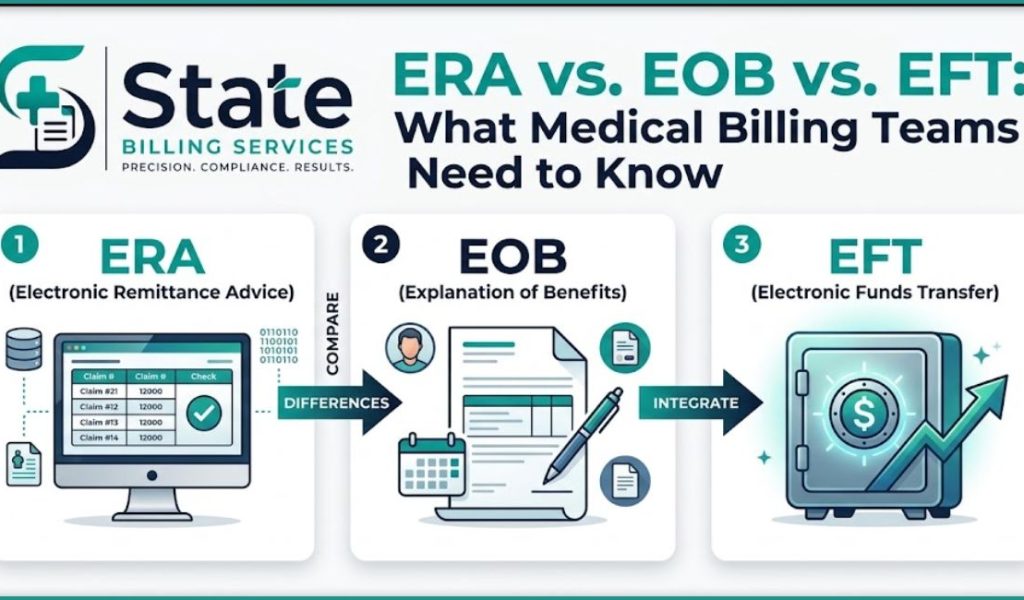
ERA, EOB, and EFT each answer a different question in the payment process. The ERA explains how a claim was adjudicated. The EOB communicates that same information to a patient in a readable format. The EFT is simply the money moving into the bank account.
Billing teams that treat these as three connected pieces, rather than three unrelated documents, reconcile payments faster and catch discrepancies before they become larger accounts receivable problems. Understanding basic medical billing terms like these is not just background knowledge. It directly affects how quickly a practice gets an accurate picture of its own cash flow, and how confidently staff can answer a patient’s billing question the first time they call instead of promising to look into it and call back.
If your practice struggles to reconcile ERAs, EOBs, and EFTs consistently, a dedicated billing team can close that gap and give you a clearer, more current view of your cash flow. Our certified team helps practices streamline payment posting and keep accounts receivable accurate. Visit States Billing Services in SC to learn how our team can support your payment reconciliation process.