A patient walks into a clinic with knee pain. The provider examines the joint, orders an X-ray, and prescribes a treatment plan. Weeks later, the practice is still waiting on payment from the insurance company, and nobody on staff can explain why the claim was denied. This scenario plays out in medical offices every single day, and in most cases, the root cause traces back to a simple misunderstanding: confusing medical billing with medical coding, or assuming they are the same task handled by the same person.
They are not. And the gap between the two is often where revenue quietly disappears.
If you run a practice, manage a clinic, or simply want to understand how your medical bills get generated, knowing the difference between these two functions is not optional knowledge anymore. It is the foundation of a healthy revenue cycle. This article breaks down exactly what separates medical billing from medical coding, how each one works, why both matter, and what happens when a practice gets either one wrong.
Why This Confusion Exists in the First Place
Medical billing and medical coding are frequently mentioned together, often in the same job posting, the same training program, or the same software suite. That pairing makes sense operationally, since both functions sit inside the same revenue cycle and depend on each other to produce a paid claim. But pairing does not mean sameness.
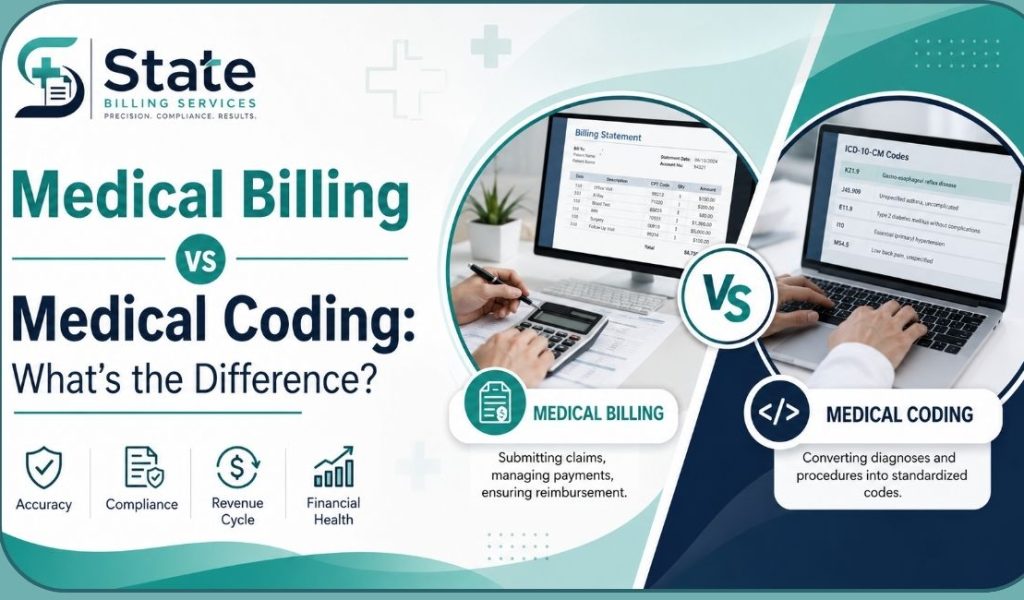
Coding happens first. It is the translation of a patient encounter into standardized codes. Billing happens after. It is the process of turning those codes into a claim, submitting that claim to a payer, and following through until the practice gets reimbursed. One converts clinical documentation into a universal language. The other manages the financial transaction built on top of that language.
Think of it like construction. A coder is the architect who draws the blueprint based on what actually happened during the visit. A biller is the contractor who takes that blueprint, submits the permits, deals with the city inspector, and makes sure the project actually gets paid for. Without an accurate blueprint, the contractor cannot get anything approved. Without a competent contractor, even a perfect blueprint sits unused.
What Medical Coding Actually Involves
Medical coding is the process of reviewing clinical documentation, physician notes, lab results, and procedure records, then assigning standardized alphanumeric codes to describe the diagnosis, the procedure performed, and any supplies or services used during a patient visit.
Coders rely on several code sets, and each serves a distinct purpose.
ICD-10 Coding
ICD-10 stands for the International Classification of Diseases, 10th revision. It is maintained by the World Health Organization and adapted for use in the United States by the Centers for Medicare and Medicaid Services. This code set covers diagnoses, meaning it answers the question: what condition does the patient have?
ICD-10 coding requires precision. A code for a fracture, for example, changes depending on which bone is affected, whether it is the initial encounter or a follow up, and whether the fracture is displaced or non displaced. Getting even one digit wrong can shift a claim from covered to denied, or trigger an audit flag.
CPT Codes
CPT codes, short for Current Procedural Terminology, are maintained by the American Medical Association and describe the actual services or procedures performed. If ICD-10 answers what is wrong with the patient, CPT codes answer what the provider did about it.
A single office visit might involve several CPT codes stacked together: an evaluation and management code, a code for an injection, and a code for a diagnostic test, all billed for the same encounter. Coders have to know which codes can be billed together, which require modifiers, and which combinations will trigger automatic denials under payer bundling rules.
HCPCS Level II Codes
Alongside ICD-10 and CPT, coders also work with HCPCS Level II codes, which cover items like durable medical equipment, ambulance services, and certain drugs administered in a clinical setting. These codes fill gaps that CPT does not address, particularly for supplies and equipment.
The Skill Behind the Codes
Coding is not data entry. A trained coder reads the physician’s documentation and has to interpret clinical language accurately enough to select the correct code from thousands of options. This requires ongoing education, since code sets update annually and payer rules shift just as often. A coder who is a year behind on ICD-10 updates can unintentionally cause a wave of denials without anyone realizing why.
Accurate medical coding services in South Carolina protect a practice in two directions. They make sure the practice gets paid for everything it is entitled to, and they protect against compliance risk from upcoding or inaccurate documentation, which can trigger audits from Medicare or private payers.
What Medical Billing Actually Involves
Once a coder has translated the encounter into ICD-10 and CPT codes, the billing process begins. Medical billing is the administrative and financial side of the revenue cycle. It takes the coded information and turns it into an actual claim submitted to an insurance company, government payer, or patient.
Step One: Patient Registration and Eligibility Verification
Before a single code is even applied, billing staff typically confirm the patient’s insurance is active and covers the planned service. Eligibility verification services catch problems early, such as a lapsed policy or a plan that requires prior authorization, before the visit happens rather than after the claim gets rejected.
Step Two: Charge Entry and Claim Creation
Billing staff take the codes from the coder and enter them into a claim form, either the CMS-1500 for professional services or the UB-04 for institutional claims. This step also involves attaching the correct modifiers, patient demographic information, and payer details.
Step Three: Claims Submission
The claim is submitted electronically to the payer through a clearinghouse, which checks for basic formatting errors before the claim reaches the insurance company. A clean claim, meaning one free of errors on the first submission, gets paid faster and with fewer complications.
Step Four: Payment Posting
Once the payer processes the claim, payment posting services record the amount paid, adjust for any contractual write offs, and identify the balance, if any, that gets billed to the patient.
Step Five: Denial Management and Appeals
Not every claim gets approved the first time. Denial management services review rejected claims, identify the reason for denial, correct the issue, and resubmit or appeal. Common denial reasons include mismatched codes, missing prior authorization, timely filing issues, or eligibility problems that were missed earlier in the process.
Step Six: Accounts Receivable Follow Up
Billing does not end at submission. AR recovery services track unpaid claims, follow up with payers on outstanding balances, and work to close the loop on aging accounts before they become uncollectible.
Billing, in short, is a continuous cycle of submission, tracking, correction, and collection. It requires attention to payer specific rules, since Medicare, Medicaid, and private insurers each have different requirements for what a clean claim looks like.
Side by Side Comparison
| Aspect | Medical Coding | Medical Billing |
| Primary task | Assigns ICD-10, CPT, and HCPCS codes to clinical documentation | Converts coded data into claims and manages the payment process |
| Timing in cycle | Happens immediately after the patient encounter | Happens after coding is complete |
| Core skill | Clinical documentation interpretation and code accuracy | Payer rules, claims tracking, and financial follow up |
| Main output | An accurately coded patient record | A submitted, paid, or appealed claim |
| Risk if done poorly | Compliance exposure, incorrect reimbursement rates | Denied claims, delayed payments, revenue loss |
Qualifications, Training, and Certification Behind Each Role
The gap between coding and billing also shows up in how each professional gets trained. Medical coders typically pursue certification through organizations such as the American Academy of Professional Coders or the American Health Information Management Association. Common credentials include the Certified Professional Coder designation and the Certified Coding Specialist designation, both of which require passing an exam covering ICD-10, CPT, and HCPCS Level II code sets along with anatomy, physiology, and medical terminology.
This training matters because coding is not something a person can pick up casually and apply correctly. A coder has to recognize clinical language patterns across dozens of specialties, know which codes payers will reject on sight, and stay current every year when the ICD-10 and CPT manuals get updated. The Centers for Medicare and Medicaid Services publishes ICD-10 updates annually, usually effective October first, and coders who miss these updates risk applying outdated codes that get automatically rejected by payer systems.
Billing professionals, by contrast, often build expertise through a combination of on the job training and certifications like the Certified Professional Biller credential. Their learning curve centers less on clinical interpretation and more on payer contracts, claim form requirements, appeals processes, and the specific quirks of Medicare, Medicaid, and commercial insurance plans. A biller working with a practice that accepts Medicaid, for instance, needs to understand South Carolina specific Medicaid billing rules, which can differ from commercial payer requirements in areas like prior authorization thresholds and timely filing deadlines.
Some practices choose to invest in cross training, teaching billers enough coding fundamentals to catch obvious errors before submission, and teaching coders enough about claims processing to understand how their code choices affect downstream reimbursement. This cross functional awareness tends to reduce friction between departments and catches errors earlier in the process, before a claim ever reaches a payer.
Where the Two Roles Overlap
Even though coding and billing are distinct, they are not isolated from each other. A biller cannot submit an accurate claim without correct codes. A coder’s work has no financial impact until a biller processes it into a claim. This is why many smaller practices combine both functions into a single role, sometimes called a coder biller, particularly in specialties with lower claim volume.
Larger practices and specialty groups, on the other hand, tend to separate the two functions entirely, often because the complexity of certain specialties demands it. South Carolina Cardiology billing, for example, involves complex bundling rules around diagnostic testing and procedures that require specialized coding knowledge separate from the billing follow up process. The same applies to orthopedic care, where surgical coding accuracy directly affects reimbursement for multi step procedures, and to radiology, where coding for imaging studies has its own set of modifier rules tied to global periods and professional versus technical components.
Mental health billing presents a different kind of overlap challenge, since time based CPT codes for therapy sessions require precise documentation of session length, and billing staff need to track authorization limits that vary significantly by payer. Internal medicine practices often deal with high volume, varied encounters that require coders who can move fluidly between multiple specialties within a single day. Urgent care carries its own complexity too, since walk in visits often combine evaluation and management codes with same day procedures, and coding accuracy directly affects how quickly those claims clear.
How a Single Error Cascades
Consider a mid sized orthopedic practice in South Carolina. A patient comes in for a follow up after knee surgery. The physician documents the visit thoroughly, but the coder misreads the documentation and applies a code for an initial encounter instead of a subsequent encounter. That single ICD-10 error passes through billing untouched, since the biller assumes the coding is correct and submits the claim as is.
The payer denies the claim because the encounter type does not match the documented timeline of care. Now the biller has to identify the denial reason, communicate with the coder to correct the ICD-10 code, resubmit the corrected claim, and wait through another processing cycle. What could have been a same day payment turns into a 30 to 45 day delay, and that delay repeats across every claim the coder touches with the same error until someone catches the pattern.
This is the kind of breakdown that a well run revenue cycle management process is designed to prevent, through regular audits, cross checks between coding and billing teams, and consistent monitoring of denial trends.
The Financial Impact of Getting This Wrong
Practices that treat coding and billing as interchangeable, or that understaff one function while overloading the other, tend to see specific symptoms. Claim denial rates climb. Days in accounts receivable stretch longer than they should. Staff spend more time on rework than on new claims. Over time, this erodes cash flow in a way that is hard to reverse without a structural fix.
Tracking a few key billing metrics gives practices a way to catch these problems before they compound. Metrics like first pass claim acceptance rate, denial rate by payer, and average days in AR reveal whether the coding and billing functions are working in sync or pulling against each other.
Practices dealing with recurring denial issues often benefit from reviewing common medical claim denial reasons, since many of them trace back to a coding gap that billing staff cannot fix on their own. Similarly, practices trying to reduce accounts receivable usually find that the fastest improvements come from tightening the handoff between coding accuracy and claims submission, not from adding more billing staff.
In House vs Outsourced: Where Should These Functions Live?
Some practices keep coding and billing entirely in house, hiring dedicated staff for each function. Others choose to outsource one or both, particularly as claim volume grows or as specialty complexity increases. The decision between in house vs outsourced medical billing usually comes down to a few practical factors: staff turnover, access to certified coders, the cost of ongoing training on annual code updates, and the practice’s ability to keep up with payer specific billing rules across multiple insurers.
For practices that decide outsourcing makes sense, timing matters as much as the decision itself. The right time is usually before denial rates spike or accounts receivable balloons, not after. Practices that outsource coding and billing together often see tighter coordination between the two functions, since both teams operate under a single accountable process rather than two disconnected departments.
Affordable outsourcing does not necessarily mean cutting corners. Cost effective outsourcing usually comes from efficiency, meaning fewer errors, faster turnaround, and stronger denial management, rather than from cheaper labor alone.
Compliance Considerations Both Functions Share
Coding accuracy directly affects compliance. Upcoding, meaning billing for a more complex service than what was actually documented or performed, can trigger audits and financial penalties. Undercoding, on the other hand, means the practice loses revenue it earned. Coders trained on current ICD-10 and CPT updates reduce this risk substantially.
Billing compliance follows a parallel track. Claims must be submitted within timely filing windows, patient balances must be billed accurately, and documentation supporting each claim must be retained in case of an audit. Provider credentialing also plays a role here, since a provider who is not properly credentialed with a payer will have claims denied regardless of how accurate the coding is.
Prior authorization intersects with both coding and billing as well. Certain procedures require authorization before the service is performed, and the authorization request itself depends on accurate CPT codes describing the planned procedure. If the authorization does not match what actually gets billed later, the claim gets denied even if the coding is technically correct.
How Technology Has Changed Both Roles
Coding and billing today rely heavily on software systems, from electronic health records that feed documentation directly to coders, to practice management systems that track claims through the entire billing cycle. Automated coding tools using natural language processing can suggest codes based on physician documentation, though human review remains necessary since these tools still miss context that an experienced coder catches.
On the billing side, clearinghouses now flag many errors before a claim ever reaches the payer, catching issues like mismatched patient demographics or invalid code combinations. This has reduced some denial rates industry wide, but it has not eliminated the need for skilled billing staff who understand payer specific nuances that automated systems cannot fully account for.
What Providers in South Carolina and Beyond Should Take Away
Understanding the difference between medical billing and medical coding is not an academic exercise. It directly affects how quickly a practice gets paid, how much revenue it retains, and how exposed it is to compliance risk. Coding sets the foundation. Billing builds on that foundation and carries the claim through to payment. Weakness in either function creates a bottleneck that the other cannot fully compensate for.
Practices should regularly review their coding accuracy rates, monitor denial trends by category, and ask whether their current staffing model, whether in house, outsourced, or a hybrid, is actually keeping pace with claim volume and specialty complexity. Growing patient volume without a solid billing infrastructure behind it only amplifies existing revenue cycle problems.
For practices unsure where their current process is losing money, a practical first step is a coding and billing audit, comparing documentation against submitted claims to spot patterns in denials or missed charges. This kind of review often reveals whether the issue sits upstream in coding accuracy or downstream in claims follow up, which then determines exactly what needs to change.
Medical billing and medical coding will always be connected, but treating them as one and the same is where many practices lose revenue without realizing it. Getting clear on where one function ends and the other begins is the first step toward a revenue cycle that actually works the way it should.
If your practice is dealing with rising denials, slow reimbursements, or uncertainty about where coding and billing responsibilities overlap, working with a dedicated partner can close that gap. States Billing Services SC offers coding and billing support built around accuracy, compliance, and faster reimbursement, helping practices across specialties keep their revenue cycle running the way it should. Visit statebillingservices.com to see how a coordinated approach to coding and billing can strengthen your practice’s bottom line.