
A physician reviews a monthly revenue report and sees a line item labeled “adjustment” next to a claim that was supposedly paid in full. Below it sits another claim marked “denied, CO-16” with no further explanation. The physician has spent years mastering clinical care, but the billing report in front of them reads like a foreign language. This happens far more often than most people in healthcare admit, and it is not a sign of poor training. Medical billing has its own vocabulary, and nobody teaches it in medical school.
For a provider running a practice in South Carolina or anywhere else, not knowing this vocabulary creates a real problem. Staff use these terms constantly in conversations about claims, denials, and payments, and a provider who cannot follow along has no way to catch mistakes, ask the right questions, or hold a billing team accountable. Understanding basic medical billing terminology is not about becoming a coder or a biller. It is about being able to read your own financial data and make informed decisions about your practice.
This article walks through 25 terms that show up constantly in day to day billing operations. Each one is explained in plain language, with context on why it matters and how it connects to the broader claims process. By the end, reading a claims report or an explanation of benefits should feel far less confusing.
Why Billing Terminology Matters More Than It Seems
Every claim that moves through a practice passes through several stages: registration, coding, submission, adjudication, and payment or denial. At each stage, specific terms describe what is happening and why. When a provider does not understand these terms, communication breaks down between clinical staff and billing staff, and problems get missed until they show up as a drop in revenue.
There is also a compliance angle. Billing terminology often reflects specific payer rules and federal regulations. A provider who understands what a term like “timely filing” means is far less likely to lose revenue simply because a claim sat too long before submission. Terminology, in this sense, is not academic. It is directly tied to whether a practice gets paid accurately and on time.
Foundational Claims and Billing Process Terms
1. Claim
A claim is the formal request submitted to an insurance company or payer asking for payment for services rendered to a patient. It includes the patient’s information, the provider’s information, the diagnosis codes, the procedure codes, and the charges for each service. Every claim follows a standardized format, most commonly the CMS-1500 form for professional services or the UB-04 form for institutional billing.
2. Clean Claim
A clean claim is one that passes through the payer’s system without errors on the first submission. It has correct patient information, valid codes, and no missing data. Clean claims get processed and paid faster, while claims with even minor errors get kicked back for correction, which delays payment by days or weeks.
3. Adjudication
Adjudication is the process a payer uses to review a submitted claim and decide how much, if anything, to pay. During adjudication, the payer checks the claim against the patient’s coverage, the provider’s contract, and any applicable coverage rules. The outcome of adjudication determines whether the claim is paid in full, paid partially, or denied.
4. Explanation of Benefits
An explanation of benefits, commonly shortened to EOB, is a document sent to the patient after a claim has been adjudicated. It outlines what the insurance company covered, what was applied to deductibles or copays, and what portion, if any, the patient owes. It is not a bill, though patients often confuse it for one.
5. Remittance Advice
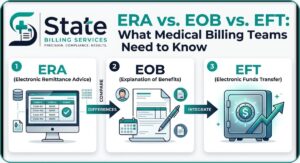
A remittance advice, sometimes called an ERA when sent electronically, is the version of the EOB sent to the provider rather than the patient. It details how each line item on a claim was paid, adjusted, or denied, and it includes reason codes that explain the payer’s decision.
Coding and Documentation Related Terms
6. ICD-10
ICD-10 stands for the International Classification of Diseases, 10th revision. These are the codes used to describe a patient’s diagnosis. Every claim needs at least one ICD-10 code to justify why a service was medically necessary.
7. CPT Code
CPT stands for Current Procedural Terminology. These codes describe the specific procedure or service performed during a patient visit, such as an office visit, a lab test, or a surgical procedure. CPT codes are maintained by the American Medical Association and updated annually.
8. HCPCS
HCPCS, pronounced “hick picks,” stands for Healthcare Common Procedure Coding System. Level II of this code set covers items that CPT codes do not, such as durable medical equipment, ambulance transport, and certain injectable medications.
9. Modifier
A modifier is a two character code added to a CPT or HCPCS code to provide additional detail about a service, such as indicating that a procedure was performed on a specific side of the body or that multiple procedures were performed during the same visit. Missing or incorrect modifiers are one of the most common reasons claims get denied or underpaid.
10. Superbill
A superbill is an internal document, often generated at the end of a patient visit, that lists the diagnosis and procedure information a provider recorded during the encounter. It serves as the source document that coders and billers use to create the actual claim.
Payer and Insurance Related Terms
11. Explanation of Payer Policy: Prior Authorization
Prior authorization is approval a payer requires before certain services, tests, or medications can be provided. Without it, a payer may deny the claim entirely, even if the service was medically appropriate. Providers dealing with imaging, certain surgeries, or specialty medications run into this term constantly, and confirming authorization requirements through prior authorization services in South Carolina before the appointment prevents avoidable denials later.
12. Eligibility Verification
Eligibility verification is the process of confirming that a patient’s insurance is active and that the planned service is covered under their plan. This step happens before the visit, and skipping it is one of the fastest ways to end up with an unpaid claim. Practices that build eligibility verification SC into their scheduling workflow catch coverage problems before they become billing problems.
13. Coordination of Benefits
Coordination of benefits, often abbreviated COB, applies when a patient has more than one insurance plan. It determines which plan pays first, called the primary payer, and which pays second, called the secondary payer. Errors in coordination of benefits frequently cause claims to be denied or delayed while payers sort out responsibility.
14. In Network vs Out of Network
A provider who is in network has a contract with a specific payer that sets agreed upon rates for services. An out of network provider has no such contract, which usually means higher costs for the patient and a more complicated reimbursement process for the practice.
15. Allowed Amount
The allowed amount is the maximum a payer will pay for a specific service under a patient’s plan, based on the contract between the payer and the provider. Anything billed above the allowed amount is typically written off by the provider rather than charged to the patient, depending on the contract terms.
Denial and Appeals Terminology
16. Denial
A denial occurs when a payer refuses to pay a claim, either in whole or in part. Denials come with specific reason codes explaining why, and understanding these codes is the first step toward correcting and resubmitting the claim. Practices with recurring denial patterns often benefit from reviewing detailed medical claim denial reasons to understand which categories of errors show up most frequently and how to prevent them.
17. Rejection
A rejection is different from a denial. A rejection happens before adjudication, usually because of a formatting error, a missing field, or an invalid code. Rejected claims never actually reach the payer’s review process, while denied claims do get reviewed and then declined.
18. Appeal
An appeal is a formal request asking a payer to reconsider a denied claim. Appeals typically require supporting documentation, such as medical records or a letter of medical necessity, and they must be filed within a specific window of time set by the payer.
19. Timely Filing
Timely filing refers to the deadline a payer sets for submitting a claim after the date of service. This deadline varies by payer, ranging anywhere from 90 days to a full year. Missing the timely filing window usually means the claim is permanently unpayable, regardless of how valid the underlying charge is.
20. Write Off
A write off is an amount that a provider agrees not to collect, either because it exceeds the allowed amount under a payer contract or because the practice has decided the balance is uncollectible. Write offs directly reduce net revenue, which is why tracking them closely matters for financial planning.
Financial and Revenue Cycle Terms
21. Accounts Receivable
Accounts receivable, often shortened to AR, refers to the total amount of money owed to a practice for services already provided but not yet paid. AR aging reports break this down by how long each balance has been outstanding, typically in 30, 60, 90, and 120 day increments. Practices that let AR age too long often see that money become far harder to collect.
22. Days in AR
Days in AR measures the average number of days it takes a practice to collect payment after a service is rendered. Lower numbers generally indicate a healthier revenue cycle, while a rising trend often signals problems somewhere in the billing process, whether that is slow claim submission, frequent denials, or weak follow up.
23. Payment Posting
Payment posting is the process of recording payments received from payers and patients into the practice’s billing system, matching each payment to the correct claim and line item. Accurate payment posting is what allows a practice to see, at any given moment, exactly what has been paid and what remains outstanding.
24. Revenue Cycle Management
Revenue cycle management describes the entire financial process a healthcare organization follows, starting from patient scheduling and eligibility verification through coding, claims submission, payment posting, and collections. It is the umbrella term that ties every other billing concept together into a single ongoing process.
25. Contractual Adjustment
A contractual adjustment is the difference between what a provider charges for a service and what the payer’s contract actually allows. This amount is written off automatically as part of the payer agreement and should not be confused with a denial, since it represents an agreed upon discount rather than a refusal to pay.
Quick Reference Glossary
| Term | Category | Plain Language Meaning |
| Clean claim | Claims process | A claim submitted correctly the first time |
| Adjudication | Claims process | Payer’s review and payment decision |
| ICD-10 | Coding | Diagnosis code describing the patient’s condition |
| CPT code | Coding | Code describing the procedure performed |
| Modifier | Coding | Added detail changing how a code is billed |
| Prior authorization | Payer rules | Payer approval required before a service |
| Eligibility verification | Payer rules | Confirming active coverage before treatment |
| Denial | Denials | Payer refusal to pay a submitted claim |
| Timely filing | Denials | Deadline for submitting a claim |
| Accounts receivable | Financial | Money owed for services already provided |
| Revenue cycle management | Financial | The full billing process from scheduling to payment |
How These Terms Show Up in Real Practice
Consider a mid sized internal medicine practice that notices a pattern of denials for a specific CPT code tied to a diagnostic test. Without understanding the reason codes on the remittance advice, staff might assume the issue is random. But a closer look often reveals a missing modifier or a prior authorization requirement that was not met before the test was performed. Once the team understands what the denial reason code actually means, they can fix the root cause instead of resubmitting the same flawed claim repeatedly.
A similar scenario plays out with coordination of benefits. A patient with both a commercial plan and Medicare might have claims denied simply because the primary and secondary payer designation was entered incorrectly at registration. Staff who understand this term know exactly where to look and how to correct it, rather than treating every denial as a mystery that requires a phone call to the payer.
Building Terminology Fluency Across a Practice
Providers do not need to memorize every billing term the way a certified coder would. What matters more is building enough fluency to ask informed questions and recognize when something in a report does not add up. A few practical habits help with this.
Reviewing remittance advice reports periodically, even briefly, helps providers see which denial reason codes appear most often. Asking billing staff to explain unfamiliar terms in plain language, rather than assuming the explanation will be too technical, builds understanding over time. Tracking a small set of financial metrics regularly also reinforces terminology naturally, since numbers like days in AR and denial rate only make sense once the underlying concepts are clear.
Practices that want a more structured way to monitor their financial health often find it useful to review common medical billing KPIs, since these metrics tie directly back to the terminology covered here and give providers a concrete way to track whether their revenue cycle is actually performing well.
Common Abbreviations Worth Recognizing
Beyond the 25 terms above, a handful of abbreviations show up constantly in billing conversations and reports. EOB and ERA refer to explanation of benefits and electronic remittance advice, both covering how a payer communicates payment decisions. COB stands for coordination of benefits. AR refers to accounts receivable. NPI stands for National Provider Identifier, a unique number assigned to providers and used on every claim. TIN refers to Tax Identification Number, used to identify the billing entity for tax and payment purposes.
Recognizing these abbreviations on sight saves time and reduces the back and forth that happens when staff have to stop and explain basic terms during otherwise straightforward conversations about a claim or a report.
Why This Knowledge Protects Revenue
A provider who understands these terms is better positioned to catch problems early. If a monthly report shows a spike in denials tied to a specific reason code, a provider who knows what that code represents can ask the right follow up question immediately, rather than waiting for a billing team to eventually flag the trend. This kind of early awareness often prevents small issues from turning into larger revenue gaps.
Terminology fluency also improves conversations with a billing partner, whether that partner is an in house team or an outsourced service. Clear communication reduces the chance of misunderstandings about what a denial means, what a write off represents, or why a claim is still sitting in accounts receivable after 60 days. Denial patterns tied to missing authorizations or eligibility issues are often preventable once a provider understands the terminology well enough to ask about them directly, which is where denial management support becomes most effective, since it works best when providers and billing staff are speaking the same language about what went wrong and why.
Practical Next Steps for Providers
Understanding medical billing terms and definitions is not a one-time task. Payer rules change, new codes are introduced every year, and the way claims move through the system continues to evolve as technology and regulations change. The goal is not to master every detail. Instead, focus on building enough familiarity that billing reports stop feeling like a foreign language.
Focus on the Terms That Matter Most
Start by identifying three or four terms that appear most often in your practice’s billing reports. Make sure everyone on your front office team understands these terms in the same way. Consistent terminology reduces confusion, improves communication, and helps your staff spot potential revenue issues before they become larger problems.
Build a Shared Billing Glossary
Keeping a printed or digital glossary available during staff onboarding makes training more efficient. New employees often hesitate to ask basic questions in a busy office. A shared reference gives them confidence, reduces guesswork, and helps prevent avoidable billing errors.
Keep Your Team’s Knowledge Current
Medical billing terminology changes over time. Payer policies are updated, code sets change annually, and billing software introduces new features and abbreviations. Reviewing your glossary every few months helps your team stay current and reduces mistakes caused by outdated information.
This is especially important for practices that work with multiple insurance payers. Different payers may use different wording for the same billing concept. Staff members who understand the underlying terminology can navigate payer portals and remittance advice more accurately.
Turn Billing Knowledge into Better Financial Decisions
Providers do not need the same level of expertise as certified coders or professional billers. However, understanding these 25 essential medical billing terms makes it easier to review financial reports, ask informed questions, monitor billing performance, and identify issues before they affect cash flow.
If your practice is struggling with claims, denials, or confusing billing reports, partnering with an experienced medical billing company can simplify the process. States Billing Services SC helps practices across specialties transform complex billing data into clear, actionable financial insights. From claims submission and denial management to complete revenue cycle oversight, the right billing partner can help your practice improve collections and make more informed financial decisions.