A claim that took two days to process last year now takes minutes. A denial that once required a phone call now gets flagged before submission. A payment that used to arrive by mail now posts automatically. Medical billing is changing faster than most practices can track, and 2026 is shaping up to be a year where the gap between practices that adapt and practices that fall behind becomes harder to ignore.
Billing is no longer just about submitting a claim and waiting. It now involves automation, predictive tools, tighter payer requirements, and systems that talk to each other in ways they never used to. Practices that understand these shifts can plan ahead. Practices that ignore them often find out the hard way, through slower payments, more denials, and rising administrative costs.
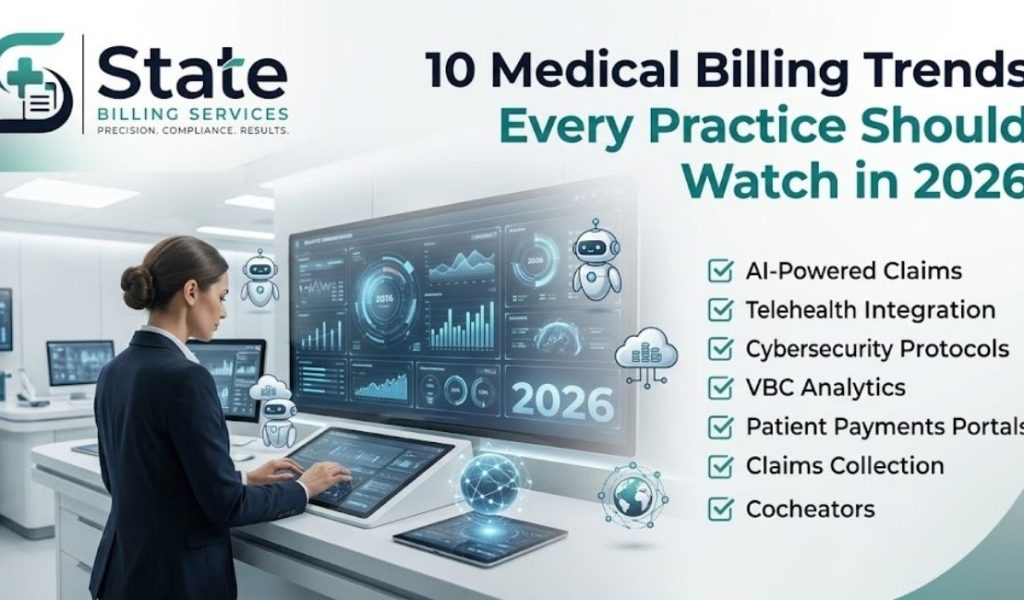
This article covers 10 medical billing trends every practice should watch in 2026. It explains what is changing, why it matters, and what practical steps a practice can take to stay ahead. The goal is not to chase every new tool. It is to understand which changes actually affect claim accuracy, revenue timing, and compliance.
Why Medical Billing Is Changing So Quickly
Several forces are converging at once. CMS continues to update coding rules, documentation requirements, and reimbursement policies on a regular cycle. Payers are investing heavily in their own automated claims review systems, which means claims face more scrutiny before a human ever looks at them. Electronic health record platforms are becoming more connected to billing systems, reducing the manual data entry that used to introduce errors.
At the same time, patient expectations have shifted. Patients now expect the same kind of clear, real time information from a medical bill that they get from a retail purchase or a bank transaction. A confusing paper statement that arrives six weeks after a visit does not meet that expectation anymore.
These pressures are pushing practices toward more automated, more transparent, and more data driven billing operations. The trends below reflect where that pressure is having the biggest impact.
None of these trends developed in isolation. AI adoption is accelerating because payer systems now process claims fast enough that manual review can no longer keep pace. Interoperability improvements are happening because EHR vendors face increasing pressure to reduce administrative burden on clinical staff. Payer requirements are tightening in part because automated review on the payer side makes it easier to catch inconsistencies that used to go unnoticed. Understanding these connections helps explain why 2026 feels like a turning point rather than just another year of incremental change.
1. AI Moves From Experimental to Standard Practice
For several years, artificial intelligence in medical billing was treated as an experiment. Practices tested tools cautiously, often on a small scale, to see whether the technology actually improved accuracy or speed. In 2026, AI in medical billing is becoming a standard part of the workflow rather than a pilot project.
This shift shows up in several ways. AI tools now flag missing information before a claim leaves the practice. They review historical claims data to identify which claims carry a higher denial risk. They help match remittance data to patient accounts during payment posting, reducing manual reconciliation work.
The important distinction is that AI is supporting billing staff, not replacing them. A model can flag a claim as high risk, but a trained biller still needs to review the reasoning and decide what to do next. Practices that treat AI as a second set of eyes, rather than an autonomous decision maker, tend to see the most reliable results.
The technology behind these tools has also matured. Earlier AI billing tools often relied on relatively simple rule matching, flagging claims based on narrow criteria that produced a high number of false positives. Newer models trained on larger volumes of claims data tend to produce more accurate flags, though they still require ongoing calibration as payer rules change. A tool trained on last year’s denial patterns will not automatically know about a policy update announced this quarter, which is why human oversight remains essential regardless of how sophisticated the underlying model becomes.
2. Predictive Denial Management Becomes More Common
Denial management used to be reactive. A claim would get denied, and staff would spend time figuring out why before resubmitting. Predictive denial management flips that sequence. Instead of waiting for a denial, the system analyzes claim data before submission and flags patterns associated with past denials.
This might mean a system notices that claims with a specific combination of payer, procedure code, and modifier have historically been denied more often. That claim gets flagged for review before it is ever sent out. This does not eliminate denials completely, since payer rules and clinical circumstances vary. But it does shift more attention toward prevention rather than correction.
Practices interested in strengthening this area can review common medical claim denial causes as a starting point for building internal checklists that predictive tools can then reinforce.
The value of predictive denial management grows with claim volume. A solo practitioner submitting a few hundred claims a month may find manual pattern recognition manageable, but a multi-provider group submitting several thousand claims monthly benefits significantly from software that can scan that volume consistently. The consistency matters as much as the speed, since manual review quality tends to vary depending on staff workload and fatigue.
3. Real Time Eligibility Verification Becomes the Baseline Expectation
Eligibility verification used to mean a phone call or a manual portal check, often done the morning of the appointment or even after the visit. That approach is becoming outdated. Real time eligibility verification, connected directly to the EHR, is becoming the baseline expectation rather than an advanced feature.
This matters because coverage changes happen more often than practices assume. A patient’s plan status, copay amount, or deductible balance can shift between the time an appointment is scheduled and the time it happens. Checking eligibility close to the date of service, ideally automated and built into the scheduling workflow, catches these changes before they turn into a denied claim or a surprise balance for the patient.
Practices that have not automated this step often see a higher rate of front end denials. Reviewing best practices for patient insurance verification offers a practical framework for closing this gap.
Real time verification also changes the patient experience at check-in. Front desk staff can inform a patient of an updated copay or a lapsed policy before the visit happens, rather than the patient discovering a coverage issue weeks later through a confusing statement. This shift benefits both sides of the transaction, since the practice reduces its denial risk and the patient avoids an unexpected bill.
4. Payer Requirements Keep Getting More Specific
Payers are not simplifying their rules. If anything, requirements are becoming more granular, with narrower definitions of medical necessity, more frequent updates to prior authorization lists, and more payer specific documentation standards.
This creates a real challenge for practices trying to keep up. A rule that applied last quarter may not apply this quarter. A service that did not require authorization last year might require it now. Staying current requires either a dedicated internal compliance function or a billing partner that tracks these updates as part of daily operations.
Common mistakes in this area, particularly around authorization timing and documentation, are outlined in this breakdown of common prior authorization mistakes, which remains relevant as payer scrutiny increases.
Practices in specialties with higher rates of prior authorization requirements, such as radiology and certain surgical fields, feel this pressure most acutely. A single missed authorization can mean an entire high value claim gets denied outright, with limited appeal options depending on the payer’s policy. Building a proactive authorization tracking process, rather than handling it reactively at the point of scheduling, has become less of a best practice suggestion and more of an operational necessity.
5. Interoperability Between EHR and Billing Systems Improves
Interoperability, the ability of different systems to share data accurately, has been a slow moving goal in healthcare technology for years. In 2026, meaningful progress is showing up in the connection between EHR platforms and billing systems specifically.
When these systems communicate well, clinical documentation flows more directly into coding and claims, reducing the manual re-entry that introduces errors. A diagnosis documented during the visit can populate the claim automatically, rather than requiring a coder to transcribe it separately. This reduces both the time spent on each claim and the chance of a transcription mistake that leads to a denial.
Practices evaluating new EHR or billing software Integration should ask specific questions about how well the systems integrate, rather than assuming compatibility based on marketing claims alone.
Interoperability also affects reporting. When billing and clinical data live in separate systems that do not communicate well, generating an accurate picture of practice performance requires manual reconciliation between two data sources. Better integration means medical billing reports can pull from a single, consistent data set, which reduces both the effort involved and the risk of reporting errors that come from combining mismatched data manually.
| Trend Area | What Is Changing | Practical Impact |
| AI in claims review | Moves from pilot to standard tool | Fewer missed errors before submission |
| Predictive denial management | Flags risk before submission | Lower denial rates over time |
| Real time eligibility | Automated, closer to date of service | Fewer coverage related denials |
| Payer requirements | More granular and frequent updates | Requires ongoing compliance tracking |
| EHR and billing interoperability | Tighter data connection | Less manual re-entry and fewer errors |
6. Automation Expands Beyond Claims Submission
Medical billing automation used to focus mostly on claims submission itself, getting the claim formatted and sent correctly. In 2026, automation is expanding into other parts of the revenue cycle, including payment posting, accounts receivable follow-up, and patient statement generation.
Automated payment posting matches remittance data to patient accounts without manual entry, reducing both the time required and the chance of posting errors. Automated accounts receivable tools can flag aging accounts that need follow-up, prioritizing them based on balance size, payer, or age. This connects directly to reducing outstanding balances, a topic covered in more depth in this guide on how to reduce accounts receivable in medical billing.
Automation does not remove the need for oversight. A flagged account still needs a person to make the follow-up call or send the appeal. But automation reduces the time spent identifying which accounts need attention in the first place.
7. Revenue Forecasting Becomes More Data Driven
Practices have traditionally relied on historical averages and rough estimates to plan cash flow. That approach is becoming less reliable as payer mix, reimbursement rates, and denial patterns shift more frequently than they used to. In 2026, more practices are using data driven revenue forecasting tools that pull from actual claims history rather than static assumptions.
These tools analyze factors like payer mix, average reimbursement by code, denial rates, and days in accounts receivable to project expected collections over the coming weeks or months. This gives practice leadership a clearer basis for decisions about staffing, equipment purchases, or expansion timing.
Forecasts are still estimates, not guarantees. Payer behavior can change, and unexpected events can shift collection timelines. But a forecast built on actual data trends tends to be more useful than one based on last year’s average alone.
8. Clean Claim Submission Gets More Attention as a Cost Control Measure
Practices are increasingly viewing clean claim submission not just as an operational goal but as a direct cost control measure. Every claim that requires rework costs money in staff time, and every delayed payment affects cash flow. As automation and AI tools make it easier to catch errors before submission, practices that adopt these tools are seeing measurable improvement in first pass claim acceptance rates.
This trend connects closely to broader revenue cycle health. A higher clean claim rate reduces the burden on accounts receivable teams, shortens the reimbursement timeline, and reduces the administrative cost per claim. Practices building internal checklists around this often start with the fundamentals covered in guidance on clean claim submission, focusing on eligibility accuracy, coding specificity, and timely filing.
9. Compliance and Audit Readiness Become Continuous, Not Periodic
Practices used to treat compliance reviews and audit preparation as occasional tasks, something to think about when a notice arrived or during an annual review. In 2026, more practices are shifting toward continuous compliance monitoring, using software that flags potential documentation gaps or coding inconsistencies on an ongoing basis rather than during a scheduled review.
This shift is partly driven by increased payer and federal scrutiny, and partly by the availability of tools that make continuous monitoring practical for smaller practices that previously lacked the staff to do this manually. A practice that reviews its coding and documentation patterns monthly, rather than annually, is better positioned if a formal medical billing audit request arrives.
Provider credentialing accuracy remains part of this picture as well. Claims tied to expired or improperly enrolled providers create compliance risk regardless of how accurate the coding is, which makes ongoing credentialing management an important companion to clinical documentation review.
10. Practices Reassess In-House Versus Outsourced Billing Models
As billing technology becomes more sophisticated, the gap between what a small in-house team can manage and what a specialized outsourced partner can offer is becoming more visible. Many practices are reassessing whether their current billing model still makes sense given the pace of change in payer requirements, AI tools, and compliance expectations.
This is not a universal answer. Some practices have the volume and resources to maintain a strong in-house team supported by modern tools. Others find that the cost of staying current, in staff training, software licensing, and compliance monitoring, exceeds what an outsourced partner can offer at a comparable or lower cost. Understanding the hidden costs of in-house medical billing is a useful exercise for any practice weighing this decision heading into next year.
What These Trends Mean for Day to Day Operations
Reading about trends is one thing. Applying them to a specific practice is another. A few practical starting points can help translate these shifts into action.
- Review current claim scrubbing and denial prediction tools to see whether they use any predictive or AI supported features, and whether those features are actually being used effectively by staff.
- Evaluate how eligibility verification currently works, and whether it happens close enough to the date of service to catch coverage changes.
- Ask whether current EHR and billing systems share data automatically or still require manual re-entry at any stage.
These three questions alone can reveal a significant amount about how prepared a practice is for the direction billing technology is heading.
The Role of Staff Training in a Changing Billing Environment
New tools do not eliminate the need for trained billing and coding staff. If anything, they increase the importance of staff who understand both the technology and the underlying rules well enough to catch mistakes the technology misses.
A predictive denial tool can flag a claim as high risk, but a trained biller still needs to determine whether the flag reflects a real issue or a false positive. An AI coding suggestion still needs review from someone who understands the clinical documentation and payer specific rules. Practices that invest in ongoing training alongside new technology tend to get more value from both.
This is particularly relevant for specialties with more complex coding requirements. A practice managing cardiology billing or orthopedic billing in SC needs staff who understand the specific nuances of those specialties, since general billing knowledge alone often is not enough to catch specialty specific errors that automated tools might miss.
Preparing for What Comes Next
The pace of change in medical billing is not slowing down. CMS will continue updating coding and coverage rules. Payers will continue refining their own automated review systems. Patients will continue expecting clearer, faster communication about what they owe.
Practices that treat these changes as ongoing rather than occasional tend to adapt more smoothly. This means building regular review of billing KPIs into standard operations, rather than checking metrics only when a problem becomes obvious. Reviewing top medical billing KPIs on a monthly basis gives practice leadership the visibility needed to spot shifts early, whether that is a rising denial rate, a slowing collection cycle, or a change in payer mix.
It also means staying realistic about what technology can and cannot do. AI and automation reduce manual work and catch patterns that are hard to spot by hand. They do not replace the judgment needed for complex coding decisions, documentation review, or payer negotiation. The practices that get the most value from these tools are the ones that pair them with experienced staff rather than treating them as a full replacement.
Final Thoughts
Medical billing in 2026 looks different from just a few years ago, and the pace of change shows no sign of slowing. AI tools, predictive denial management, real time eligibility checks, tighter payer requirements, and better system interoperability are reshaping how practices manage claims and revenue. None of these trends work in isolation. They reinforce each other, and practices that adopt them together tend to see stronger results than those that adopt them piecemeal.
Staying ahead does not require adopting every new tool immediately. It requires understanding which changes affect your specific practice, your specialty, and your current billing bottlenecks, then making deliberate decisions about where to invest time and resources.
For practices that want support navigating these changes, States Billing Services SC works directly with providers to strengthen claim accuracy, denial prevention, and revenue cycle performance using both proven billing practices and modern technology.