Every denied or rejected medical claim creates more work than most healthcare organizations realize. Staff must identify the problem, correct the error, resubmit the claim, monitor payer responses, and often wait weeks for reimbursement that could have been received much sooner. While one rejected claim may seem manageable, hundreds of preventable errors each month can significantly reduce cash flow and increase administrative costs.
The most successful healthcare practices focus on getting claims right the first time. High first-pass claim acceptance means claims move through payer systems without requiring corrections or resubmissions. This not only accelerates reimbursement but also reduces staff workload, improves financial stability, and strengthens the overall revenue cycle.
Improving first-pass claim acceptance is not about one department working harder. It requires coordination between front desk staff, providers, coders, billers, and revenue cycle managers. Every step, from patient registration to claim submission, influences whether a payer accepts or rejects a claim.
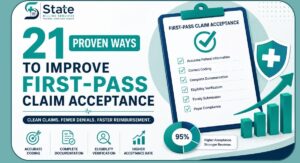
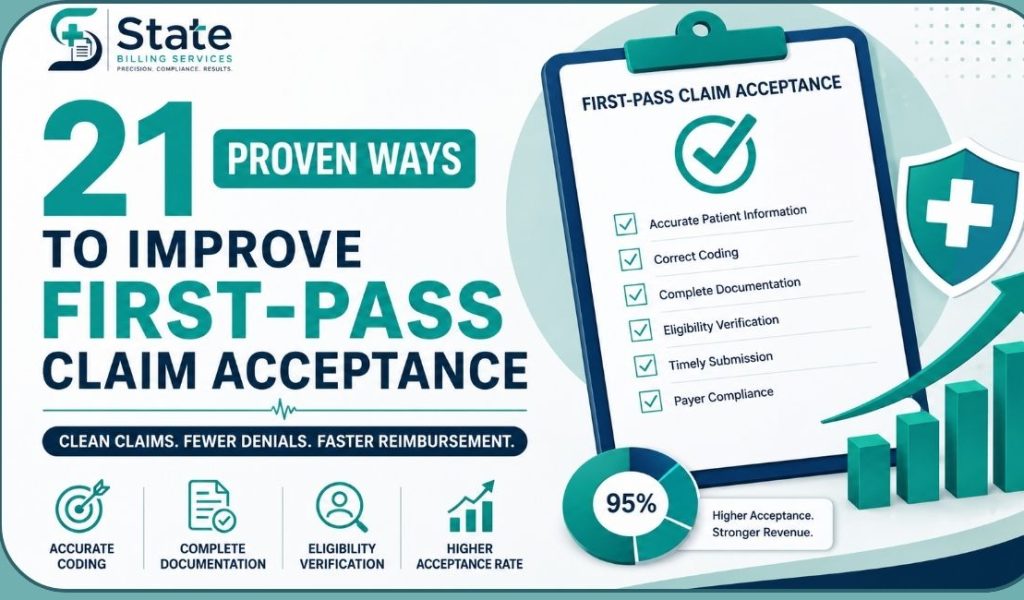
This guide outlines 21 proven ways to improve first-pass claim acceptance. These practical strategies help healthcare organizations submit more clean claims, improve claim accuracy, strengthen denial prevention efforts, and receive reimbursement more quickly.
Why First-Pass Claim Acceptance Matters
First-pass claim acceptance measures the percentage of claims accepted by a payer on their initial submission without requiring corrections.
Although acceptance does not always mean immediate payment, it indicates that the claim successfully passed initial validation and entered the adjudication process without avoidable administrative issues.
Higher first-pass acceptance provides several benefits:
- Faster reimbursement
- Lower administrative costs
- Fewer claim corrections
- Reduced denial rates
- Better cash flow
- Improved staff productivity
- Stronger patient satisfaction through fewer billing delays
Practices that consistently submit clean claims spend less time fixing preventable errors and more time focusing on patient care and operational improvement.
A well-managed medical billing services workflow supports this goal by improving coordination between registration, coding, billing, payment posting, and claim submission.
Common Reasons Claims Fail on the First Submission
Many rejected claims result from routine administrative mistakes rather than complex medical issues.
Some of the most common causes include:
| Common Issue | Effect on Claim Acceptance |
| Incorrect patient demographics | Immediate rejection |
| Insurance eligibility errors | Claim returned before adjudication |
| Missing authorization | Payment delay or denial |
| Coding inaccuracies | Claim rejection or denial |
| Invalid modifiers | Incorrect reimbursement |
| Missing documentation | Additional information requests |
| Duplicate claims | Automatic rejection |
Most of these issues can be prevented through standardized workflows and regular quality checks.
Understanding why claims fail provides the foundation for improving first-pass claim acceptance.
1. Verify Insurance Eligibility Before Every Appointment
Insurance eligibility verification is one of the simplest ways to increase first-pass claim acceptance.
Coverage changes frequently because of employer changes, policy renewals, coordination of benefits updates, or plan terminations. Assuming insurance information remains unchanged often leads to rejected claims.
Verification should confirm:
- Active coverage
- Member identification
- Effective dates
- Copayment requirements
- Deductible status
- Referral requirements
- Prior authorization requirements
Electronic eligibility verification tools integrated into modern practice management systems allow staff to complete this process within minutes.
Practices that consistently perform eligibility verification submit more clean claims while reducing avoidable billing errors.
Many organizations also strengthen this process by using dedicated eligibility verification services, ensuring that coverage issues are identified before patient visits rather than after claim submission.
2. Collect Accurate Patient Demographics
Even minor registration errors can prevent claims from reaching the payer.
Incorrect spelling, outdated addresses, inaccurate dates of birth, and subscriber identification mistakes frequently trigger automatic claim rejection.
Registration staff should verify:
- Full legal name
- Date of birth
- Address
- Phone number
- Insurance policy number
- Subscriber information
- Employer details when applicable
Rather than relying on existing records, practices should confirm demographic information during every patient visit.
Patient self-service registration portals also help reduce manual entry errors while allowing patients to update their own information securely.
3. Submit Complete and Clean Claims
A clean claim contains all required information before submission.
It includes accurate coding, complete provider identifiers, patient demographics, insurance information, required modifiers, and supporting documentation when applicable.
Claims requiring correction consume additional administrative resources and delay reimbursement.
Many clearinghouses perform automated claim scrubbing before submission by identifying:
- Invalid diagnosis codes
- Missing modifiers
- Incorrect provider identifiers
- Formatting errors
- Incomplete patient information
Reviewing claim edits before submission significantly improves first-pass acceptance rates.
4. Strengthen Medical Coding Accuracy
Coding accuracy directly affects reimbursement.
Medical coders must correctly assign:
- ICD-10-CM diagnosis codes
- CPT procedure codes
- HCPCS Level II codes
- Appropriate modifiers
Errors frequently result in:
- Medical necessity denials
- Procedure mismatches
- Duplicate billing
- Incorrect reimbursement
- Additional documentation requests
Regular coding education, internal audits, and updated coding references help maintain accuracy as coding guidelines evolve each year.
Practices with complex specialties often benefit from dedicated medical coding services that ensure coding consistency while supporting accurate claim submission.
5. Submit Claims Quickly After Services Are Completed
Delaying claim submission increases financial risk.
The longer claims remain unsubmitted, the greater the chance of documentation issues, missed filing deadlines, or administrative backlogs.
Efficient organizations establish daily claim submission schedules rather than waiting until the end of the week.
A streamlined workflow generally follows this sequence:
- Provider completes documentation.
- Coding is finalized.
- Claims are reviewed.
- Claim scrubbing is completed.
- Electronic submission occurs.
Moving claims through this process without unnecessary delays helps accelerate reimbursement while reducing outstanding claims.
Practices should also monitor payer filing limits carefully since missed deadlines often result in permanent payment loss.
6. Obtain Prior Authorization Before Services Are Performed
Many diagnostic procedures, surgeries, imaging studies, specialty medications, and advanced treatments require prior authorization.
Submitting claims without approved authorization frequently results in denials regardless of whether the services were medically necessary.
Authorization workflows should include:
- Verification of payer requirements.
- Submission of supporting documentation.
- Tracking authorization status.
- Recording authorization numbers within the patient’s record.
- Confirming validity dates before treatment.
Automated reminders within electronic health record systems help prevent authorization from being overlooked during scheduling.
Obtaining approval before treatment protects both reimbursement and patient financial responsibility.
7. Keep Provider Credentialing Current
Even a perfectly coded claim can be denied if the provider is not properly credentialed with the payer. Expired enrollment, missing participation agreements, or outdated provider information often causes claims to fail before medical necessity is even reviewed.
Credentialing should be treated as an ongoing process rather than a one-time task.
Practices should regularly verify:
- Provider enrollment status
- National Provider Identifier (NPI) information
- Tax Identification Number (TIN)
- Practice addresses
- Specialty information
- Revalidation deadlines
Maintaining accurate provider records reduces unnecessary administrative denials and improves first-pass claim acceptance.
8. Standardize Clinical Documentation
Accurate documentation supports accurate coding.
Payers review documentation to confirm that billed services match the patient’s condition, the provider’s assessment, and the treatment delivered.
Incomplete documentation often results in requests for additional information, medical necessity denials, or payment delays.
Providers should consistently document:
- Chief complaint
- History of present illness
- Examination findings
- Assessment
- Treatment plan
- Medical necessity
- Procedure details
- Follow-up recommendations
Using standardized templates within electronic health record systems helps improve consistency while allowing providers to document efficiently.
Documentation should always reflect the patient’s actual clinical condition rather than relying on copied notes or generic templates.
9. Use Claim Scrubbing Before Submission
Claim scrubbing acts as the final quality check before a claim reaches the payer.
Modern clearinghouses automatically review claims against payer rules and coding guidelines, identifying errors that might otherwise trigger rejection.
Common edits include:
- Invalid CPT codes
- Diagnosis and procedure mismatches
- Missing modifiers
- Incorrect patient information
- Duplicate claims
- Missing provider identifiers
- Incomplete insurance information
Correcting these issues before submission saves considerable time compared to correcting rejected claims later.
Many organizations experience noticeable improvements in clean claims simply by reviewing clearinghouse edits each day instead of bypassing them.
10. Monitor Payer-Specific Billing Requirements
Each insurance payer has unique billing rules.
Although CPT and ICD-10 coding standards are nationally recognized, individual commercial insurers and government programs frequently establish their own documentation requirements, modifier rules, authorization policies, and filing deadlines.
Billing teams should maintain updated payer reference guides covering:
- Filing limits
- Authorization requirements
- Modifier usage
- Medical necessity policies
- Documentation requirements
- Electronic submission rules
Keeping these resources current reduces preventable billing mistakes while improving claim accuracy.
11. Review Rejected Claims Daily
Rejected claims differ from denied claims.
A rejected claim never enters the payer’s adjudication process because it contains administrative errors identified during initial validation.
Examples include:
- Missing patient information
- Invalid subscriber numbers
- Formatting errors
- Incorrect provider identifiers
- Clearinghouse edits
Because rejected claims have not been processed, they should be corrected and resubmitted immediately.
Waiting several days allows unnecessary delays to accumulate and increases the risk of missing payer filing deadlines.
Successful billing departments establish daily workflows for resolving claim rejections before focusing on newly submitted claims.
12. Analyze Denial Trends Instead of Individual Claims
Correcting one denied claim solves an immediate problem.
Analyzing hundreds of denials reveals opportunities to prevent future errors.
Practices should routinely categorize denials by:
- Payer
- Provider
- Specialty
- Diagnosis
- Procedure
- Denial reason
- Billing staff member
- Service location
Trend analysis often identifies recurring operational issues that remain hidden when claims are reviewed individually.
For example, repeated authorization denials may indicate scheduling problems rather than billing errors.
Similarly, recurring modifier denials may highlight training opportunities for coding staff.
Reviewing recurring medical claim denial reasons helps organizations identify systemic issues that affect first-pass claim acceptance across multiple departments.
13. Improve Communication Between Departments
Claim accuracy depends on teamwork.
Registration staff collect patient information.
Providers document clinical services.
Coders translate documentation into billable codes.
Billers prepare claims.
Payment posting specialists reconcile reimbursements.
If communication breaks down between any of these departments, billing errors become much more likely.
Regular cross-functional meetings allow staff to discuss:
- Frequent claim errors
- Documentation gaps
- Payer updates
- Coding questions
- Registration issues
- Workflow improvements
Open communication reduces repetitive mistakes while improving overall revenue cycle performance.
14. Invest in Ongoing Staff Education
Healthcare billing regulations change constantly.
Annual CPT updates, ICD-10 revisions, payer policy changes, Medicare updates, and commercial insurance requirements all affect claim submission.
Continuous education helps billing professionals stay current without relying on outdated procedures.
Training should include:
- Coding updates
- Compliance requirements
- Documentation standards
- Payer policy revisions
- Software training
- Customer service skills
Organizations that prioritize professional development typically experience higher claim accuracy and lower denial rates over time.
15. Automate Routine Revenue Cycle Tasks
Automation reduces repetitive manual work while improving consistency.
Many practice management systems now automate processes such as:
- Eligibility verification
- Claim creation
- Claim scrubbing
- Electronic submission
- Payment posting
- Reporting dashboards
- Denial alerts
Platforms such as Epic, athenahealth, NextGen Healthcare, eClinicalWorks, Kareo, and AdvancedMD provide automation features that help practices reduce administrative errors without replacing experienced billing professionals.
Automation works best when combined with standardized workflows and regular quality reviews.
16. Perform Regular Internal Billing Audits
Billing audits identify weaknesses before payers identify them.
Rather than waiting for increased denials or external audits, practices should review a sample of claims each month.
Internal audits typically evaluate:
- Coding accuracy
- Documentation quality
- Modifier usage
- Provider information
- Authorization compliance
- Claim completeness
- Billing policy adherence
Audit findings should lead to practical improvements, staff education, and updated workflows rather than simply documenting errors.
Organizations that routinely evaluate their billing processes often maintain stronger first-pass claim acceptance rates.
17. Track Key Performance Indicators Regularly
Improving first-pass claim acceptance requires more than fixing individual claim errors. Practices need measurable data to determine whether billing processes are improving over time.
Key performance indicators (KPIs) provide a clear picture of revenue cycle performance and help leadership identify trends before they affect reimbursement.
The most valuable KPIs include:
| KPI | Why It Matters |
| First-pass claim acceptance rate | Measures claims accepted on initial submission |
| Clean claim rate | Indicates the percentage of claims submitted without errors |
| Denial rate | Highlights recurring billing issues |
| Days in Accounts Receivable | Reflects collection efficiency |
| Net collection rate | Measures revenue successfully collected |
| Average reimbursement time | Shows how quickly claims are paid |
| Rejection rate | Identifies front-end billing errors |
Rather than reviewing these metrics quarterly, practices should evaluate them monthly. Regular reporting allows billing managers to recognize emerging issues early and adjust workflows before financial performance declines.
Many organizations also compare their first-pass acceptance trends with other revenue cycle indicators to determine whether improvements in claim accuracy are translating into faster reimbursement.
18. Strengthen Front-End Registration Processes
The quality of every claim begins at patient registration.
If incorrect information enters the practice management system, every department downstream inherits the same error.
Front desk staff should never assume patient information remains unchanged.
Every visit should include verification of:
- Patient name
- Address
- Date of birth
- Phone number
- Insurance carrier
- Subscriber information
- Employer information, when applicable
- Referral requirements
Registration staff should also confirm that scanned insurance cards remain current.
Many practices reduce registration errors by allowing patients to complete digital intake forms before appointments. Self-service portals often improve accuracy while reducing manual data entry.
A strong front-end process significantly increases the likelihood that claims will be accepted on their first submission.
19. Reduce Manual Data Entry Whenever Possible
Manual data entry remains one of the leading causes of billing mistakes.
Typing errors, incorrect insurance numbers, transposed dates, and incomplete patient information frequently result in rejected claims.
Technology helps minimize these risks through:
- Electronic patient registration
- Insurance card scanning
- Automated eligibility verification
- Electronic claim generation
- Digital provider documentation
- Electronic remittance advice integration
Reducing manual entry improves consistency while allowing billing staff to spend more time reviewing exceptions instead of performing repetitive administrative work.
Automation should still be supported by periodic quality reviews to ensure imported information remains accurate.
20. Develop a Proactive Denial Prevention Strategy
Many organizations devote significant effort to correcting denied claims.
The highest-performing practices focus instead on preventing denials before claims are submitted.
A proactive denial prevention strategy includes regular analysis of payer feedback, staff education, workflow improvements, and quality monitoring.
Effective denial prevention involves:
- Reviewing recurring denial reasons.
- Updating payer-specific billing guidelines.
- Conducting coding audits.
- Monitoring documentation quality.
- Providing staff education.
- Tracking clean claim performance.
- Reviewing authorization compliance.
Instead of reacting after denials occur, practices continuously refine their billing processes to reduce future errors.
Organizations that invest in structured denial management services often improve first-pass claim acceptance by identifying root causes rather than repeatedly correcting the same mistakes.
21. Continuously Improve Your Revenue Cycle
Improving first-pass claim acceptance is not a one-time initiative.
Healthcare regulations, payer policies, coding standards, and reimbursement requirements continue to evolve throughout the year.
Successful organizations regularly evaluate every stage of the revenue cycle, from patient scheduling through final payment posting.
Continuous improvement includes:
- Reviewing billing workflows.
- Updating internal procedures.
- Monitoring payer changes.
- Training staff regularly.
- Evaluating billing software performance.
- Measuring financial outcomes.
- Implementing process improvements based on data.
Practices that embrace continuous improvement consistently produce more clean claims, experience fewer billing delays, and strengthen long-term financial performance.
Healthcare organizations seeking additional operational improvements often benefit from reviewing strategies for reducing accounts receivable in medical billing, since many of the same workflow improvements contribute to stronger claim acceptance and faster reimbursement.
Real-World Example
Consider a multi-provider internal medicine practice that noticed its first-pass claim acceptance rate had dropped over several months.
After reviewing billing reports, the practice identified several recurring issues:
- Insurance eligibility was not consistently verified before appointments.
- Clinical documentation varied significantly between providers.
- Coding updates had not been communicated to all staff.
- Prior authorizations were occasionally overlooked.
- Clearinghouse edits were being ignored until claims were rejected.
Rather than hiring additional billing staff, the practice standardized registration procedures, introduced weekly coding reviews, implemented daily claim scrubbing, and assigned one employee to monitor payer policy updates.
Within a few months, the practice experienced fewer rejected claims, faster reimbursement, lower administrative workload, and a noticeable improvement in overall revenue cycle performance.
This example illustrates that improving first-pass claim acceptance usually results from strengthening multiple workflows rather than relying on one isolated solution.
Building a Culture of Claim Accuracy
Organizations with consistently high first-pass acceptance rates share one common characteristic: they view claim accuracy as a responsibility shared across the entire practice.
Front desk staff collect accurate patient information.
Providers create complete clinical documentation.
Medical coders assign accurate diagnosis and procedure codes.
Billing specialists prepare clean claims.
Revenue cycle leaders monitor financial performance and implement process improvements.
Technology supports each stage, but people remain responsible for maintaining quality.
When every department understands how its work affects reimbursement, billing becomes more efficient, denials decline, and patients benefit from fewer billing complications.
Frequently Asked Questions
What is first-pass claim acceptance in medical billing?
First-pass claim acceptance is the percentage of claims accepted by an insurance payer on the initial submission without requiring corrections, resubmissions, or additional administrative action. A high first-pass acceptance rate reflects efficient billing processes and contributes to faster reimbursement.
What is the difference between a rejected claim and a denied claim?
A rejected claim is returned before it enters the payer’s adjudication process because of administrative or formatting errors, such as incorrect patient information or missing data. A denied claim has already been reviewed by the payer but was not approved for payment due to reasons such as medical necessity, authorization issues, or coding errors.
Why are clean claims important?
Clean claims contain complete and accurate information that allows payers to process them without requesting corrections or additional documentation. Submitting clean claims reduces administrative work, shortens payment cycles, improves reimbursement, and supports a healthier revenue cycle.
How can healthcare practices improve claim accuracy?
Claim accuracy improves when practices verify insurance eligibility, collect accurate patient demographics, maintain complete clinical documentation, use current coding guidelines, perform claim scrubbing before submission, and monitor billing quality through regular audits.
What role does technology play in first-pass claim acceptance?
Modern revenue cycle platforms help reduce billing errors through automated eligibility verification, claim scrubbing, electronic claim submission, payment posting, denial tracking, and reporting dashboards. These tools support staff by identifying issues before claims are submitted, improving efficiency without replacing experienced billing professionals.
How often should billing teams review claim performance?
Practices should review claim performance every month. Monitoring first-pass claim acceptance, denial rates, rejection rates, clean claim percentages, and reimbursement timelines helps identify workflow issues early and supports continuous improvement across the revenue cycle.
Final Thoughts
Improving first-pass claim acceptance is one of the most effective ways to strengthen the financial health of any healthcare organization. Every clean claim submitted on the first attempt reduces administrative effort, minimizes payment delays, and allows staff to focus on patient care instead of correcting preventable billing errors.
Success begins long before a claim reaches the payer. Accurate patient registration, insurance eligibility verification, complete clinical documentation, precise medical coding, timely claim submission, and consistent quality reviews all contribute to higher acceptance rates.
Technology can simplify many routine billing tasks, but sustainable improvement depends on well-defined processes and knowledgeable teams. Regular staff training, payer-specific workflow updates, internal audits, and ongoing performance monitoring help organizations adapt to changing regulations while maintaining high claim accuracy.
Rather than treating claim denials as unavoidable, healthcare practices should focus on building systems that prevent errors from occurring in the first place. A proactive approach to denial prevention not only improves reimbursement but also creates a more efficient and reliable revenue cycle.
Practical Takeaway
Improving first-pass claim acceptance is an ongoing process rather than a single project. Small improvements across registration, documentation, coding, billing, and quality assurance can significantly reduce rejected claims and strengthen long-term financial performance.
If your organization is facing frequent claim rejections, increasing denial rates, or delayed reimbursements, working with an experienced revenue cycle partner can help streamline billing operations and improve claim quality. States Billing Services SC provides comprehensive Medical Billing Services, Eligibility Verification Services, and Denial Management Services to help healthcare providers submit cleaner claims, improve reimbursement, and maintain a more efficient revenue cycle.