Choosing a medical billing company is one of the most important business decisions a healthcare practice can make. The right partner can improve cash flow, reduce claim denials, and give providers more time to focus on patient care. The wrong one can lead to delayed reimbursements, compliance concerns, frustrated patients, and lost revenue that is difficult to recover.
Many practices begin looking for billing support after they notice rising accounts receivable, increasing claim denials, or an overwhelmed in-house billing team. Others make the decision while opening a new practice or expanding into additional specialties. Whatever the reason, hiring a billing partner should never be based on price alone.
Medical billing affects every stage of the revenue cycle. A company that submits claims quickly but ignores denial trends or fails to provide meaningful reporting may create more problems than it solves. Before signing a contract, providers should carefully evaluate experience, processes, technology, communication, and performance expectations.
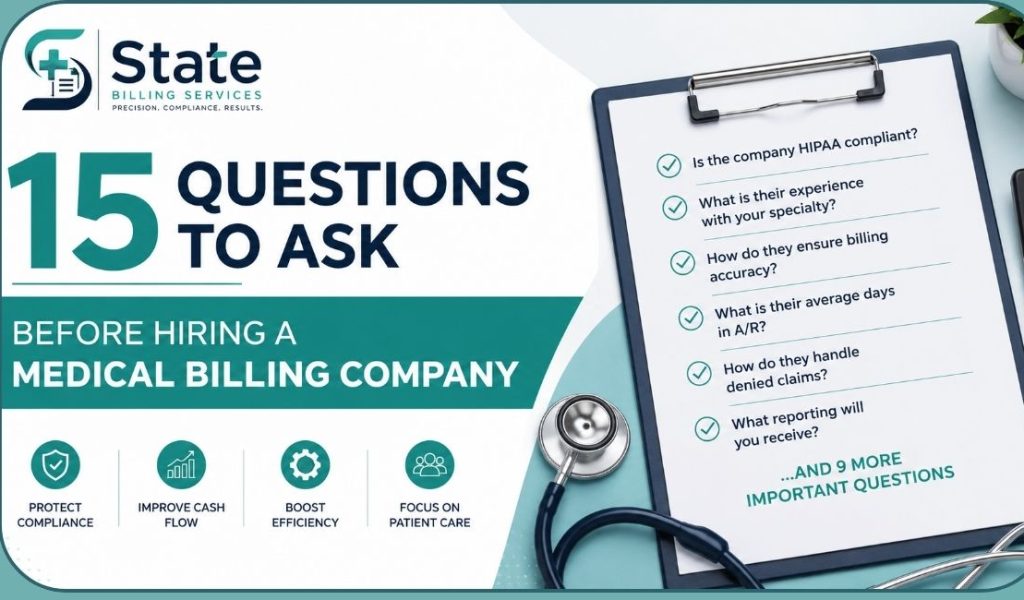
This medical billing company checklist provides fifteen practical questions to ask before selecting a billing partner. Each question explains why it matters, what to listen for during conversations, and how the answer can affect your practice’s financial health.
Why Choosing the Right Billing Company Matters
Medical billing has become increasingly complex.
Healthcare providers work with Medicare, Medicaid, commercial insurance companies, workers’ compensation carriers, and self-pay patients. Every payer has different documentation standards, filing deadlines, coding requirements, and reimbursement rules.
At the same time, coding systems such as ICD-10-CM, CPT, and HCPCS continue to evolve. Organizations such as the Centers for Medicare & Medicaid Services (CMS) and the American Medical Association (AMA) regularly update guidance that directly affects reimbursement.
A qualified billing company stays current with these changes while helping providers reduce administrative work and improve financial performance.
The right partner should function as an extension of your practice rather than simply processing claims.
How to Use This Medical Billing Company Checklist
Every medical practice has unique needs.
A solo family physician may prioritize affordable support and responsive communication. A cardiology practice may require deep knowledge of procedure coding and prior authorization. A behavioral health clinic may need experience with payer rules specific to mental health services.
Instead of asking only whether a company offers billing services, evaluate how they manage every part of the revenue cycle.
Use these questions during interviews, proposal reviews, and contract discussions.
Medical Billing Company Evaluation Checklist
| Evaluation Area | Why It Matters |
| Industry Experience | Reduces billing errors |
| Specialty Knowledge | Improves coding accuracy |
| Technology | Supports efficient workflows |
| Reporting | Tracks financial performance |
| Compliance | Protects patient information |
| Communication | Resolves issues quickly |
| Denial Management | Improves collections |
| Scalability | Supports future growth |
Questions That Help You Compare Medical Billing Providers
1. How Much Experience Do You Have in Medical Billing?
Experience should be one of the first topics discussed.
Medical billing differs significantly from general accounting or bookkeeping. It requires knowledge of insurance regulations, coding guidelines, payer contracts, appeals, compliance standards, and revenue cycle management.
Questions to ask:
- How long has the company been providing medical billing services?
- What types of providers do they support?
- How many practices do they currently manage?
An experienced company will explain its workflow confidently and provide realistic expectations instead of making guarantees that every claim will be paid immediately.
2. Do You Have Experience With My Medical Specialty?
Every specialty presents different billing challenges.
An orthopedic practice bills differently than a pediatric clinic. Cardiology procedures involve complex coding and documentation requirements. Mental health providers often face unique payer rules related to session limits and authorization requirements.
A billing partner should understand your specialty’s common procedures, modifiers, documentation requirements, and reimbursement challenges.
3. What Technology and Software Do You Use?
Technology plays an important role in modern Revenue Cycle Management.
EHR platforms to ask about:
- Epic
- athenahealth
- eClinicalWorks
- NextGen Healthcare
- AdvancedMD
Additional technology features:
- Electronic claim scrubbing
- Clearinghouse integrations
- Automated eligibility verification
- Payment posting automation
- Financial dashboards
Technology should improve efficiency without reducing transparency. You should always have access to your billing data.
4. How Do You Handle Insurance Eligibility Verification?
Many claim denials begin before the patient arrives.
If insurance eligibility is not verified, providers may perform services for patients whose coverage has expired or whose benefits do not include the planned treatment.
Questions to ask:
- When is eligibility verified?
- Is verification performed before every visit?
- How are benefit changes communicated?
Companies with a structured eligibility verification process often reduce preventable denials and improve patient payment collections.
5. What Is Your Claim Submission Process?
The speed of claim submission matters, but accuracy matters even more.
A clean claim reaches the payer with complete information, correct coding, appropriate modifiers, and supporting documentation when necessary.
Questions to ask:
- How quickly are claims submitted?
- What percentage of claims pass on the first submission?
- What claim scrubbing software is used?
- How are rejected claims corrected?
A reliable billing company focuses on preventing errors before claims reach insurance companies.
6. How Do You Manage Claim Denials?
Every practice experiences denials. The difference lies in how those denials are managed.
Ask about:
- How denials are categorized
- How appeals are prepared
- Who follows up with payers
- How denial trends are analyzed
Simply resubmitting claims without identifying the underlying cause often results in repeated denials.
7. What Reports Will I Receive?
Reporting separates professional Revenue Cycle Management from basic billing.
Reports you should expect:
- Collections
- Accounts receivable
- Claim status
- Denial trends
- Payer performance
- Aging balances
Reports should answer questions rather than create confusion. Transparent reporting builds trust between providers and billing teams.
8. How Do You Protect Patient Information?
Medical billing companies handle highly sensitive patient information.
HIPAA compliance should be a standard part of their operations.
Security questions to ask:
- Data encryption
- Employee training
- Secure file transfers
- Access controls
- Business Associate Agreements
- Cybersecurity monitoring
A trustworthy billing company should explain its security practices clearly without hesitation.
9. Who Handles Medical Coding and How Is Accuracy Maintained?
Accurate coding is one of the most important parts of the revenue cycle.
Questions to ask:
- Do you employ certified medical coders?
- How often is coding accuracy reviewed?
- Do you perform internal coding audits?
- How do you communicate documentation deficiencies?
A company that invests in ongoing education is better prepared to adapt to changing payer requirements and coding guidelines.
10. How Will You Communicate With Our Practice?
Strong communication prevents small issues from becoming expensive problems.
Questions to ask:
- Will we have a dedicated account manager?
- How quickly do you respond?
- How often are review meetings scheduled?
- Who handles urgent billing issues?
A provider should never feel disconnected from their billing partner.
11. What Is Included in Your Pricing?
Medical billing companies use different pricing models.
Some charge a percentage of collections, while others charge a flat monthly fee or a fee per claim.
Pricing questions:
- Are there setup fees?
- Are there software fees?
- Is there an additional charge for appeals?
- Are patient statements included?
- Is reporting included?
- Are credentialing services billed separately?
The lowest price is not always the best value.
12. How Do You Measure Success?
A professional RCM provider should rely on measurable performance indicators rather than general promises.
Important KPIs include:
- Clean claim rate
- First-pass acceptance rate
- Days in accounts receivable
- Net collection rate
- Denial rate
- Patient collection rate
Consistent reporting allows practices to monitor financial performance over time instead of reacting only when revenue declines.
13. How Do You Handle Accounts Receivable Follow-up?
Submitting claims is only one part of the collection process.
Questions to ask:
- How often are aging reports reviewed?
- When do you contact insurance companies?
- How do you prioritize outstanding balances?
- What percentage of old accounts is successfully recovered?
Effective accounts receivable management improves cash flow and reduces revenue loss.
14. Can You Scale as Our Practice Grows?
Your practice may look very different in three or five years.
Questions to ask:
- Can your systems support multiple providers?
- Do you bill for multiple specialties?
- Can you handle increasing claim volume?
- How do you manage practice expansion?
Choosing a scalable partner today can prevent another billing transition in the future.
15. Can You Provide References or Client Success Stories?
One of the best ways to evaluate a billing company is to speak with existing clients.
Questions for client references:
- Has communication been reliable?
- Have collections improved?
- Were implementation timelines realistic?
- How were billing issues resolved?
- Would you choose the same company again?
Consistent positive feedback provides valuable insight into how a company operates over time.
Common Mistakes to Avoid During Billing Company Selection
Some of the most common mistakes include:
- Choosing the lowest-priced provider without evaluating service quality.
- Ignoring specialty-specific billing experience.
- Failing to review reporting capabilities.
- Not asking about denial management processes.
- Overlooking cybersecurity and HIPAA compliance.
- Signing long-term contracts without understanding termination terms.
- Assuming all billing companies provide the same level of service.
Comparing Medical Billing Companies
| Evaluation Factor | Strong Billing Partner | Potential Warning Sign |
| Experience | Years of healthcare billing experience | Limited healthcare background |
| Specialty Knowledge | Familiar with your specialty | General experience only |
| Reporting | Detailed monthly KPI reports | Minimal reporting |
| Communication | Dedicated account manager | Slow or inconsistent responses |
| Compliance | HIPAA-focused processes | Unclear security practices |
| Denial Management | Structured appeals and analysis | Limited follow-up |
| Technology | Modern billing software and automation | Outdated manual workflows |
When Does It Make Sense to Outsource Billing?
Not every practice reaches the decision to outsource for the same reason.
Some are growing quickly. Others struggle with staffing shortages, increasing denials, or inconsistent collections.
Outsourcing can provide access to experienced billing professionals, advanced technology, and established revenue cycle processes while reducing administrative burden.
Signs You Have Found the Right Billing Partner
Strong billing partners usually:
- Explain processes clearly.
- Answer difficult questions directly.
- Provide transparent reporting.
- Invest in staff education.
- Understand payer requirements.
- Communicate consistently.
- Focus on long-term improvement.
The goal is not simply to process claims. It is to build a partnership that supports the financial health of your practice.
Frequently Asked Questions
What is a medical billing company checklist?
A medical billing company checklist is a list of questions and evaluation criteria that helps healthcare providers compare billing companies before making a hiring decision.
Why should I compare more than one billing company?
Comparing multiple providers allows you to evaluate experience, reporting, technology, communication, pricing, and specialty expertise before entering a long-term agreement.
What should I ask about pricing?
Ask whether fees include claim submission, payment posting, denial management, reporting, patient statements, software, implementation, and any additional administrative services.
Is experience in my specialty important?
Yes. Specialty-specific experience often leads to more accurate coding, better documentation support, and improved reimbursement because billing requirements vary across medical specialties.
How do I know if a billing company is performing well?
Review measurable indicators such as clean claim rate, denial rate, net collection rate, days in accounts receivable, and regular financial reports.
Final Words
Choosing a billing partner is about more than outsourcing administrative work. It is about selecting a company that will contribute to the financial stability and long-term success of your practice.
Using this medical billing company checklist helps providers evaluate each stage of the decision-making process with greater confidence. From industry experience and specialty knowledge to communication, technology, compliance, reporting, and denial management, every question provides insight into how a billing partner operates behind the scenes.
A thoughtful billing company selection process reduces risk, improves transparency, and helps practices build stronger revenue cycle operations. Whether you are planning to outsource billing for the first time or replacing an RCM provider, asking the right questions today can prevent costly challenges later.
If your practice is looking for experienced billing services backed by a comprehensive revenue cycle approach, States Billing Services SC can help improve collections, reduce administrative burden, and optimize your revenue cycle so your team can focus on patient care.