
Healthcare providers work hard to deliver quality patient care, but providing excellent treatment alone does not guarantee a financially healthy practice. Every appointment, procedure, and follow-up visit must move through a series of administrative and financial steps before payment reaches the provider. When one step is missed or delayed, the result can be denied claims, slow reimbursements, higher administrative costs, and frustrated patients.
Many new practice owners assume that medical billing begins after a patient leaves the office. In reality, the financial journey starts much earlier. From scheduling appointments to collecting the final payment, every interaction affects the practice’s revenue.
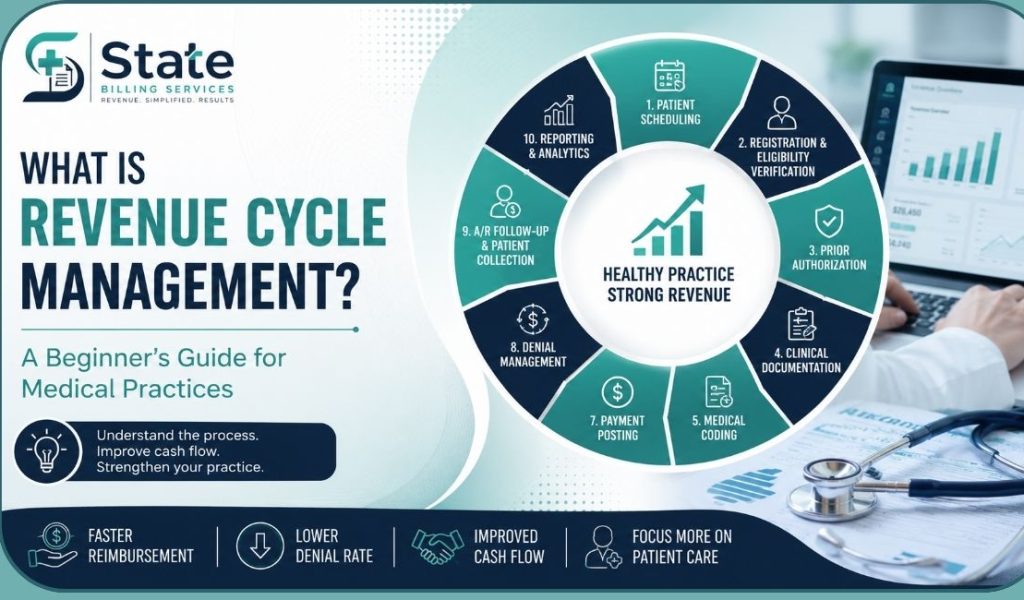
This complete guide answers an important question: What is Revenue Cycle Management? It also explains the revenue cycle management process, the stages of revenue cycle management, the revenue cycle workflow, and the essential RCM process steps that help medical practices maintain steady cash flow while reducing claim denials.
Whether you operate a small independent clinic, a specialty practice, or a growing healthcare organization, understanding Revenue Cycle Management provides the foundation for stronger financial performance and a better patient experience.
What is Revenue Cycle Management?
Revenue Cycle Management, commonly called RCM, is the process healthcare providers use to manage the financial lifecycle of a patient visit. It covers every administrative and financial activity from scheduling an appointment until the provider receives full payment for the services delivered.
Instead of viewing billing as a single task, Revenue Cycle Management connects multiple departments into one coordinated system. Front desk staff, medical coders, billers, providers, insurance companies, and patients all contribute to the success of the process.
A complete revenue cycle includes activities such as:
- Patient registration
- Insurance verification
- Prior authorization
- Medical documentation
- Medical coding
- Claim submission
- Payment posting
- Denial management
- Patient billing
- Accounts receivable follow-up
- Financial reporting
When each stage functions properly, providers receive payments faster, administrative costs decrease, and patients experience fewer billing problems.
Why Revenue Cycle Management Matters More Than Ever
Healthcare reimbursement has become increasingly complex.
Insurance companies frequently update coverage rules. Government programs revise payment policies. Coding guidelines change annually. At the same time, patients are responsible for larger deductibles and copayments than ever before.
Without an organized revenue cycle, even well-established practices may struggle with:
- Increasing claim denials
- Delayed reimbursements
- Higher outstanding balances
- Poor cash flow
- Compliance risks
- Administrative overload
A strong Revenue Cycle Management strategy allows practices to identify problems early rather than waiting until claims remain unpaid for months.
For example, if insurance eligibility is verified before the appointment, staff can identify inactive coverage before services are provided. This simple step prevents many avoidable claim denials later in the process.
Understanding the Revenue Cycle Management Process
The revenue cycle management process is a continuous workflow rather than a collection of separate billing tasks.
Every stage depends on the accuracy of the previous one. An incorrect insurance ID entered during registration may eventually lead to a denied claim weeks later. Likewise, incomplete provider documentation may prevent coders from assigning accurate diagnosis and procedure codes.
The process can be divided into several connected stages.
| Stage | Primary Goal |
| Patient Scheduling | Begin accurate patient record creation |
| Registration | Collect demographic and insurance information |
| Insurance Verification | Confirm active benefits and eligibility |
| Prior Authorization | Obtain insurer approval when required |
| Medical Documentation | Record services accurately |
| Medical Coding | Assign ICD-10-CM, CPT, and HCPCS codes |
| Claim Submission | Send clean claims to insurers |
| Payment Posting | Record insurer and patient payments |
| Denial Management | Correct and resubmit rejected claims |
| Accounts Receivable Follow-up | Recover outstanding balances |
| Reporting | Improve financial performance through analysis |
Each stage supports the next, creating an efficient revenue cycle workflow.
The Stages of Revenue Cycle Management
1. Patient Scheduling
Revenue Cycle Management begins before the patient enters the clinic.
Scheduling staff gather essential information including:
- Patient demographics
- Insurance carrier
- Reason for visit
- Referring physician if applicable
Collecting complete information at this stage reduces registration errors later.
For example, if a patient schedules a cardiology consultation, staff can determine whether a referral or prior authorization may be needed before the appointment date.
2. Patient Registration
Registration creates the official patient record.
Staff verify:
- Legal name
- Date of birth
- Address
- Contact information
- Insurance details
- Emergency contacts
Even minor mistakes can create major billing issues.
An incorrect member ID or misspelled name may cause an insurance company to reject the claim automatically.
Many practices now use electronic registration systems integrated with Electronic Health Record (EHR) platforms such as Epic, athenahealth, eClinicalWorks, or NextGen Healthcare to reduce manual entry errors.
3. Insurance Eligibility Verification
Insurance verification confirms that coverage is active before services are provided.
Verification includes checking:
- Active insurance coverage
- Deductible status
- Copayment amount
- Coinsurance
- Covered services
- Referral requirements
Skipping this step often results in avoidable denials.
Practices that perform eligibility verification before every visit generally experience fewer payment delays because insurance issues are identified before treatment.
Professional eligibility verification services can help practices automate this process while reducing front-office workload.
4. Prior Authorization
Some medical procedures require insurance approval before treatment.
Examples include:
- Advanced imaging
- Certain medications
- Surgical procedures
- Specialty treatments
Failure to obtain authorization may result in claim denial even if the treatment was medically necessary.
Because payer requirements frequently change, many practices assign dedicated staff or outsource prior authorization services to improve approval rates and reduce administrative delays.
5. Clinical Documentation
Accurate documentation forms the backbone of successful Revenue Cycle Management.
Providers must clearly document:
- Patient history
- Examination findings
- Diagnosis
- Treatment plan
- Procedures performed
- Medical necessity
Documentation supports coding accuracy while meeting compliance standards established by organizations such as the Centers for Medicare & Medicaid Services (CMS).
Incomplete documentation often creates coding errors that delay reimbursement.
6. Medical Coding
Medical coding converts clinical documentation into standardized billing codes.
Certified coders assign:
- ICD-10-CM diagnosis codes
- CPT procedure codes
- HCPCS Level II codes when applicable
These standardized coding systems allow insurance companies to understand exactly what services were provided.
Accurate coding affects:
- Reimbursement accuracy
- Compliance
- Audit preparedness
- Claim approval rates
For example, assigning an incorrect CPT code may result in underpayment, overpayment, or claim rejection.
Practices that use experienced medical coding services often reduce coding-related denials while improving documentation accuracy.
7. Medical Claim Submission
After coding is complete, claims are prepared and submitted electronically through a clearinghouse to insurance companies.
A clean claim includes:
- Accurate patient information
- Correct coding
- Valid provider credentials
- Required modifiers
- Supporting documentation when necessary
Electronic claim scrubbing software checks claims before submission to identify common errors such as missing diagnosis codes or invalid procedure combinations.
Submitting clean claims the first time significantly reduces reimbursement delays.
Many organizations rely on dedicated medical billing services in South Carolina to improve first-pass claim acceptance rates and streamline claim submission.
Common Technologies Used in Revenue Cycle Management
Modern RCM depends heavily on technology to reduce manual work and improve accuracy.
Some commonly used systems include:
| Technology | Purpose |
| Electronic Health Record (EHR) | Stores clinical documentation |
| Practice Management Software | Scheduling, billing, and reporting |
| Clearinghouses | Validate and transmit insurance claims |
| Payment Portals | Patient online payments |
| Revenue Cycle Analytics | Track KPIs and financial trends |
| AI-assisted Coding Tools | Improve coding efficiency |
Artificial intelligence is increasingly helping practices identify billing errors before claims are submitted. While AI supports staff productivity, trained coding professionals remain essential for maintaining coding accuracy and compliance.
Revenue Cycle Management Is More Than Billing
One of the biggest misconceptions among new providers is that Revenue Cycle Management simply means sending insurance claims.
Billing is only one part of the larger process.
An effective revenue cycle starts before care is delivered and continues until every outstanding balance has been resolved.
For example, imagine two identical orthopedic clinics.
The first clinic verifies insurance, obtains authorizations, documents care thoroughly, submits clean claims, follows up on denials quickly, and monitors financial reports every month.
The second clinic focuses only on submitting claims after appointments without reviewing earlier workflow steps.
Although both clinics provide the same quality of medical care, the first practice is likely to experience fewer denials, stronger cash flow, and lower administrative costs because every stage of its revenue cycle supports accurate reimbursement.
This illustrates why successful Revenue Cycle Management depends on coordination across the entire practice rather than one billing department alone.
8. Payment Posting
Once an insurance payer processes a claim, the explanation of benefits (EOB) or electronic remittance advice (ERA) is returned to the practice. The next step in the revenue cycle workflow is payment posting.
Payment posting involves recording every payment, adjustment, contractual write-off, and patient responsibility accurately within the practice management system.
This stage is much more than bookkeeping. It allows practices to answer important questions such as:
- Was the claim paid correctly?
- Was the reimbursement lower than expected?
- Is additional documentation required?
- Does the patient have a remaining balance?
- Is the claim eligible for an appeal?
Accurate payment posting also helps identify payer trends. If one insurance company consistently underpays certain services, the issue can be investigated before it affects a large number of claims.
Many healthcare organizations choose specialized payment posting services to improve accuracy and quickly identify payment discrepancies that might otherwise go unnoticed.
9. Denial Management
No practice can eliminate claim denials entirely, but an effective denial management strategy can significantly reduce their financial impact.
A denied claim is one that an insurance company has reviewed but decided not to pay. Denials can occur for many reasons, including:
- Missing documentation
- Incorrect coding
- Expired filing deadlines
- Eligibility issues
- Lack of prior authorization
- Duplicate claim submission
- Medical necessity concerns
The key difference between successful and struggling practices is not whether denials happen, but how quickly they respond.
An effective denial management process includes:
- Identifying the denial reason.
- Correcting the issue.
- Resubmitting or appealing the claim.
- Tracking denial trends.
- Preventing similar errors in the future.
For example, if multiple claims are denied because authorization numbers are missing, the problem may originate with scheduling or front-office procedures rather than the billing department.
Practices that regularly analyze denial patterns often improve their first-pass claim acceptance rates over time.
Healthcare providers looking to reduce denied claims often benefit from dedicated denial management services that focus on appeals, payer communication, and root cause analysis.
If you want a deeper understanding of common denial causes, the article on Medical Claim Denial Reasons provides practical examples and prevention strategies.
10. Patient Billing and Collections
Healthcare payments no longer come exclusively from insurance companies. As deductibles and coinsurance have increased, patients are responsible for a larger share of healthcare costs.
A patient-friendly billing process should include:
- Clear financial policies
- Transparent cost estimates
- Multiple payment methods
- Online payment options
- Flexible payment plans when appropriate
Confusing bills often delay payments and increase collection costs.
Providing patients with understandable statements and prompt communication improves both the financial outcome and the overall patient experience.
11. Accounts Receivable Follow-up
Accounts Receivable (AR) represents money owed to the practice that has not yet been collected.
Outstanding balances can come from:
- Insurance companies
- Patients
- Secondary payers
Monitoring AR is one of the most important RCM process steps because unpaid claims become more difficult to recover as they age.
An effective AR follow-up process includes:
- Reviewing aging reports weekly
- Contacting insurance companies about delayed claims
- Correcting rejected claims quickly
- Following up with patients regarding outstanding balances
- Escalating unresolved claims when necessary
Many successful organizations establish internal benchmarks, such as reviewing all claims older than 30 days before they become long-term receivables.
Key Performance Indicators That Measure Revenue Cycle Success
Revenue Cycle Management should be measured using data rather than assumptions.
The following metrics help practices evaluate financial performance.
| KPI | Why It Matters |
| Clean Claim Rate | Indicates how many claims are accepted on first submission |
| Days in Accounts Receivable | Measures collection speed |
| Denial Rate | Tracks claim quality and workflow issues |
| Net Collection Rate | Shows how much collectible revenue is received |
| First Pass Resolution Rate | Reflects claim accuracy |
| Patient Collection Rate | Measures patient payment performance |
Regular KPI reviews help identify problems before they become significant financial issues.
Practices that consistently monitor these indicators can make informed decisions about staffing, workflow improvements, and technology investments.
Common Revenue Cycle Management Challenges
Even experienced medical practices face obstacles that affect revenue.
Frequent Coding Updates
Coding standards change every year. ICD-10-CM, CPT, and HCPCS updates require ongoing education for providers and coders.
Changing Insurance Policies
Every payer has different reimbursement rules, authorization requirements, and documentation expectations.
Keeping up with these differences requires continuous monitoring.
Documentation Gaps
Incomplete provider documentation remains one of the leading causes of coding errors and claim denials.
Staffing Shortages
Experienced medical billers and coders are in high demand.
When practices experience staffing shortages, billing backlogs often increase.
Technology Integration
Many organizations use multiple software platforms.
If systems do not communicate effectively, duplicate work and billing errors become more common.
Increasing Patient Financial Responsibility
Higher deductibles mean practices must devote more attention to patient collections while maintaining positive patient relationships.
Best Practices for Improving Revenue Cycle Management
Improving Revenue Cycle Management does not always require major operational changes. Small, consistent improvements often produce meaningful financial results.
Some proven best practices include:
- Verify insurance before every appointment.
- Collect copayments during patient check-in.
- Document services completely and promptly.
- Submit claims within payer deadlines.
- Monitor denials every week.
- Review revenue reports each month.
- Train staff regularly on coding and payer policy updates.
- Use technology to automate repetitive administrative tasks where appropriate.
Practices that focus on prevention generally spend less time correcting avoidable billing errors later in the cycle.
In-house vs Outsourced Revenue Cycle Management
One decision many medical practices face is whether to manage Revenue Cycle Management internally or partner with an external RCM provider.
An in-house team offers direct oversight and immediate access to staff, but it also requires ongoing investment in hiring, training, software, compliance, and employee retention.
Outsourcing Revenue Cycle Management allows practices to access experienced billing professionals, advanced technology, and specialized knowledge without maintaining a large internal billing department. This approach can be especially valuable for smaller practices or organizations experiencing rapid growth.
The right choice depends on factors such as practice size, specialty, claim volume, available resources, and long-term business goals.
For a detailed comparison of both approaches, see In-house vs Outsourced Medical Billing.
How Revenue Cycle Management Differs Across Medical Specialties
Although the core stages of revenue cycle management remain consistent, each specialty faces unique billing and reimbursement challenges.
For example:
- Cardiology practices often manage complex diagnostic testing and procedure coding.
- Orthopedic providers frequently require extensive prior authorizations for surgeries and imaging.
- Mental health providers navigate varying payer rules for therapy sessions and behavioral health benefits.
- Urgent care centers process high patient volumes while requiring rapid eligibility verification.
Because each specialty has unique documentation and reimbursement requirements, many organizations benefit from specialty-focused Revenue Cycle Management solutions rather than a one-size-fits-all approach.
The Growing Role of Technology in Revenue Cycle Management
Technology continues to reshape how healthcare organizations manage financial operations.
Modern Revenue Cycle Management platforms increasingly include:
- Automated eligibility verification
- Electronic prior authorization
- AI-assisted coding suggestions
- Predictive denial analytics
- Automated payment reminders
- Real-time financial dashboards
Artificial intelligence can identify patterns that humans might overlook, such as claims likely to be denied based on historical payer behavior. However, human oversight remains essential for coding accuracy, compliance, and complex reimbursement decisions.
Practices that combine skilled professionals with well-integrated technology often achieve stronger financial performance than those relying solely on manual processes.
Frequently Asked Questions
What is Revenue Cycle Management in simple terms?
Revenue Cycle Management is the process of managing every financial step associated with patient care, from appointment scheduling through final payment collection.
Why is Revenue Cycle Management important?
It helps healthcare providers receive accurate and timely reimbursement while reducing billing errors, claim denials, and administrative costs.
What are the main stages of revenue cycle management?
The major stages include patient scheduling, registration, insurance verification, prior authorization, documentation, medical coding, claim submission, payment posting, denial management, patient billing, accounts receivable follow-up, and financial reporting.
Who is responsible for Revenue Cycle Management?
Revenue Cycle Management involves collaboration between front-office staff, providers, medical coders, billers, insurance specialists, financial managers, and practice leadership.
Can small medical practices benefit from Revenue Cycle Management?
Yes. Even solo practices can improve cash flow, reduce denied claims, and simplify administrative work by following structured Revenue Cycle Management processes.
Final Words
Revenue Cycle Management is much more than submitting insurance claims. It is a connected system that supports the financial health of a medical practice from the moment a patient schedules an appointment until every payment has been collected and recorded.
Understanding what is Revenue Cycle Management helps providers recognize how each step affects reimbursement. Accurate registration, insurance verification, clinical documentation, coding, claim submission, payment posting, denial management, and accounts receivable follow-up all contribute to a smoother revenue cycle management process.
Practices that consistently evaluate their revenue cycle workflow, monitor key performance indicators, and improve their RCM process steps are better positioned to reduce revenue leakage, strengthen cash flow, and create a better financial experience for patients.
If your practice is looking to streamline billing operations, reduce claim denials, and improve reimbursement performance, States Billing Services SC provides comprehensive Revenue Cycle Management solutions tailored to the needs of healthcare providers. Whether you need support with eligibility verification, coding, billing, payment posting, or denial management, the team can help create a more efficient financial workflow while allowing your staff to stay focused on patient care.