
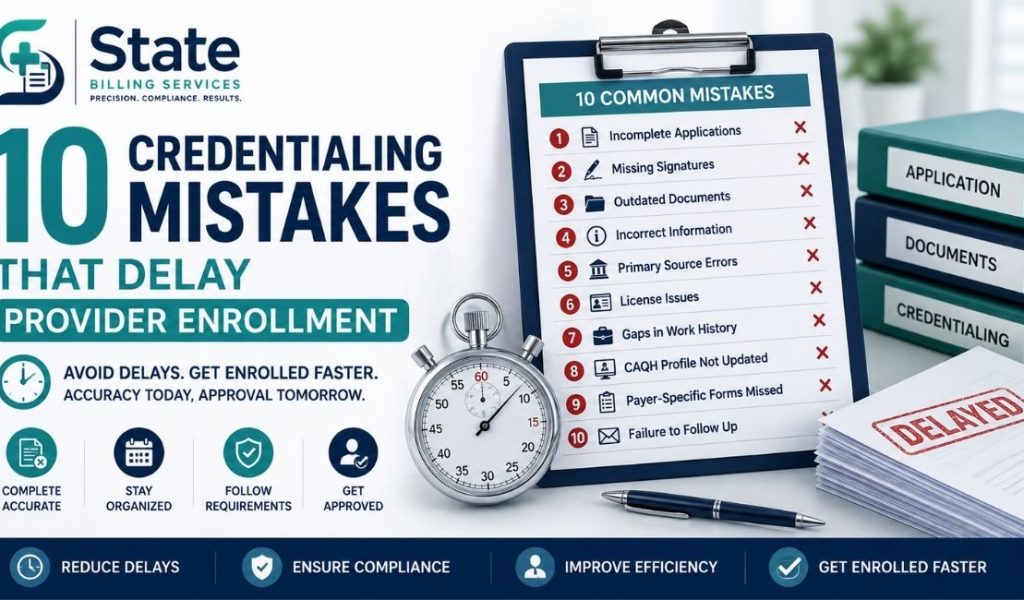
A practice adds a new provider. Weeks later, an insurance payer sends back a rejection notice. One field on the application does not match the CAQH profile. The submission goes to the back of the queue, and the provider still cannot be billed.
This is how most credentialing delays happen. Not through a compliance failure, but through small, avoidable mistakes in the application process. Every error adds weeks to a timeline that is already long.
This article walks through the 10 credentialing mistakes that most often slow down enrollment, and what practices can do instead.
Why Small Errors Cause Big Delays in Credentialing
Credentialing is not a single review. It moves through several checkpoints, including CAQH verification, payer application review, primary source verification, and committee approval. A mistake caught early costs a few days. The same mistake caught late, after weeks of processing, can send the application back to the start of a stage that already took a month to reach.
This is what makes credentialing mistakes more costly than they first appear. A typo on a license number does not just need correcting. It often means resubmitting through a payer’s process, sometimes missing a committee meeting cutoff, and waiting for the next scheduled review. That single error can add four to six weeks to the timeline.
Insurance companies also process large volumes of applications. Staff reviewing them are not looking for context. They are checking whether the information submitted matches what is on file elsewhere, including state licensing boards and the NPI registry. A mismatch, even a minor one, triggers a hold rather than an automatic correction.
A few reasons small mistakes carry this much weight:
- Each checkpoint depends on the one before it, so an error found late restarts part of the process
- Payer reviewers flag mismatches instead of correcting them, which shifts the delay back to the practice
- Missing a committee cutoff by a few days can add a full month before the next review cycle
The 10 Credentialing Mistakes to Watch For
1. Submitting an Incomplete or Unattested CAQH Profile
Most payers pull provider information directly from CAQH, the Council for Affordable Quality Healthcare database. If the profile is incomplete or the attestation has expired, payers will not begin reviewing the application at all. This is one of the most common mistakes, and it is also one of the easiest to prevent. A CAQH profile needs periodic re-attestation, and practices sometimes miss this because no single person is responsible for tracking it.
The fix is simple in principle. Assign one person or team to own CAQH profile management, and set a reminder well before each attestation deadline. Treating this as a recurring task rather than a one time setup avoids the majority of profile related delays.
2. Mismatched Information Across Systems
A provider’s name, license number, or practice address needs to match exactly across every system involved, including the CAQH profile, state license records, and the NPI registry maintained through the National Plan and Provider Enumeration System. Even something as small as a suite number left off one form but included on another can trigger a manual review.
These mismatches are rarely intentional. They usually happen because different staff members update different systems at different times, without cross checking. Before submitting any application, compare the CAQH profile, NPI record, and license information side by side. A short checklist at this stage catches most mismatches before a payer does.
3. Missing or Expired Malpractice Insurance Documentation
Malpractice insurance information is a required part of most credentialing applications. If the policy has expired, or if the documentation submitted does not reflect current coverage dates, the application stalls until updated proof is provided. This is especially common when a provider changes malpractice carriers around the same time they are being credentialed with a new practice.
Confirm that malpractice coverage documentation reflects current, active dates before submission, not just at the time the provider was hired. If a policy is set to renew soon, submit updated proof proactively rather than waiting for a payer to flag it.
4. Incomplete Work History or Unexplained Gaps
Credentialing applications typically require a full work history covering several years, without unexplained gaps. A gap of a few months for parental leave, further training, or a personal reason is common and usually not a problem on its own. What causes delays is leaving that gap unexplained, since it often triggers a request for additional documentation rather than being cleared automatically.
Address any gaps directly on the application with a brief, factual explanation. This small step prevents a routine review from turning into a follow up request that adds weeks to the process.
5. Applying to Payers Without Confirming Committee Meeting Schedules
Many payers review credentialing applications through a committee that meets on a set schedule, sometimes monthly. An application that becomes fully verified just after a meeting date can sit waiting for the next cycle, even though the actual work is done. Practices that do not track these schedules often assume a delay means something is wrong, when in reality the timeline is simply following the payer’s internal calendar.
Ask each payer about their committee review schedule early in the process. Submitting applications with enough lead time to make an upcoming meeting, rather than just missing it, can save several weeks.
6. Applying to Every Payer at Once Without a Tracking System
It is common for a provider to need enrollment with five or more insurance companies at the same time, plus CMS for Medicare and the relevant state Medicaid program. Without a clear system to track submission dates, verification status, and follow up needs for each one, some applications quietly fall behind while attention goes to others.
A simple shared tracking sheet, listing each payer, submission date, current status, and next action, prevents this. It also makes it easier to prioritize payers by patient volume, so the applications with the biggest revenue impact move first. At a minimum, the tracker should include:
- Payer name and application submission date
- Current stage, such as verification, committee review, or approved
- Next action needed and who owns it
- Expected or confirmed committee meeting date
7. Assuming Backdating Rules Are the Same Across Payers
Some payers backdate a provider’s effective date to the original submission date once approved. Others only allow billing from the date of committee approval forward. Assuming one policy applies across every payer, without confirming, can mean losing weeks or months of billable revenue that could have been recovered.
Ask each payer directly about their backdating policy before assuming anything. This single question, asked early, can make a measurable difference in how much revenue is recoverable from the credentialing period.
8. Waiting Until the Provider’s Start Date to Begin Credentialing
Credentialing takes time under the best conditions, often 90 to 150 days depending on the payer mix. Starting the process only when a new provider’s start date arrives guarantees a revenue gap, since the timeline does not compress to match a shorter runway. This is one of the most preventable mistakes on this list, and also one of the most common.
Begin credentialing as soon as a hire is confirmed, ideally three to four months before the expected start date. Practices that want a clearer picture of how each stage typically unfolds can review this breakdown of the provider credentialing timeline to plan hiring and onboarding with more accurate expectations.
9. Not Verifying License and Certification Status Before Submission
Applications sometimes get submitted with license or board certification information that is technically accurate but close to renewal, without confirming the renewal has actually been processed. If a license renewal is delayed on the state’s end, even briefly, it can cause a credentialing application to stall until updated proof is available.
Before submitting any application, confirm that licenses and certifications are current and that any pending renewals have been completed, not just initiated. This small verification step avoids a delay that has nothing to do with the provider’s actual qualifications.
10. Treating Credentialing as a One Time Task Instead of an Ongoing Process
Credentialing does not end once a provider is approved. Payers require periodic re-credentialing, typically every two to three years, and CAQH attestations need regular renewal in between. Practices that treat the initial approval as the finish line often find themselves scrambling when a re-credentialing deadline is missed, which can result in a provider being dropped from a payer’s network entirely.
Build recurring reminders for re-credentialing deadlines and attestation renewals into the same system used for initial applications. This keeps credentialing status current on an ongoing basis, rather than becoming a crisis every few years.
A Quick Reference for the Most Common Mistakes
| Mistake | Typical Cause | Prevention |
| Incomplete CAQH profile | No owner assigned to upkeep | Assign one person, set attestation reminders |
| Mismatched information | Different staff updating different systems | Cross check CAQH, NPI, and license records before submission |
| Expired malpractice documentation | Policy renewal timing overlooked | Confirm current dates before every submission |
| Unexplained work gaps | Assumed obvious, left unaddressed | Add brief explanation directly on the application |
| Missed committee cutoffs | Schedule not confirmed in advance | Ask each payer for their review calendar |
How These Mistakes Add Up Across Multiple Providers
For a solo provider, one credentialing mistake is frustrating but manageable. For a practice bringing on several providers at once, or one that regularly adds new staff, these same mistakes compound. A mismatched NPI record on one application might be a quick fix. The same error repeated across five provider applications, each with a different payer and a different reviewer, can multiply the total delay significantly.
This is often where practices start looking at whether their internal process can keep up with growth. Credentialing overlaps closely with several other revenue cycle functions, including eligibility verification services, since both processes determine whether a claim is payable before it is ever submitted. When credentialing errors and eligibility gaps happen at the same time, denials tend to increase across the board rather than staying isolated to one issue.
Practices managing multiple providers and payer relationships at once sometimes find that dedicated credentialing support prevents these errors before they happen. Reviewing how insurance credentialing services handle documentation review, submission tracking, and payer follow up can clarify whether outside support makes sense for a given practice size and growth pace.
Building a Simple Internal Process to Avoid These Mistakes
Most of the 10 mistakes covered here share a common root cause. They happen when credentialing is handled reactively, without a consistent process behind it. A practical internal process does not need to be complicated. It needs three things: a single point of ownership, a shared tracking system, and a checklist applied before every submission.
Assigning ownership means one person or team is accountable for CAQH management, application tracking, and follow up, rather than the task being spread across whoever has time. A shared tracking system, even a simple spreadsheet, keeps every payer application visible instead of relying on memory. A pre-submission checklist, covering CAQH status, document currency, and cross system matching, catches the majority of these mistakes before a payer ever sees the application.
Practices refining this process alongside their broader billing operations may also find it useful to review best practices for patient insurance verification, since credentialing and eligibility checks often rely on the same underlying attention to detail and consistent documentation habits.
What to Do If a Delay Has Already Happened
Sometimes a mistake has already caused a delay, and the priority shifts from prevention to recovery. In this situation, contact the payer directly to confirm exactly what is missing or mismatched, rather than resubmitting the full application and hoping the issue resolves itself. Ask specifically whether the correction can be processed within the current review cycle or whether it requires a new submission entirely, since this affects how much additional time to expect.
It also helps to document what caused the delay once it is resolved. Practices that keep a running list of past credentialing issues, even informally, start to notice patterns, such as a specific payer that consistently requires extra documentation or a recurring gap in internal processes. That pattern recognition becomes valuable for preventing the same mistake with the next provider.
When a delay happens, a few steps help resolve it faster:
- Call the payer directly instead of resubmitting blind
- Ask exactly what field or document triggered the hold
- Confirm whether the fix stays in the current review cycle or restarts it
- Log the cause so the same mistake does not repeat with the next provider
Bringing It All Together
Most credentialing delays are not caused by complicated compliance issues. They come from small, preventable mistakes: an unattested CAQH profile, mismatched information between systems, an unexplained work gap, or a missed committee cutoff. Each one is manageable on its own, but together they explain why provider enrollment so often takes longer than practices expect.
The practices that avoid these delays share a consistent approach. They assign clear ownership over credentialing tasks. They track every payer application individually. They double check documentation before submission rather than after a rejection. And they treat credentialing as an ongoing responsibility, not a one time task that ends once approval arrives.
If your practice wants to reduce credentialing delays and get new providers billing sooner, State Billing Services SC helps manage documentation, payer submissions, and follow up so fewer applications get stuck in avoidable errors.