Introduction: Why AR Follow Up Matters
Every healthcare provider wants to get paid on time. But that does not always happen.
Insurance companies delay payments. Claims get denied. Some bills just sit there, unpaid, for weeks or even months.
That is where AR follow up comes in.
AR follow up is the process of tracking unpaid claims and taking action to collect payment. It is one of the most important parts of medical billing. Without it, healthcare providers lose thousands of dollars every year.
In this guide, we will explain what AR follow up is, how it works, and why it matters. Whether you are new to medical billing or just want to understand it better, this post will help.
What Is AR in Medical Billing?
Before we talk about AR follow up, let us answer a simple question. What is A/R in medical billing?
AR stands for Accounts Receivable. It means money that is owed to a healthcare provider but has not been paid yet.
In medical billing, AR includes:
- Claims submitted to insurance companies that are still unpaid
- Patient balances that are due
- Denied claims waiting to be appealed
When a doctor treats a patient, a claim is sent to the insurance company. The insurance company then reviews it and pays (or denies it). The time between sending the claim and receiving payment is called the AR period.
The goal of accounts receivable medical billing is to reduce this time and collect as much money as possible.
What Is AR Follow Up?
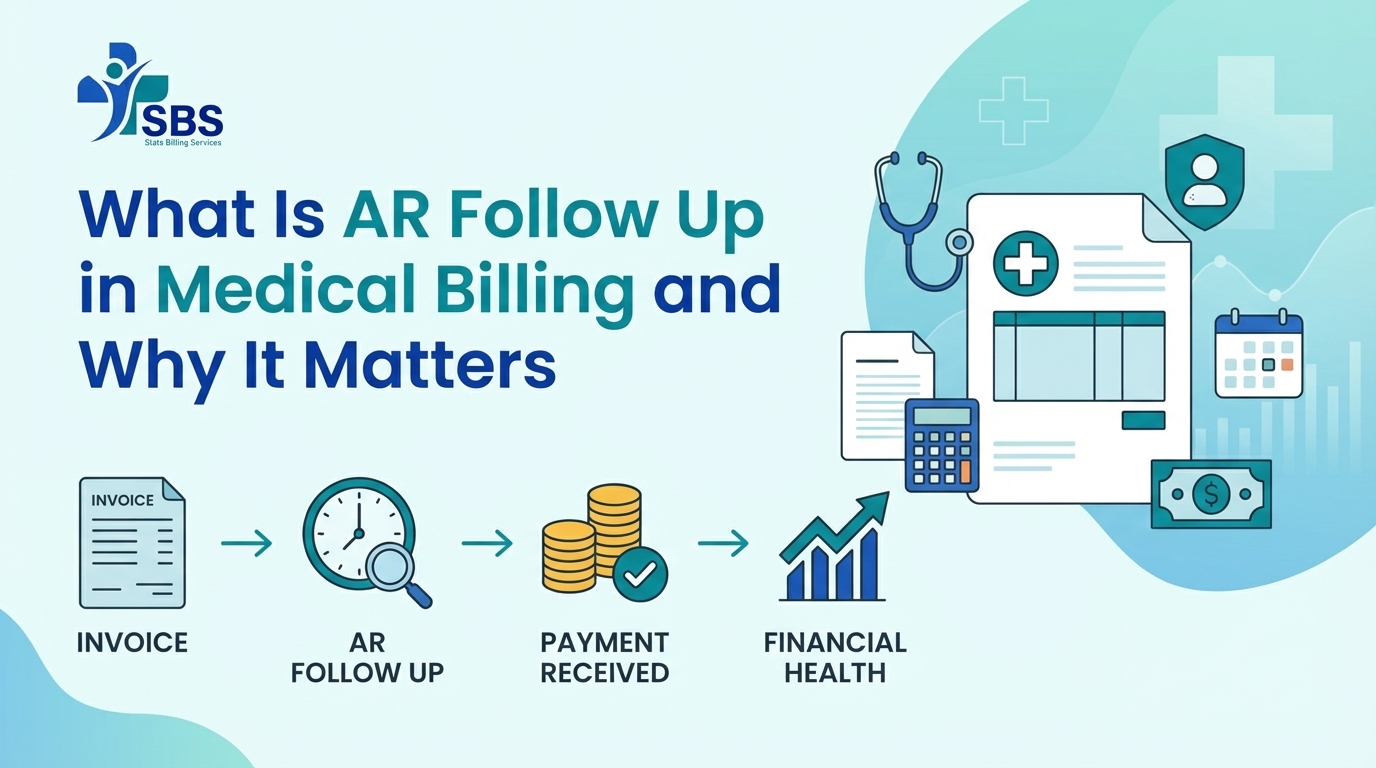
AR follow up is the process of checking on unpaid claims and taking steps to get them paid.
It is also called accounts receivable follow-up or A/R billing and follow up.
Here is a simple way to think about it: You send a claim. The insurance company does not pay it. You follow up. That is AR follow up.
The AR follow up team contacts insurance companies, patients, or both. They find out why a claim was not paid. Then they take action to fix the problem and get the payment.
Why Is AR Follow Up Important?
According to the American Medical Association, claim denials cost healthcare providers billions of dollars each year. Many of these denials can be reversed with proper AR follow up.
Without a good AR follow up process, providers lose money they have already earned.
Here is why AR follow up is so important:
- It reduces the number of unpaid claims
- It catches errors early before they become bigger problems
- It speeds up the payment process
- It improves the cash flow of a medical practice
- It reduces write-offs and bad debt
A strong AR follow up process is the difference between a financially healthy practice and one that struggles every month.
How Does AR Follow Up Work?
The AR follow up process has several steps. Let us walk through each one.
Step 1: Submit the Claim
The billing team sends the claim to the insurance company. This happens right after the patient visit.
Step 2: Check the AR Aging Report
The AR aging report shows how long each claim has been unpaid. Claims are grouped by age:
- 0 to 30 days
- 31 to 60 days
- 61 to 90 days
- Over 90 days
The older a claim gets, the harder it is to collect. That is why AR in medical billing requires constant attention.
Step 3: Prioritize Which Claims to Follow Up On
Not all claims need the same attention. The AR follow up team looks at:
- High-value claims
- Claims that are 30 days or older
- Claims that have been denied
Step 4: Contact the Insurance Company
The billing team calls the insurance company or checks the payer portal. They ask:
- Was the claim received?
- Is it still being processed?
- Was it denied? If so, why?
This is the core of accounts receivable follow-up. It requires patience, persistence, and good communication skills.
Step 5: Take Action
Depending on what the insurance company says, the team takes action:
- If the claim is in process, they wait and check again later
- If the claim was denied, they file an appeal or correct the claim
- If the patient owes money, they send a statement or make a call
Step 6: Post the Payment
When payment is received, it is posted to the patient account. The claim is then closed.
What Is A/R in Medical Billing? Understanding the Full Picture
Many people ask: what is A/R in medical billing and how does it connect to overall revenue?
Simply put, A/R is a snapshot of the money a practice has earned but not yet received. A high AR balance is not always bad. But if too many claims are old (over 90 days), that is a warning sign.
Good accounts receivable medical billing means keeping the AR balance low and the collection rate high.
Here are some key metrics used in AR management:
- Days in AR: The average number of days it takes to collect payment. The lower, the better. A good benchmark is under 40 days.
- Clean claim rate: The percentage of claims paid on the first submission. A higher rate means fewer follow-ups needed.
- Denial rate: The percentage of claims denied. A low denial rate shows strong billing processes.
Common Reasons Claims Are Not Paid
Understanding why claims go unpaid helps the AR follow up team act faster. Common reasons include:
- Missing or incorrect patient information
- Wrong diagnosis or procedure codes
- Claim filed after the deadline
- Services not covered by the plan
- Prior authorization not obtained
- Duplicate claim submitted
- Patient eligibility issues
Each of these issues can be fixed. That is the job of the AR follow up team.
A/R Billing and Follow Up: Best Practices
Good A/R billing and follow up does not happen by accident. It takes a clear process and dedicated effort.
Here are some best practices:
Work claims daily. Do not let unpaid claims sit. The older a claim gets, the less likely it will be paid.
Use AR aging reports. Review them every week. Focus on claims over 30 days old.
Set follow-up schedules. Create a clear plan for when to follow up on each type of claim.
Track denial reasons. Keep a log of why claims are denied. Look for patterns and fix the root cause.
Appeal every denial. Many denials can be overturned. Do not accept a denial as the final answer.
Train your team. Make sure everyone involved in AR follow up knows the process and the payer rules.
Use billing software. Good medical billing software can automate reminders and track unpaid claims automatically.
AR Follow Up and Patient Collections
AR follow up is not just about insurance companies. Patients also owe money in many cases.
Co-pays, deductibles, and balances after insurance are common. The accounts receivable follow-up process also includes:
- Sending patient statements
- Making reminder calls
- Offering payment plans
- Using online payment options
Collecting from patients can be sensitive. But it is an important part of AR in medical billing.
Related post:
How Pediatrics Billing Services Boost Your Revenue
AAPC Coding Certification: Complete Beginner’s Guide
- American Medical Association (AMA) – www.ama-assn.org – Offers detailed resources on medical billing practices and denial management.
- Centers for Medicare and Medicaid Services (CMS) –www.cms.gov– Provides official guidance on claim submission and billing regulations.
FAQs: 5 Most Searched Questions About AR Follow Up
Q1: What does AR follow up mean in medical billing? AR follow up means tracking unpaid insurance claims and taking action to collect payment. It involves calling payers, appealing denials, and resolving billing issues.
Q2: How often should AR follow up be done? AR follow up should be done regularly, ideally daily or weekly. Claims over 30 days old need immediate attention to avoid losing payment.
Q3: What is a good days in AR benchmark for medical billing? A good benchmark is under 40 days. If your days in AR are above 50 to 60, your AR follow up process may need improvement.
Q4: What is the difference between AR follow up and denial management? AR follow up covers all unpaid claims. Denial management is a part of AR follow up that focuses specifically on claims the insurance company has rejected.
Q5: Who is responsible for AR follow up in a medical practice? Usually, the billing department or a medical billing company handles AR follow up. In small practices, the office manager or biller may take on this role.
Final Thoughts
AR follow up is not optional. It is a must for any healthcare provider that wants to stay financially healthy.
Without proper accounts receivable follow-up, money gets left on the table. Claims age out. Denials go unchallenged. Cash flow suffers.
But with a strong AR follow up process, you can collect more of what you earn, faster. You can fix problems before they become write-offs. And you can build a more stable, sustainable medical practice.
Understanding AR in medical billing and taking it seriously is one of the best investments a practice can make.
Search
Categories
Recent Posts
- Colorado Medicaid CPT Code Billing and Billing Chart Guide April 21, 2026
- Medical Billing News Today: What Providers Must Know April 20, 2026
- What Is Healthcare Marketing and Why Does It Matter? April 15, 2026
- American Medical Billing Association & CPT Codes Explained April 14, 2026
- Affordable Medical Billing Services: What Every Doctor Needs to Know April 13, 2026
- How Medical Billing Automation Reduces Claim Denials April 12, 2026
- Healthcare Denial Management Software: Complete Guide April 12, 2026
Recent Comments
- Colorado Medicaid CPT Code Billing and Billing Chart Guide - statebillingservices.com on What Is Denial Management in Medical Billing?
- Medical Billing News Today: What Providers Must Know - statebillingservices.com on What Is AR Follow Up in Medical Billing and Why It Matters
- What Is Healthcare Marketing and Why Does It Matter? - statebillingservices.com on What Is AR Follow Up in Medical Billing and Why It Matters
- American Medical Billing Association & CPT Codes Explained - statebillingservices.com on What Is Denial Management in Medical Billing?
- Affordable Medical Billing Services: What Every Doctor Needs to Know - statebillingservices.com on What Is AR Follow Up in Medical Billing and Why It Matters
- How Medical Billing Automation Reduces Claim Denials - statebillingservices.com on What Is AR Follow Up in Medical Billing and Why It Matters
- Healthcare Denial Management Software: Complete Guide - statebillingservices.com on What Is AR Follow Up in Medical Billing and Why It Matters

State Billing Services is a healthcare solutions provider offering a full range of integrated services to support the clinical and administrative operations of medical practices.
Services
- Medical Billing
- Medical Coding
- AR Follow Up
- Credentialing
- Denial Management
- Healthcare Marketing
6 thoughts on “What Is AR Follow Up in Medical Billing and Why It Matters”