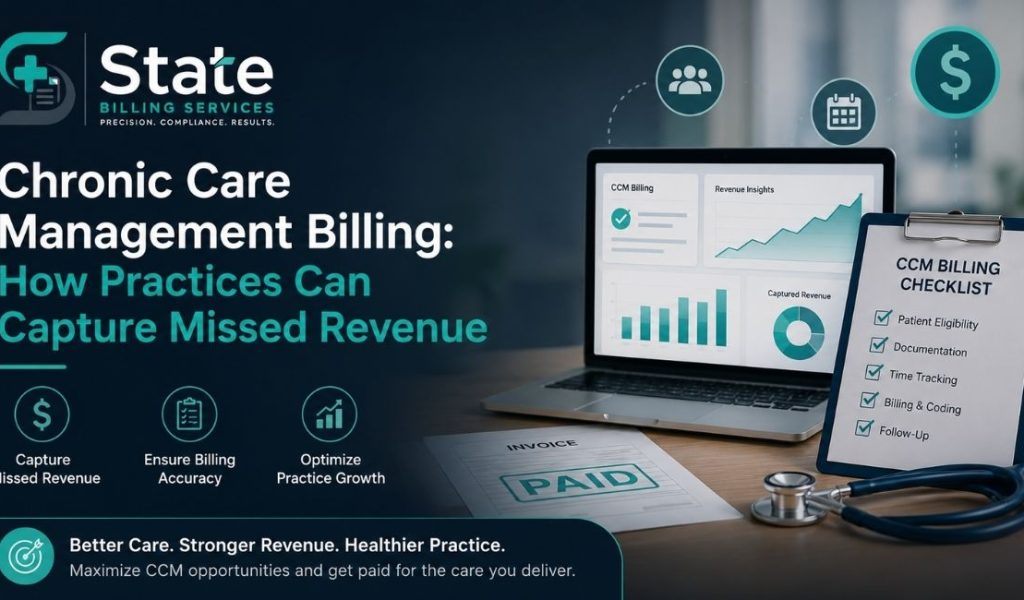
A patient with diabetes and hypertension calls the office three times a month. Staff review labs, adjust medication reminders, and coordinate with a specialist. None of it gets billed. This happens in primary care and internal medicine practices constantly. The work is done. The revenue is not captured.
Chronic care management, or CCM, exists specifically to pay for this kind of ongoing, non-face-to-face care. Yet many practices either do not bill it at all, or bill it incorrectly and lose the payment during audit or review. This guide explains chronic care management billing clearly, so eligible services stop slipping through the cracks.
What Chronic Care Management Actually Covers
CCM is a Medicare program that pays for care coordination provided outside of office visits. It applies to patients with two or more chronic conditions expected to last at least twelve months, or until the patient’s death, and that place the patient at significant risk of decline.
This includes conditions like diabetes, COPD, congestive heart failure, hypertension, and chronic kidney disease, among many others. The care itself includes:
- Reviewing and updating a comprehensive care plan
- Coordinating care between specialists, pharmacies, and other providers
- Managing medication reconciliation
- Responding to patient calls related to chronic condition management
- Monitoring lab results and adjusting care plans accordingly
None of this requires a face-to-face visit. That is the point. CCM pays for the coordination work that happens between visits, work that most practices already perform but rarely bill for.
Why So Much CCM Revenue Goes Uncaptured
Three patterns explain most of the missed CCM revenue.
Staff do not track time correctly. CCM billing depends on documented time spent per calendar month. If time is not logged consistently, the service cannot be billed, even if the work happened.
Practices assume patients need to opt in formally before any work counts. Consent is required, but many practices delay starting the clock until paperwork is fully processed, losing weeks of billable time in the process.
Eligible patients are never identified. Without a system to flag patients with two or more qualifying chronic conditions, CCM-eligible patients are often missed entirely. The care still happens. It is just never billed.
Each of these is fixable with the right workflow, not additional staff.
CCM CPT Codes Explained
CCM billing depends on accurate use of specific CPT codes, based on time and complexity.
| CPT Code | Time Requirement | Description |
|---|---|---|
| 99490 | 20 minutes per month | Non-complex CCM, clinical staff time |
| 99439 | Each additional 20 minutes | Add-on to 99490 |
| 99487 | 60 minutes per month | Complex CCM, requires moderate or high complexity medical decision making |
| 99489 | Each additional 30 minutes | Add-on to 99487 |
| 99491 | 30 minutes per month | CCM performed personally by a physician or qualified health professional |
Choosing the correct base code depends on who performs the service and how much time is spent. Clinical staff time under general supervision supports 99490. Time spent personally by the billing provider supports 99491. Mixing these up is a common coding error that either underbills the service or creates compliance risk.
Time Tracking: The Foundation of Accurate CCM Billing
Time is the single most important variable in CCM billing. Without accurate, contemporaneous time logs, a CCM claim cannot be defended in an audit, even if the care was clearly provided.
Effective time tracking includes:
- Logging each CCM-related activity with a start and stop time, or clearly documented duration
- Recording who performed the activity, since this affects which CPT code applies
- Capturing the specific care coordination task performed, not just “CCM work”
- Totaling time monthly, since CCM billing resets each calendar month
Many practices use dedicated CCM software or a module within their EHR to track this automatically. Manual tracking works too, but only if staff are trained to log time consistently, not retroactively at the end of the month.
Patient Consent and Eligibility Requirements
CCM requires informed patient consent before billing begins. This consent can be verbal, but it must be documented in the chart. Patients need to understand:
- That only one provider can bill CCM services per month
- That cost sharing may apply, since CCM is a billable Medicare service
- That they can stop CCM services at any time
Once consent is documented, billing can begin from that point forward. Practices do not need to wait for a separate enrollment visit unless local policy requires one. Delaying the start of billable time unnecessarily is one of the most common ways practices lose CCM revenue in the first month of a patient’s enrollment.
Common CCM Documentation Mistakes
CCM claims face denial or audit risk for a few recurring reasons.
Vague time entries. Notes that say “spoke with patient about care plan” without a duration are not sufficient. Time must be specific and add up to the required monthly threshold.
Duplicate billing across providers. If two providers at different practices both attempt to bill CCM for the same patient in the same month, one claim will be denied. Care coordination should include confirming no other provider is currently billing CCM for that patient.
Missing comprehensive care plan documentation. CCM requires an accessible, shared care plan. If this is missing or outdated, it weakens the claim during review, even if time was tracked correctly.
Billing under the wrong code for who performed the work. As noted earlier, mixing up 99490 and 99491 based on staff versus provider time is a frequent and avoidable error.
Building a CCM Program That Actually Captures Revenue
A well-run CCM program does not require large staffing changes. It requires a clear, repeatable process.
Start by identifying eligible patients using EHR data on chronic condition diagnoses. Patients with two or more qualifying conditions should be flagged automatically where possible, rather than relying on staff memory during visits.
Next, build consent into the existing workflow. This can happen during a regular office visit, over the phone, or through patient portal messaging, as long as it is documented clearly.
Then, standardize time tracking. Whether this happens through EHR-integrated software or a simple shared log, consistency matters more than the specific tool.
Finally, review CCM claims monthly before submission. This is where a strong revenue cycle management process makes a measurable difference, since inconsistent time documentation or missed monthly thresholds are easy to catch with a structured review step.
The Bigger Picture: CCM and Healthcare Revenue Leakage
CCM billing is one of the clearest examples of healthcare revenue leakage that practices can actually control. Unlike denials caused by payer policy or prior authorization issues, missed CCM revenue is almost entirely internal. The care is delivered. The billing simply does not happen, or happens incorrectly.
For a primary care or internal medicine practice managing a large panel of chronic disease patients, even a modest increase in properly billed CCM services adds meaningful monthly revenue. This is recurring revenue too, since CCM bills monthly for as long as the patient remains eligible and consented.
Tracking this accurately also feeds into stronger medical billing reports, giving practice leadership visibility into how much chronic care coordination work is happening, and how much of it is actually being reimbursed.
A Quick Self-Check for Practices
Before assuming your CCM program is working correctly, ask a few direct questions.
- Are chronic condition patients flagged consistently, or only when a provider happens to notice?
- Is time tracked at the moment work happens, or reconstructed later from memory?
- Does documentation clearly separate clinical staff time from provider time?
- Is there a monthly review step before CCM claims go out?
If the answer to any of these is unclear, there is likely uncaptured revenue sitting in the current workflow.
CCM and Other Care Management Programs
CCM is not the only care management program Medicare offers, and practices sometimes confuse the requirements between them. Principal care management, or PCM, applies to patients with a single serious chronic condition rather than two or more, using its own distinct CPT codes. Transitional care management, or TCM, covers a different window of time following a hospital discharge.
Confusing these programs leads to incorrect code selection. A patient with one serious condition managed intensively after a hospital stay may actually qualify for TCM in the short term, then shift to CCM or PCM for ongoing management once the transitional period ends. Billing staff need clear criteria to distinguish which program applies to which patient and time period, since overlapping or incorrect program selection creates denial risk.
Staffing Models That Support CCM Programs
Practices approach CCM staffing in different ways, and the right model depends on patient panel size and available resources.
Smaller practices often assign CCM responsibilities to existing clinical staff, such as a medical assistant or LPN, who dedicates specific hours each week to care coordination calls and documentation. This works well when the eligible patient population is modest and time tracking discipline is strong.
Larger practices or health systems sometimes build a dedicated CCM team, separate from front-line clinical staff, focused entirely on care coordination across the eligible patient population. This model supports higher volume but requires more upfront investment in staffing and training.
A third option involves outsourcing CCM care coordination to a third-party service that specializes in chronic care management delivery, while the practice retains billing oversight. Each model has tradeoffs in cost, control, and scalability, and the right choice depends on how large the eligible patient population is relative to existing staff capacity.
Technology’s Role in CCM Success
Time tracking accuracy improves significantly with the right technology support. EHR-integrated CCM modules can log time automatically as staff work within a patient’s chart, reducing the risk of vague or reconstructed time entries.
Standalone CCM platforms offer similar functionality outside the EHR, often including automated eligibility flagging based on diagnosis codes, consent tracking, and care plan templates that meet documentation requirements. For practices without integrated tools, even a well-structured spreadsheet with clear fields for date, duration, activity type, and staff member can meet documentation standards, as long as it is used consistently.
The specific tool matters less than the consistency of its use. A sophisticated platform used inconsistently produces the same documentation gaps as a simple spreadsheet used carelessly.
Handling CCM Denials
When CCM claims are denied, the reason usually falls into one of a few categories worth checking systematically.
Time threshold not met. If documented time falls under twenty minutes for 99490, or the relevant threshold for other codes, the claim will be denied regardless of care quality.
Duplicate CCM billing. As mentioned earlier, only one provider can bill CCM per patient per month. If another provider or practice already billed CCM for that patient in that period, the second claim is denied.
Missing or expired consent. If patient consent was never documented, or if a significant gap in service delivery raises questions about ongoing consent, payers may deny or request additional documentation.
Diagnosis codes not supporting chronic condition criteria. If the patient’s active diagnosis codes on file do not clearly reflect two or more qualifying chronic conditions, the claim can be questioned even when care was appropriate.
Reviewing denials by category, rather than treating each one as an isolated incident, helps practices identify whether a specific workflow gap is causing repeated denials.
CCM’s Impact on Patient Outcomes and Retention
Beyond the direct reimbursement, well-run CCM programs tend to improve patient engagement and retention. Patients who receive regular check-ins about their chronic conditions are less likely to seek care elsewhere and often report better satisfaction with their primary care relationship.
This creates a secondary benefit beyond the CCM reimbursement itself. Better managed chronic conditions can reduce avoidable emergency visits and hospitalizations, which matters increasingly under value-based care arrangements where practices share in savings tied to overall cost of care for their patient population.
Common Questions Practices Ask About CCM Billing
Can CCM be billed alongside an office visit in the same month? Yes, as long as the time counted toward CCM does not include time already billed as part of a separate E/M visit. The two services must be documented and timed separately.
Does the patient need a chronic condition diagnosis confirmed by a specialist? No, the diagnosing and managing provider can be the primary care provider, as long as the conditions meet the severity and duration criteria for CCM eligibility.
What happens if a patient’s condition improves and they no longer have two qualifying chronic conditions? CCM billing should stop once the patient no longer meets eligibility criteria. Continued billing without qualifying conditions creates compliance risk.
Cost Sharing and Patient Communication for CCM
Because CCM is a billable Medicare service, patients may see a copay or coinsurance amount tied to it, depending on their specific coverage, including any supplemental insurance they carry. This surprises some patients who assume phone-based care coordination is automatically free.
Explaining this clearly during the consent conversation prevents confusion later. Staff should be prepared to explain, in simple terms, that CCM is a covered Medicare service similar to an office visit in terms of potential cost sharing, and that patients retain full control over whether to continue enrollment. This kind of proactive communication reduces patient billing questions and billing disputes after the fact.
Measuring CCM Program Performance
Practices running an established CCM program should track a few specific metrics beyond total revenue generated. Enrollment rate among eligible patients shows how well the practice is identifying and enrolling qualifying patients relative to the total eligible population. Average monthly time logged per enrolled patient helps confirm whether time tracking remains consistent over time, rather than drifting toward minimal, threshold-only entries.
Denial rate specific to CCM claims, tracked separately from overall denial rate, helps identify whether documentation or consent issues are creating a recurring problem. Reviewing these metrics quarterly, rather than only at year end, allows practices to catch and correct issues while they are still small.
CCM’s Role in Value-Based Care Arrangements
As more practices participate in value-based care models, including accountable care organizations and Medicare Advantage risk arrangements, CCM plays a dual role. It generates direct fee-for-service revenue, and it also supports the kind of proactive chronic disease management that improves performance under shared savings and quality metrics tied to these value-based contracts.
Practices in value-based arrangements should view CCM not purely as a billing opportunity, but as a clinical program that supports broader performance goals tied to reduced hospitalizations, better chronic disease control, and improved patient satisfaction scores. This dual benefit often justifies investment in CCM infrastructure even for practices still building toward full program maturity.
Common Questions About Starting a New CCM Program
Practices new to CCM often ask similar questions before launching a program.
How many eligible patients justify starting a CCM program? There is no strict minimum, but practices with a meaningful population of patients managing two or more chronic conditions, such as internal medicine or geriatric-focused primary care, typically see the clearest return relative to the setup effort involved.
Does the practice need special software to start? No, though software simplifies time tracking and eligibility identification considerably as patient volume grows. Practices can start with manual tracking for a small pilot group before investing in dedicated tools.
How long does it take to see meaningful CCM revenue? Most practices see initial billable months within the first thirty to sixty days of launching a structured program, assuming consent and eligibility identification move efficiently. Revenue typically grows over the following months as enrollment expands.
Avoiding Common CCM Rollout Mistakes
Practices launching CCM for the first time sometimes move too quickly toward broad enrollment before workflow kinks are worked out. Starting with a smaller pilot group, refining time tracking and consent processes, then expanding gradually tends to produce a more sustainable program than an immediate full-scale rollout.
Another common mistake involves treating CCM as purely an administrative task disconnected from clinical care. The strongest programs integrate CCM check-ins into the actual clinical picture of the patient, using the coordination calls to genuinely inform care decisions rather than simply logging minutes to meet a billing threshold. Programs built this way tend to produce better documentation naturally, since the clinical substance of each interaction is easier to describe specifically when it reflects real decision making.
Reviewing CCM Performance Annually
Beyond quarterly metric checks, an annual review of the full CCM program helps confirm it remains aligned with current guidelines and the practice’s evolving patient population. This review should reconfirm eligibility criteria are being applied correctly as CMS guidance evolves, check that consent documentation practices still meet current standards, and assess whether staffing levels remain appropriate for current enrollment volume.
Practices that treat this annual review as routine, similar to other compliance checkpoints, tend to catch small drifts in process before they compound into larger revenue or compliance issues over time.
Final Thoughts
Chronic care management billing rewards consistency more than complexity. The CPT codes are not difficult once time thresholds and staff roles are understood. The bigger challenge is building a workflow where eligible patients are identified, consent is documented promptly, and time is logged accurately every month.
Practices that treat CCM as a structured program, not an occasional add-on, recover revenue that reflects care they are already providing.
If your practice suspects CCM revenue is being missed or claims are getting denied due to documentation gaps, State Billing Services SC can review your current process and help you build a program that captures this revenue consistently. Visit State Billing Services to speak with our billing team about chronic care management billing.